
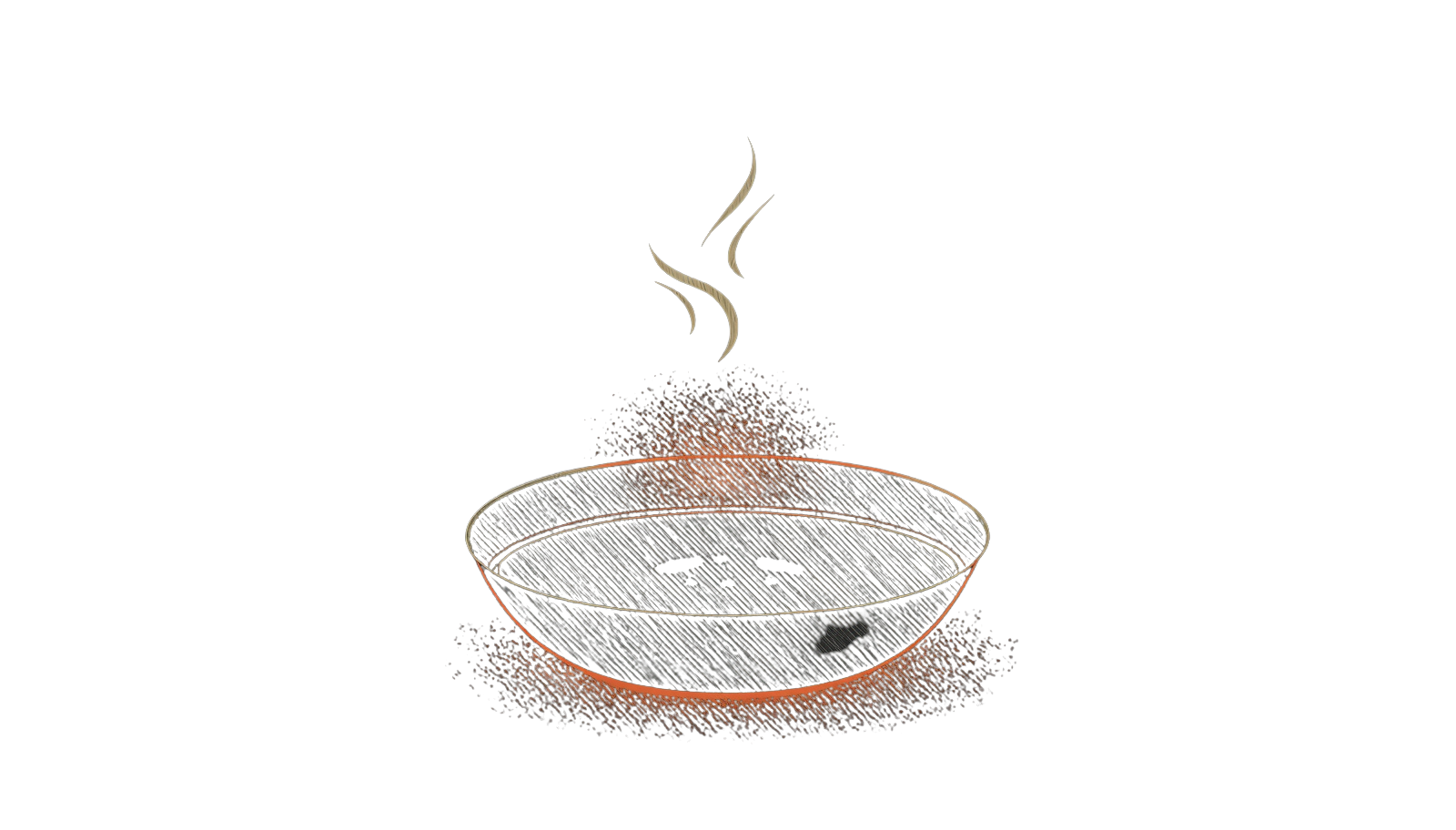
Water Pan
A water pan is exactly what it sounds like — a metal pan filled with water that sits between the fire and the food on a smoker. It is the headline design feature of the Weber Smokey Mountain and every other charcoal water smoker in the vertical smoker category, and a common add-on for offsets and kettles. The physics is the whole pitch: water never goes above 212°F, so the pan acts as a thermal flywheel that absorbs spikes and flattens the temperature line around 225–250°F. The evaporating vapor also condenses on cold meat, making the surface sticky so smoke adheres and the smoke ring builds. Meathead Goldwyn documented the science on AmazingRibs; Mad Scientist BBQ ran the experiment and lands in a more skeptical place. Read both before you commit either way.
- Material
- Aluminum (lightweight, disposable foil pans common) · stainless steel (durable, integrated on WSM)
- Sizes
- WSM 18.5" ~5 qt · WSM 22.5" ~7 qt · drop-in pans sized to fit offset firebox / kettle bowl
- Price
- Free (foil pan from the grocery store) to ~$30–60 for a stainless replacement
- Best at
- Stabilizing pit temperature on charcoal water smokers; catching drippings to prevent flare-ups
- Canonical cooker
- Weber Smokey Mountain — the pan is built into the design, not an accessory
- Care
- Empty after each cook; scrub mineral scale periodically; foil-line for easy cleanup
What it is
A water pan is a shallow metal pan — aluminum, stainless, or a disposable foil tray — filled with water and placed between the burning fuel and the cooking grate on a smoker. On a Weber Smokey Mountain it is a fixed part of the cooker, suspended on a ring above the charcoal chamber and directly under the lower cooking grate; the whole vertical-water-smoker design is built around it. On an offset or a kettle, the pan is a drop-in accessory the cook positions where it makes sense for the layout — over the firebox-to- chamber transition on an offset, or on the indirect side of a banked charcoal kettle.
The pan is doing three jobs at once and most arguments about water pans are really arguments about which of those jobs you care about. It is a thermal buffer that stabilizes pit temperature. It is a humidity source that adds moisture to the cook chamber. And it is a drippings catch that keeps fat off the coals so it doesn’t flare. The Weber Smokey Mountain leans on all three; an offset cook running a heavy stick fire may only really want the third.
How the heat moves
The physics rest on a single number: water boils at 212°F and never goes higher. As long as there is liquid water in the pan, the pan itself stays pinned at or below that temperature, no matter how aggressive the fire below. Meathead Goldwyn frames it as a thermal buffer: air temperature changes fast, water changes slow, and the pan’s water mass absorbs spikes and dampens swings so the chamber settles into the 225–250°F band instead of bouncing around it. On a Weber Smokey Mountain that buffering is the whole reason the cooker is so easy to dial in: Raichlen notes that without water in the pan the chamber can spike past 350°F on the same fuel load.
The second mechanism is humidity. Evaporating water raises the relative humidity inside the chamber, and that humid air condenses on the cold surface of the meat in the first hour of the cook. The condensation does two useful things — it keeps the surface sticky so smoke particulates adhere instead of bouncing off, and it dissolves the nitric-oxide compounds in the smoke that drive the smoke ring reaction. The wet surface also delays the moment the meat dries out and enters the stall, though the stall happens either way once evaporative cooling kicks in at the meat surface itself.
The catch is that the humidity effect depends on a closed chamber. A WSM’s sealed bullet holds vapor; an offset with a heavy draft and a wide-open firebox pulls dry air through fast enough that any moisture the pan adds is lost to the chimney. Meathead’s position on offsets and kettles is that the humidity argument largely doesn’t apply — you’re mostly getting the thermal- buffer effect and the drip catch.
Setting it up
Three approaches cover most of how water pans are run in practice; the right one depends on the cooker more than the cook.
WSM / vertical water smoker (water in)
Fill the integrated pan with at least two inches of hot water before the lid goes on. The pan does double duty as the heat deflector and the humidity source — without it the cooker spikes hot. Top up with more hot water partway through any cook longer than four or five hours so the pan doesn’t run dry and lose its thermal-flywheel effect. Always hot water, never cold — cold water steals heat from the front of the cook while it climbs to temperature.
Offset or kettle (drip pan, dry)
On an offset with a strong draft, or a charcoal kettle set up two-zone, the humidity boost is largely lost to airflow, so many cooks run the pan dry as a drippings catch positioned directly under the meat. Same hardware, different job — it stops flare-ups and keeps the bottom of the chamber clean, and a foil liner makes cleanup five minutes instead of an hour.
Foil-wrapped / sand-filled (WSM hack)
A common WSM modification: wrap the empty pan in heavy foil and run it dry, or fill it with playground sand under a foil layer. The pan still acts as a heat deflector and a thermal mass, with no water to refill or scale to scrub. You give up the humidity benefit — but on a long brisket cook many WSM owners decide they don’t miss it.
Meathead’s position is that flavoring liquids in the pan — beer, cider, apple juice, wine — are too dilute to land any flavor on the meat through the vapor, and the alcohol and sugars cook off long before they do anything useful. Raichlen openly disagrees and likes a splash of cider or aromatics for the lift. The science is on Meathead’s side; the tradition is on Raichlen’s. If you’re debugging a cook, use plain hot water and remove the variable.
Where it earns its keep
On a Weber Smokey Mountain the water pan is the whole reason the cooker is so beginner-friendly. The pan pins the chamber around 225°F on a single load of fuel for an entire cook, the cook learns to dial in vents without fighting temperature spikes, and the WSM develops its reputation as the easiest competition- capable smoker on the market. Same logic on any vertical water smoker — the pan is the design.
On any cooker, the drippings-catch job is real and underrated. Fat dripping onto hot coals flares into hard, acrid smoke; a pan under the meat catches the drippings, keeps the fire clean, and protects the bottom of the chamber from a baked-on fat coat. The humidity-and-smoke- ring case is the one that gets argued about — but the drippings case is non-controversial across every expert who has weighed in.
Where it falls short
The water pan is a tool, not a magic bullet, and a lot of the debate around it is really about the cases where the physics don’t carry as much weight as the tradition.
Heavy draft kills the humidity effect
On offsets and kettles with strong airflow, vapor from the pan blows out the chimney faster than it can settle on the meat. The thermal buffer still works, the drip catch still works, but the smoke-adhesion and smoke-ring case is largely a WSM-and-similar-cooker argument.
Caps temperature for high-heat cooks
The same 212°F ceiling that stabilizes a low-and- slow cook makes it harder to push the chamber to 325°F+ for hot-and-fast brisket or poultry-crisping temperatures. Pull the water (or run the pan dry) when you want the cooker to run hot.
Mineral scale and cleanup
Repeated evaporation leaves a mineral crust on the pan that gets harder to scrub with each cook. Foil- line the pan or wrap it before every cook and the cleanup is a thirty-second toss; skip the liner and you’re scraping a stainless basin with steel wool.
Mad-Scientist-style skepticism
Jeremy Yoder’s side-by-side tests on Mad Scientist BBQ land more skeptically than the canonical AmazingRibs position — on his rigs the measurable difference in the finished cook is smaller than the tradition suggests. The honest read: water pans help most on cookers that are designed around them, less so on cookers that aren’t.
What goes wrong.
Filling the pan with cold water
Cold water steals heat at the front of the cook while it climbs to 212°F — that's an hour of pit temperature dragging when you wanted it stable. Always fill with hot tap water (or boiling) before the lid goes on, so the pan starts doing its thermal-buffer job from the first minute of the cook.
Letting the pan run dry on a long cook
Once the water boils off, the empty pan is just dead metal and the chamber temperature drifts up as the buffer disappears. Top up with hot water every 3–4 hours on cooks longer than that, or commit to the foil-wrapped / sand-filled hack from the start so there's nothing to refill.
Beer, cider, or aromatics in the water
Meathead’s position is the safer one: the vapor that leaves the pan is mostly water no matter what was dissolved in it, so flavoring the liquid burns money without landing flavor on the meat. Raichlen disagrees in print, so the disagreement is real — but when you’re debugging a cook, use plain hot water and remove the variable. Flavor comes from the rub, the wood, and the smoke, not the pan.
Running water on a high-heat cook
The 212°F ceiling that flattens a 225°F cook also caps how hot the chamber can run with water in the pan. For a hot-and-fast cook, a high-heat poultry session, or any time you want the cooker pushing 325°F+, pull the water and either run the pan dry as a drip catch or remove it entirely.
Skipping the foil liner
Drippings and mineral scale bake onto bare stainless and become a steel-wool scrubbing job after a few cooks. A double layer of heavy-duty aluminum foil molded into the pan before every cook turns cleanup into a thirty-second toss and keeps the pan itself looking new for years.
What each of them says.
3 of the people we trust have covered this. Read or watch each in their own words.
- 01
 Meathead GoldwynAmazingRibs.com
Water never goes above 212°F, so it acts as a thermal buffer that stabilizes pit temperature and dampens swings — air temp moves fast, water moves slow. The vapor condenses on cold meat surfaces, making them sticky so smoke adheres better and building the smoke ring. Use plain hot water; flavoring liquids are too dilute to matter, and on cookers with heavy airflow (offsets, kettles) the humidity effect is largely lost to the draft.
- 02
 Steven RaichlenBarbecuebible.com
On a charcoal water smoker like the WSM, the water pan is the whole point of the design — it deflects heat, pins the cook around 225-250°F, and without it the chamber can spike past 350°F. Keep at least two inches of liquid in the pan, add hot water during the cook to avoid temp drops, and he's open to dressing it up with beer, cider, or aromatics for a flavor lift (a friendly disagreement with Meathead, who calls that a waste).
- 03
 Mad Scientist BBQYouTube
Jeremy Yoder runs the experiment side-by-side, measures the actual cook, and lands on a more skeptical conclusion than Meathead — useful counter-take when you're deciding whether the pan earns its space in your pit.
Cook it. Save the record.
Every cook gets a permanent entry — cut, fuel, temp, time, photo, what worked. Next time you want to nail that exact crust, you'll have the receipt.