
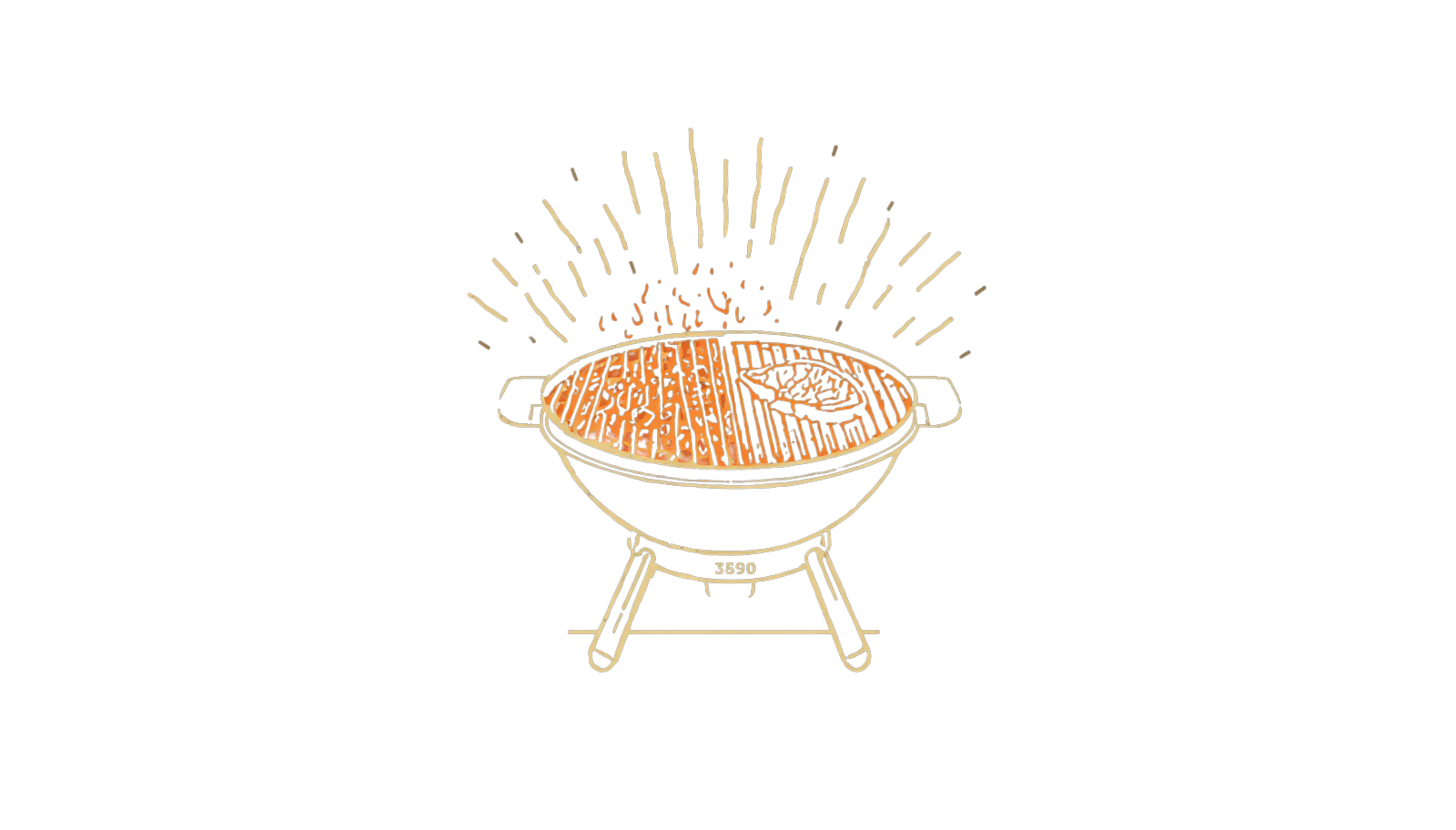
Two-Zone Fire
A two-zone fire is a coal arrangement: all the heat on one side of the grill, none on the other. Direct heat for searing or fast cooking; indirect heat for finishing, holding, smoking, or anything thick enough to overcook on full flame. It's the single setup that unlocks almost every other technique on this site — reverse sear, low-and-slow, the Texas crutch, bark formation, smoke flavor. Works on charcoal and gas; the canonical version on a charcoal kettle is what most home cooks learn first. Without it, every cook is a single-speed cook.
- Set up
- All coals one side, empty space the other
- Coal coverage
- ~50% (canonical) up to 33% for a milder indirect zone
- Hot zone
- 450–500°F for searing; 350°F+ for closed-lid grilling
- Cool zone
- 225–250°F for low-and-slow; 275–325°F for poultry
- Vents
- Top vent over the cool zone, bottom vent partly open
- Works on
- Charcoal kettles, gas grills, kamados, offsets
Before you cook.
- Equipment
- Charcoal chimney starter (essential), heat-resistant gloves, instant-read thermometer
- Fuel
- Lump charcoal for higher heat / faster burn-off; briquettes for steady longer cooks
- Light order
- Open all vents → light the chimney → wait 20 min for full ash-over → bank to one side
- Lid + vents
- Top vent positioned over the cool zone, bottom vent partly open — pulls heat across the food rather than straight up
What to cook with it.
Other ways to do it.
Snake method
Coals laid in a long arc around the perimeter of a kettle, lit at one end and slowly burning around. The fire is always in one place, the food in another, and the cook can stretch 8-12 hours on a single fuel load. Same two-zone idea, extended in time.
Charcoal basket / divider
Physical barriers (Weber's Char-Basket, a fire brick, an aluminum tray of water) lock the coals to one side instead of relying on a tidy pile. More disciplined zone separation, especially on grills without a charcoal grate divider built in. The water-pan version doubles as humidity control for long smokes.
Three-zone fire
Coals at varying density across the grate — full hot, medium, off. Useful for cooks where multiple proteins need different speeds at once (shrimp on direct, thighs on medium, vegetables on cool). Adds a middle gear without the all-or-nothing of two-zone.
Gas grill version
The same logic expressed through burner placement: turn one or two burners on, leave the rest off. The on side is direct, the off side is indirect. Less fuss, less smoke flavor, easier to dial.
What goes wrong.
Heat creeps the wrong direction
If the top vent is over the hot zone, heat shortcuts straight up instead of crossing the food. Move the top vent to sit over the COOL zone — that pulls heat across the food on its way out, which is the whole point of indirect cooking.
Coals spill into the cool zone
Common on flat-bottomed grates without a built-in divider. Use a charcoal basket, a fire brick, or folded heavy-duty aluminum foil to lock coals in place. A two-zone fire that becomes a whole-zone fire is the failure mode that kills the technique.
Cool zone runs too hot
Too many coals or vents too open. Close the bottom vent partly, cap the top vent at ~50%, redistribute the coal pile into a smaller tighter bank. Let it stabilize for 10 minutes before re-adjusting — vent changes lag.
Cool zone runs too cold (or dies)
Not enough coals or vents too closed. Open the bottom vent fully and watch. If the lit coals are dwindling, add a few unlit briquettes from the chimney before the fire dies completely — restarting from cold loses 30-45 minutes.
Direct zone fades before the final sear
On long reverse sears, the hot side burns out during the slow phase. Start a fresh chimney 15-20 minutes before you need the sear, dump it onto the existing hot-zone coals, and let it ash over while the food rests.
What each of them says.
3 of the people we trust have covered this. Read or watch each in their own words.
- 01
 Meathead GoldwynAmazingRibs.com
Temperature control is the foundation of good grilling, and on a grill it almost always means a 2-zone setup — coals piled on one side, none on the other. Aim for ~225°F on the indirect zone for low-and-slow, ~325°F for poultry with skin. The cool zone brings food to temp gently; the hot zone finishes the crust or handles anything fast.
- 02
 Steven RaichlenBarbecue Bible
Direct grilling puts food right over the fire for fast, high-heat cooking — steaks, chops, thin fish. Indirect grilling moves the food next to the fire with the lid closed, turning the grill into an outdoor oven at 275-350°F. The two-zone setup makes both available on the same grill: coals spread over about two-thirds of the grate, leaving one-third coal-free as the cool zone.
- 03
 Susie BullochHey Grill, Hey
Two-zone grilling gives you direct and indirect heat at once — perfect for thick steaks, chicken breasts, side dishes, even baking. Pile lit charcoal on one side of the grate; leave the other side empty. The flexibility to cook different foods at different speeds is what makes the setup the home-cook default.
Cook it. Save the record.
Every cook gets a permanent entry — cut, fuel, temp, time, photo, what worked. Next time you want to nail that exact crust, you'll have the receipt.