
Smoke Ring
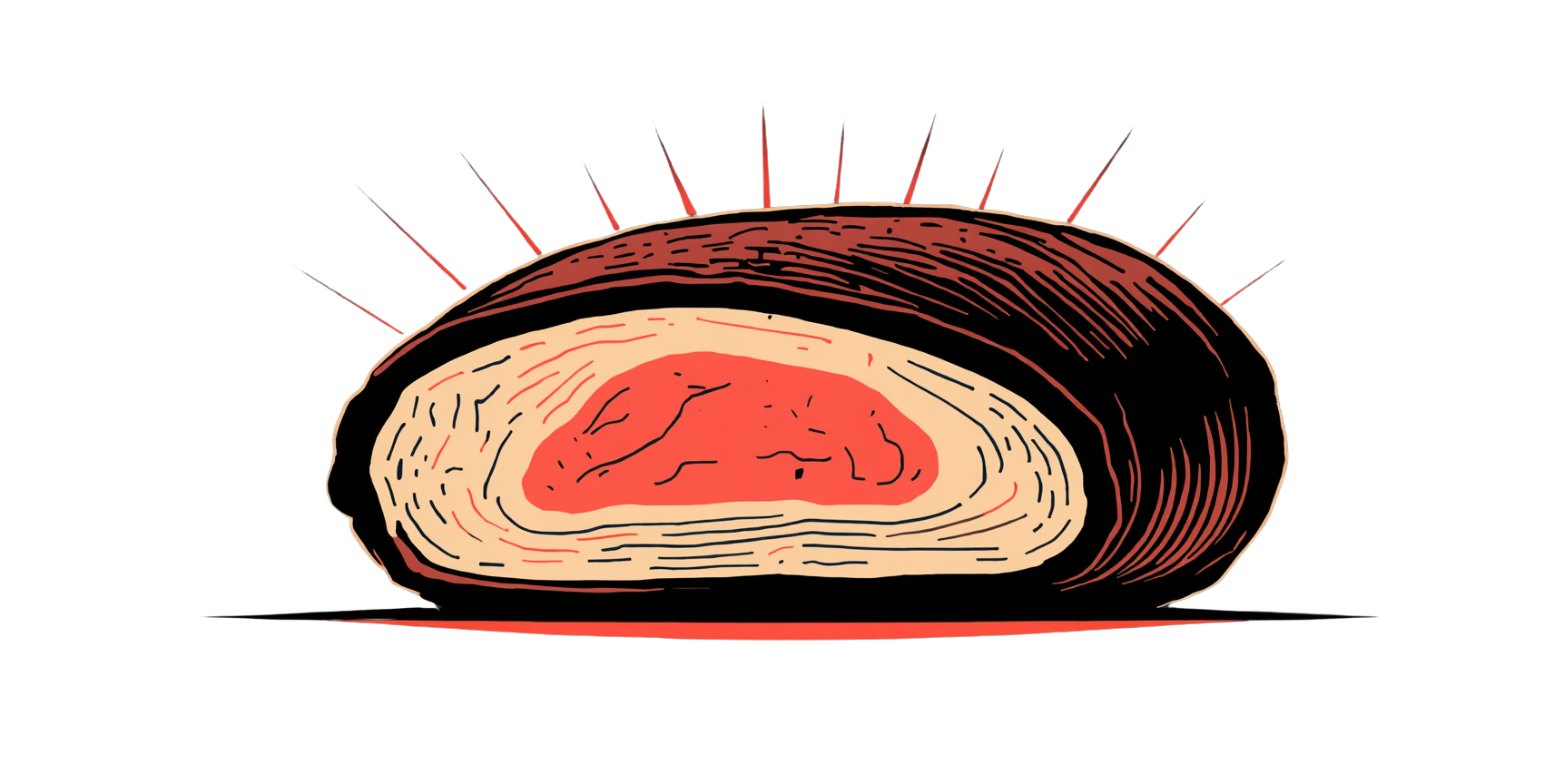
The smoke ring is the pink layer that sits just beneath the dark bark on smoked meat — usually 1/8" to 3/8" deep, most pronounced on beef brisket, less so on pork shoulder because beef has roughly four times more myoglobin. Meathead has the canonical chemistry: it's caused by nitric oxide (NO) and carbon monoxide (CO) from wood combustion penetrating the cold meat surface and locking the myoglobin into its red form before the muscle can finish cooking. The key requirements are a cold meat start, low pit temperatures, and time before the surface reaches ~140°F — above that, the reaction can't fix the pink color anymore. It is cosmetic, not a flavor marker. A brisket without a smoke ring tastes identical to one with it. The myth that deeper rings mean smokier flavor is the BBQ world's most persistent misunderstanding — competition judges still grade on it.
- What it is
- A pink layer just beneath the bark on smoked meat
- Made by
- NO + CO from wood combustion reacting with myoglobin at the meat surface
- Forms during
- Cold meat start through ~140°F surface temperature — the open window for gas penetration
- Color comes from
- Nitric oxide binding to myoglobin — not smoke flavor
- Sign you have it
- Pink ring 1/8" to 3/8" deep beneath the bark
- Flavor contribution
- Zero. Cosmetic only.
The phenomenon
Cut into a properly smoked brisket and you'll see three distinct layers: the dark, almost-black bark on the outside, then a thin pink band sitting just beneath it, then the deeper interior meat. That pink band is the smoke ring. It runs maybe 1/8" to 3/8" deep, follows the contours of the meat surface, and looks unmistakably like cured ham — because it kind of is, chemically.
For decades, BBQ culture has treated the smoke ring as a badge of pitmaster skill: deeper ring = better cook = more smoke flavor. Competition judges still award points for it. The truth is more complicated — the ring is real and predictable, but it is NOT a sign of smoke penetration or flavor depth. A great brisket can have no smoke ring. A so-so brisket can have a dramatic one.
The science behind it
Myoglobin is the protein that gives raw red meat its color. In a living animal, myoglobin is purple. When muscle is exposed to oxygen (cut open, exposed to air), it bonds to form oxymyoglobin — the bright red color of fresh steak. As meat cooks, the oxymyoglobin breaks down and turns gray-brown. This is what normal cooking does to surface color.
The smoke ring is what happens when something interrupts that process. Nitric oxide (NO) and carbon monoxide (CO) are produced when wood burns — they're part of every wood-smoke profile, charcoal too. Those gases penetrate the cold meat surface and bind to myoglobin in place of oxygen. The resulting compound is bright pink and heat-stable— it doesn't convert to gray-brown when the meat cooks. The pink color is chemically locked in.
But here's the catch: the gas penetration window closes around 140°F surface temperature. Once the meat surface heats past that, the chemistry stops working — whatever pink ring exists at that point is the ring you get. Anything later is just bark formation on top. So the ring depth is set in the first hour or two of a long cook, when the surface is still cold.
Meathead and physicist Greg Blonder demonstrated this in tests using natural gas grills (no wood smoke) where small amounts of NO injected into the cook chamber produced full smoke rings on otherwise unsmoked meat. No wood necessary — just the chemistry. The smoke ring isn't telling you anything about smoke flavor; it's telling you NO got to the surface before the meat heated past the threshold.
In the cook
If you want a pronounced smoke ring (for visuals, competition, or aesthetic preference), you're optimizing for NO/CO contact with cold meat surface. Levers that boost it:
| Lever | Effect | Note |
|---|---|---|
| Cold meat start | Maximizes NO/CO penetration window | Take straight from fridge to smoker; skip the tempering |
| Low pit temp (225°F) | Surface heats more slowly past 140°F | More time in the reaction window |
| Wood + charcoal (vs. gas/electric) | Combustion produces NO/CO; pellets less | Hickory, oak, mesquite produce more NO than fruit woods |
| Wet surface | Helps NO dissolve and penetrate | Counter-intuitive — wet meat blocks Maillard but boosts smoke ring |
| Pink curing salt | Adds NO directly; produces a fake ring | Controversial — chemically identical, ethically debated |
But here's the bigger picture: chasing the smoke ring is low-and-slow BBQ's vanity metric. None of these levers actually improve flavor. A meticulously-chased smoke ring on otherwise mediocre meat is still mediocre meat. A brisket from a pellet grill (which produces less NO and often shows a thin smoke ring) can be every bit as good as one off an offset stick burner. The ring is fine if you get one. It isn't evidence of anything else.
When it's done
Smoke ring formation has a clear endpoint: the chemistry stops working once the meat surface heats past ~140°F. Beyond that, NO/CO can't bind to myoglobin anymore, so whatever ring exists at that moment is the ring you'll have at the end.
| Window for formation | Cold meat start through ~140°F surface temp |
| Typical real-time window | First 1–2 hours of a long cook |
| Typical depth on brisket | 1/8" to 3/8" (3–9mm) |
| Visible after slicing | Pink band hugging the contour of every slice |
What you can't do is build a smoke ring late in the cook. If two hours in you don't have one, you won't get one later — the window has closed. The only way to influence the ring is to set up the conditions before the meat goes on (cold meat, wood/charcoal heat source, low pit temp) and let the chemistry happen automatically. Once the cook moves into the stall and bark formation phases, smoke ring development is already finished.
What people get wrong.
Deeper smoke ring = more smoke flavor
The myth that drives competition culture, and it's wrong. The ring is NO/CO reacting with myoglobin — purely cosmetic, no contribution to flavor. Tests with NO injected into a wood-free natural gas grill produce full smoke rings on otherwise unsmoked meat. A brisket can have deep ring and minimal smoke flavor, OR strong smoke flavor and no visible ring. The two are unrelated.
Pellet grills can't make a smoke ring
They can — just less dramatic. Pellet combustion produces some NO but less than burning wood logs or charcoal. A pellet-grill brisket often shows a thin, faint ring rather than a thick one. Cherry pellets specifically tend to produce more visible color. Malcom Reed's pellet grill brisket explicitly shows real smoke ring is achievable on pellets — it just requires longer cook times and the right pellets.
Pink curing salt is cheating
Pink salt (Prague Powder #1, sodium nitrite + sodium chloride) adds nitric oxide directly to the meat, producing a smoke ring chemically identical to one from wood smoke. Whether this counts as "cheating" depends on context: it's standard in competition for appearance-graded events, and it's the only way to get a smoke ring in genuinely smoke-free environments (sous-vide finish, oven hold). The ring it produces is the same molecules as a natural one.
You can build the ring late in the cook
Once the meat surface passes ~140°F, the NO/myoglobin reaction stops. Whatever ring exists at that point is the final ring — adding more smoke later won't deepen it. If you don't have visible ring in the first 1–2 hours of the cook, you won't develop one in hours 3–14. Smoke ring is set early and locked in.
What each of them says.
3 of the people we trust have covered this. Read or watch each in their own words.
- 01
 Meathead GoldwynAmazingRibs.com
The smoke ring is caused by nitric oxide and carbon monoxide from combustion reacting with myoglobin in the cold meat surface — it has nothing to do with smoke flavor. Tests injecting pure NO into a natural-gas grill with no wood at all produce full, deep smoke rings on otherwise unsmoked meat. The pink color is purely cosmetic. A brisket can have an enormous smoke ring and taste like nothing; one with no visible ring at all can be the best you've ever eaten. Stop using it as a quality marker.
- 02
 Daniel VaughnTexas Monthly
The smoke ring is an interaction between myoglobin in the meat and gases — primarily nitric oxide — produced during wood and charcoal combustion. Contact time matters: NO and CO can only fix the myoglobin's red color while the surface stays under about 130–140°F. Beef shows the most pronounced rings because it has roughly four times the myoglobin content of pork, which is why brisket consistently displays the deepest ring of any BBQ cut.
- 03
 Mad Scientist BBQYouTube — Jeremy Yoder
Jeremy covers smoke-ring chemistry as part of his methodical brisket-science framework — explains the NO/myoglobin reaction visually and tests how cold start temperature affects ring depth. Chemistry-teacher framing of why brisket from a low-and-slow stick burner rings deeper than from a pellet grill.
Cook it. Save the record.
Every cook gets a permanent entry — cut, fuel, temp, time, photo, what worked. Next time you want to nail that exact crust, you'll have the receipt.