
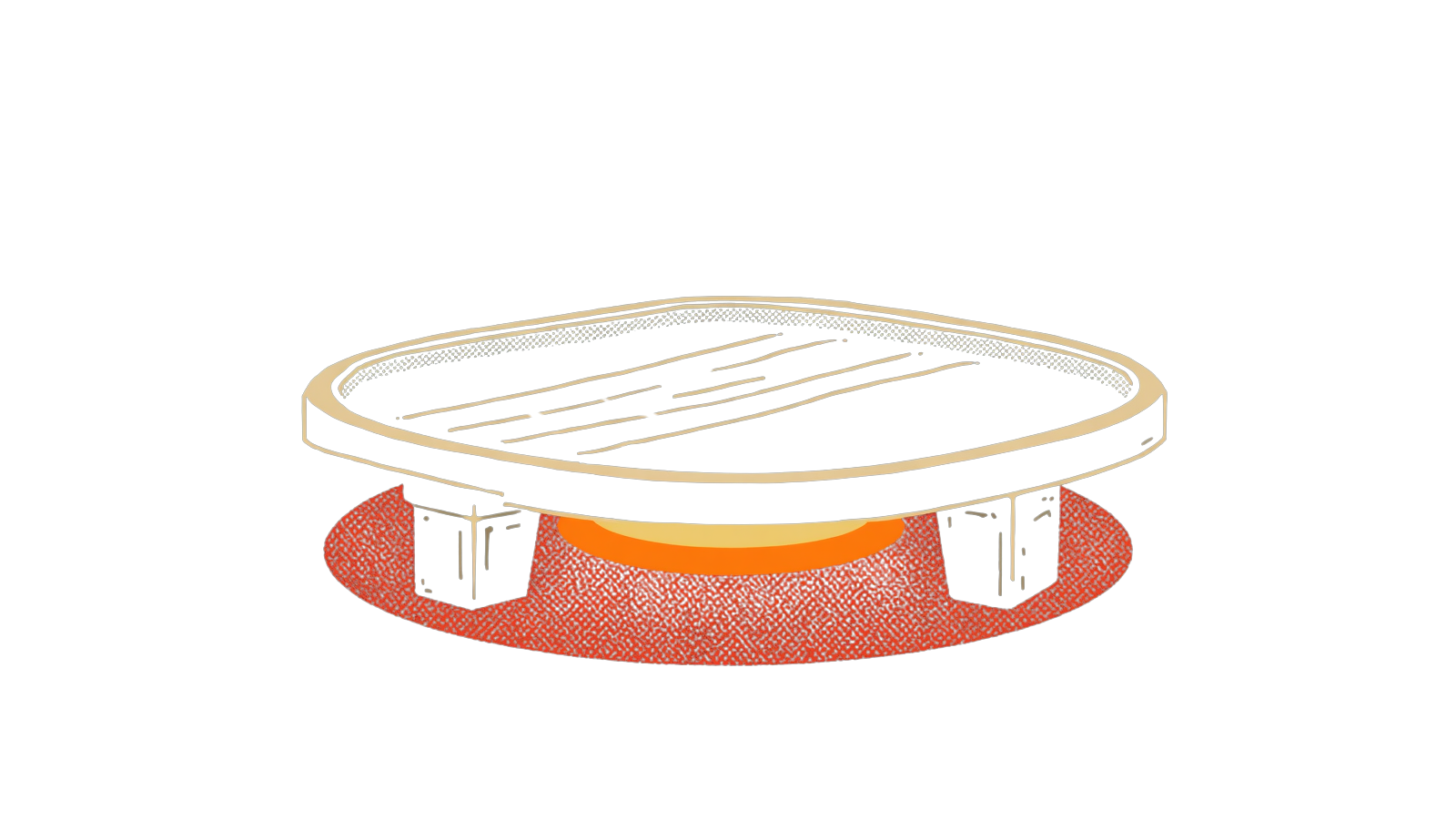
Heat Deflector
A heat deflector is the round, thick ceramic plate (steel on some models) that sits between the fire and the cooking grate on a kamado — the accessory that turns a screaming-hot radiant grill into an indirect oven and smoker. With the deflector out, a kamado sears at 700°F+; with it in, the same cooker holds a clean 225°F for low-and-slow brisket. The name changes by brand — Big Green Egg calls theirs the plate setter on older models and the convEGGtor on newer ones, Kamado Joe just calls it the deflector — but the role is identical. The catch worth knowing before you buy: many kamados ship without one in the box, sold separately as a paid extra. Meathead Goldwyn flags it as an absolutely necessary accessory for any kamado used for indirect cooking or smoking, so check what's included.
- Material
- Ceramic (most kamados) or steel (some aftermarket)
- Names by brand
- Plate setter (older BGE) · convEGGtor (newer BGE) · Deflector (Kamado Joe)
- Price
- ~$60–150, often sold separately from the cooker
- Fits
- Kamado-style ceramic cookers (BGE, Kamado Joe, Primo, others)
- Best at
- Converting a kamado from direct grill to indirect oven/smoker
- Care
- Let drippings burn off; don't shock with cold water on hot ceramic
What it is
A heat deflector is a thick ceramic plate (occasionally steel) that sits inside a kamado between the fire and the cooking grate. Steven Raichlen describes it as a heavy three-legged ceramic disc that drops in below the grate to enable indirect grilling and smoking. Without it, a kamado is a direct, radiant cooker — the food sits in the line of fire from the coals below. With it, the radiant heat hits the underside of the plate, gets absorbed and re-radiated more evenly, and the cooker becomes an oven.
The name changes by brand and generation, which trips up a lot of first-time buyers. Big Green Egg used to call theirs the plate setter — the original three-legged version — and now ships the redesigned convEGGtor on newer models. Kamado Joe just calls it the deflector, and their Divide and Conquer system uses two half-moon plates rather than one solid disc, so you can run indirect on one side and direct on the other simultaneously. Same job across brands; different vocabulary and geometry.
How the heat moves
A kamado without a deflector is a radiant cooker — the coals throw heat straight up at the food, hot and fast. The deflector interrupts that line of sight. The ceramic absorbs the radiant heat from below, heats up to the chamber temperature, and re-radiates evenly in every direction. The food above the plate no longer sees the coals; it sees a hot ceramic surface and the convected hot air circulating around it.
That conversion from direct radiant to indirect convection is the whole point. Deflector out, vents wide: a kamado runs 700°F+ for searing and pizza. Deflector in, vents choked down: the same cooker holds a clean 225°F for brisket and pork shoulder. Many cooks add a water pan on top of the deflector for long smokes — it adds humidity and acts as a thermal buffer that smooths out temperature swings.
Setting it up
The deflector slides in after the fire is lit and before the cooking grate goes back on. A few setups cover most of what people do with one:
Indirect / low-and-slow
Deflector in (legs down on a BGE plate setter, or feet down per the convEGGtor instructions), grate on top. Choke the vents and ride 225–275°F for ribs, brisket, pork shoulder. The canonical low-and-slow kamado configuration.
Indirect roasting (350–425°F)
Same setup, hotter fire. Whole chickens, pork loins, prime rib at oven temperatures with smoke flavor. The deflector keeps the underside from charring while the convection browns the top.
Half-deflector / two-zone
Kamado Joe’s Divide and Conquer (and aftermarket half-moon plates for BGE) cover only half the fire, giving you an indirect side and a direct side on the same cook. The closest a kamado gets to a true two-zone fire.
Pizza stone
Deflector in, pizza stone resting on the grate above it, vents wide for 600–700°F. The deflector protects the stone from cracking under direct radiant heat from the coals; the dome heat browns the top evenly.
Raichlen passes along a tip from BGE’s own instructors: skip the drip pan and let drippings burn off directly on the convEGGtor itself. The fat falls to the fire instead of pooling in a pan that needs cleaning, and the ceramic recovers fine with a brush between cooks.
Where it earns its keep
The deflector is what unlocks the kamado’s second and third personalities. Without it, you have an expensive, fuel-efficient searing grill. With it, the same cooker also runs as a smoker (brisket, ribs, pork shoulder), a convection oven (whole birds, roasts, baked goods), and a pizza oven. That range on one rig is the whole pitch for going kamado in the first place — and the deflector is the one piece of plastic-wrapped ceramic in the accessory box that makes it real.
The case Meathead Goldwyn keeps making is that an absolutely necessary accessory shouldn’t be sold as a paid extra — but it routinely is. A kamado without a deflector is a one-trick cooker; with one, it does everything the brand brochure shows.
Where it falls short
The deflector has real limits worth knowing about before you build a cook around it:
Slow to swap mid-cook
Pulling a hot ceramic deflector out to convert from indirect to direct mid-cook (or vice versa) means handling a 500°F+ disc with heavy gloves and somewhere safe to set it down. Plan the deflector position before you light the fire, not after.
Cracks under thermal shock
Ceramic deflectors can crack if hit with cold water on a hot surface, or dropped on a hard floor. Let them cool fully before cleaning; brush off drippings rather than scrubbing with water mid-cook.
Often sold separately
Many bare-bones kamados ship without a deflector, marketed as a paid extra. Check what’s in the box before you buy — the sticker price plus a deflector is the real cost of an indirect-capable kamado.
Brand-specific fit
Deflectors are sized to a specific kamado model. A BGE Large plate setter doesn’t fit a Kamado Joe Classic, and aftermarket half-moons assume specific internal geometry. Match the deflector to the cooker.
What goes wrong.
Forgetting it for low-and-slow
Trying to run a kamado at 225°F without the deflector means the food sits in direct radiant heat from the coals — the bottom scorches before the top cooks. The deflector is the one piece that makes low-and-slow possible on a kamado.
Putting it on a cold cooker
Some manufacturers want the deflector loaded before the fire is lit; others want it added once the coals are going. Wrong sequencing can mean the deflector takes a long time to come up to chamber temp and the early part of the cook runs uneven. Check the manual for your specific kamado.
Shocking hot ceramic with cold water
Splashing water on a hot deflector to clean it mid-cook can crack the ceramic. Let drippings burn off in place, or pull the deflector and let it cool fully before any wet cleaning.
Using a deflector from a different cooker
Deflectors are sized to specific models. A BGE plate setter won't sit right in a Kamado Joe, and an aftermarket half-moon designed for one cooker may not seat in another. Match the deflector to the rig.
Skipping the drip pan when you need it
Raichlen's tip about burning drippings off directly on the deflector works for fatty cuts where the smoke flavor benefits — but a long, very fatty cook with no pan can fill the firebox area with fat that flares. For brisket and big pork shoulders, an elevated drip pan above the deflector is the safer call.
What each of them says.
3 of the people we trust have covered this. Read or watch each in their own words.
- 01
 Meathead GoldwynAmazingRibs.com
Meathead calls the deflector plate an absolutely necessary accessory for any kamado used for indirect cooking or smoking — and warns buyers that many manufacturers ship bare-bones kamados without one included, sold as a paid extra. Same piece goes by different names across brands (plate setter on older BGE, convEGGtor on newer BGE, just deflector on Kamado Joe), so check what's in the box before you buy.
- 02
 Steven RaichlenBarbecue Bible
Raichlen describes the deflector as a heavy three-legged ceramic plate that sits under the grate to enable indirect grilling and smoking. Notes a useful trick from BGE's own instructors: skip the drip pan and let drippings burn off directly on the convEGGtor itself, which keeps the fat dripping to the fire and out of your way.
- 03
 Mad Scientist BBQYouTube
Jeremy Yoder runs IR-camera and temperature probes across different deflector placements on a Kamado Joe to test what's actually happening above and below the plate during a low-and-slow cook. The kind of myth-busting test that tells you whether feet-up vs feet-down or stacked deflectors actually changes the cook surface.
Cook it. Save the record.
Every cook gets a permanent entry — cut, fuel, temp, time, photo, what worked. Next time you want to nail that exact crust, you'll have the receipt.