
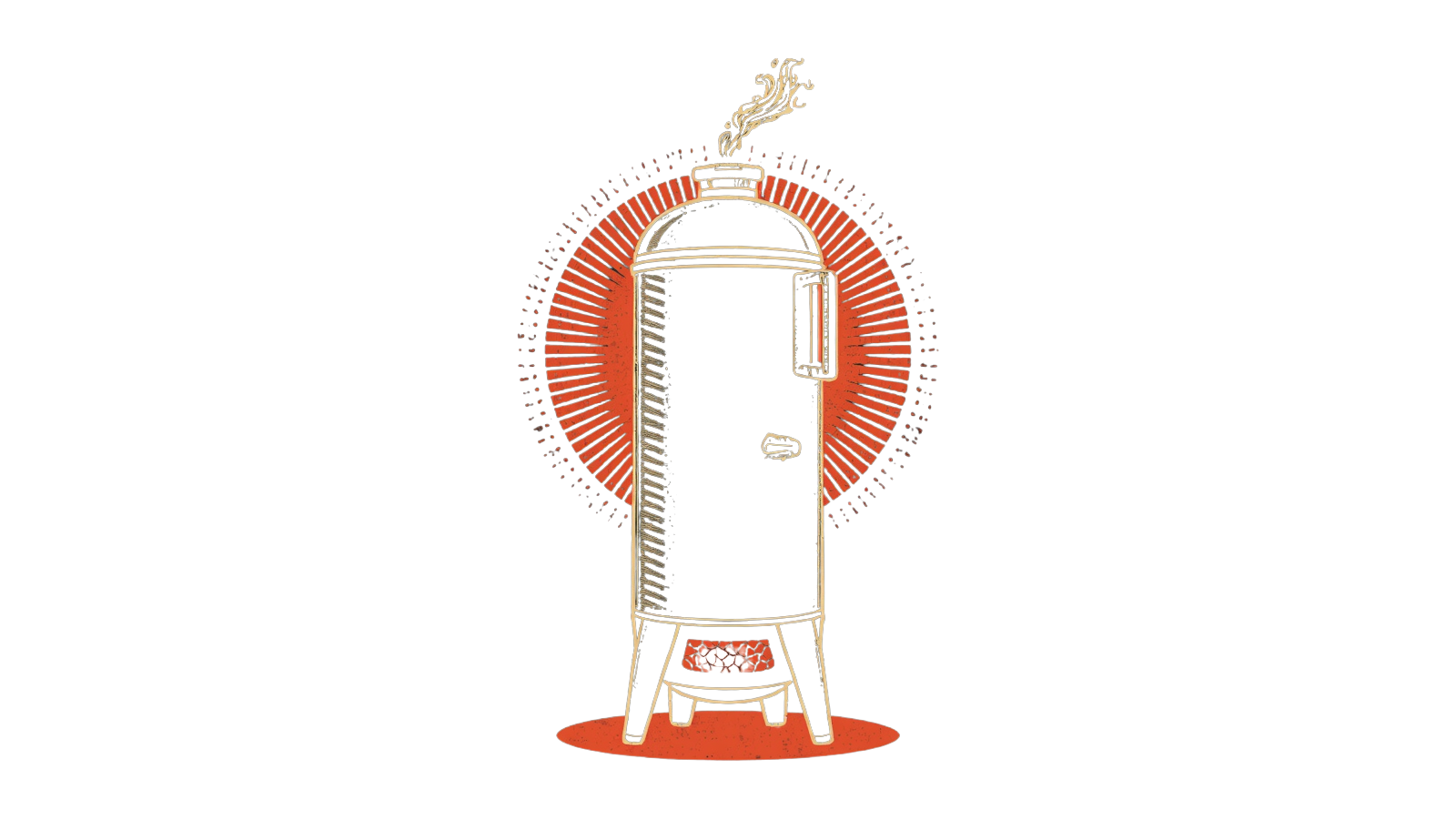
Vertical Smoker
A vertical smoker stacks the cook upward: fire at the bottom, the food on racks above it, and a lid on top, all in a tall, small-footprint body. The classic is the bullet-shaped water smoker— the Weber Smokey Mountain is the icon — which parks a pan of water between the coals and the meat to steady the heat and add humidity. Ugly drum smokers (UDS) rack or hang the meat over a charcoal basket in a steel drum, and gas and electric cabinets do the same trick with a different fuel. What they share is efficiency: a small charcoal load and two vents will hold a steady 225–250°F for hours, which is why a $400 bullet smoker shows up at competitions and beats cookers costing ten times as much. It's the cheapest honest path to real low-and-slow barbecue.
- Fuel
- Charcoal (also propane or electric cabinets)
- Sizes
- 14″/18″/22″ bullets; 55-gallon drums; cabinets
- Price
- ~$200–500 for a charcoal bullet or drum
- Temp range
- Dialed for 225–275°F low-and-slow
- Best at
- Cheap, efficient low-and-slow in a small footprint
- Skill level
- Easy to hold once it's dialed in
What it is
“Vertical smoker” covers a family of upright cookers that all stack the food above the fire instead of beside it. The most popular is the water smoker: a bullet-shaped body with charcoal at the base, a water pan in the middle, two grates of meat above, and a domed lid. The Weber Smokey Mountain is the standard-bearer — a gold-medal budget smoker that quietly wins competitions against commercial rigs.
The same upright idea shows up as the ugly drum smoker (UDS) — a 55-gallon steel drum with a charcoal basket at the bottom and the meat racked or hung high above it — and as gas and electric cabinet smokers, box-shaped units that trade live coals for a burner or element. Different fuels, same vertical stack.
How the heat moves
Heat rises, and a vertical smoker uses that directly: the fire sits at the bottom, and hot air and smoke climb past every rack of food on their way out a top vent. You control the burn with a bottom intake vent and the top exhaust, the same airflow logic as a kettle. Because the heat passes through the whole stack of food, very little is wasted — which is why these cookers sip fuel.
In a water smoker, the pan between the fire and the food is the secret. It acts as a heat sink and a baffle: it absorbs and evens out the fire's swings, holds the chamber around the 225–250°F range, and throws humidity that helps smoke stick. A drum smoker skips the pan, so it runs a little hotter and more direct — closer to a kettle standing on end.
Setting it up
The trick to a long, steady burn is the Minion method: fill the charcoal ring with unlit briquettes, drop a small amount of lit coals on top, and the fire burns slowly downward like a fuse — 12 to 18 hours on a single load without ever opening the door. (It's the same idea the snake method brings to a kettle.) Add a few wood chunks for smoke, set the bottom vents, and let it stabilize before the meat goes on.
On a water smoker, fill the pan with hot water so it comes up to temperature faster, and keep an eye on the level on very long cooks — if it boils dry, the buffer disappears and the temperature spikes. Then mostly leave it alone: vertical smokers hold a line well, and every time the lid comes off, the whole stack loses heat.
Where it earns its keep
The vertical smoker is the value champion of real barbecue. A bullet or a drum costs a few hundred dollars, sips charcoal, holds a rock-steady low-and-slow temperature with little babysitting, and turns out bark and smoke that genuinely competes with cookers costing many times more. For a first dedicated smoker, it's hard to do better.
It also takes up almost no room. Where an offset sprawls across a patio and demands constant fire-tending, a bullet smoker stands in a corner and largely runs itself once it's dialed in — the same serious smoke with a fraction of the space and the work.
Where it falls short
A vertical smoker is a smoker, not a griller. There's no real direct, high-heat zone for searing steaks or cooking hot and fast, so it's a one-trick — admittedly great — cooker. Capacity is modest too: the racks are round and there are only a couple of them, so big cooks for a crowd outgrow a bullet quickly.
The long cooks also ask for the occasional refuel — topping up the water pan, and on the longest cooks adding charcoal — and the electric cabinet versions make notably weaker smoke than a live charcoal fire. None of it is a dealbreaker; it just means a vertical smoker is built to smoke low and slow, and you reach for a kettle or a gas grill when you want to actually grill.
What goes wrong.
Lighting all the charcoal at once
Light the whole ring and the temperature rockets past 250°F and burns out fast. Use the Minion method — a small amount of lit coals on a bed of unlit — for a slow, steady, hours-long burn.
Letting the water pan boil dry
On a long cook the pan can run dry, and the moment it does the heat buffer is gone and the temperature spikes. Check the level and top up with hot water; don't let it surprise you mid-brisket.
Chasing the temperature with the vents
These smokers hold a line well, so big vent swings overshoot in both directions. Make small adjustments, then wait 15–20 minutes to see where it settles before touching them again.
Opening the door to peek
Every time you open the lid or door, the whole vertical stack dumps heat and the cook stalls while it recovers. Set it, trust it, and stay out — use a probe instead of your eyes.
Loading too much wood
A sealed upright chamber concentrates smoke, so a full load of wood turns acrid fast. A few chunks tucked into the charcoal is plenty for clean, thin blue smoke.
What each of them says.
2 of the people we trust have covered this. Read or watch each in their own words.
- 01
 Meathead GoldwynAmazingRibs.com
The Weber Smokey Mountain is a charcoal bullet water smoker that cooks at a remarkably steady temperature for hours, controlled simply by opening and closing the vents — the water pan in the middle acts as a heat diffuser, and the top grate runs 10–20°F warmer than the one below it. These are gold-medal-quality smokers that routinely beat far pricier commercial cookers at competitions. Fill the pan with hot water so it comes up to temperature faster, and expect to top it up on long cooks.
- 02
 Malcom ReedHowToBBQRight / YouTube
The drum-smoker side of the vertical family, from a competition cook who runs them: Malcom breaks down how a UDS works, why the airflow and the charcoal basket matter, and what to know before you buy or build one.
Cook it. Save the record.
Every cook gets a permanent entry — cut, fuel, temp, time, photo, what worked. Next time you want to nail that exact crust, you'll have the receipt.