
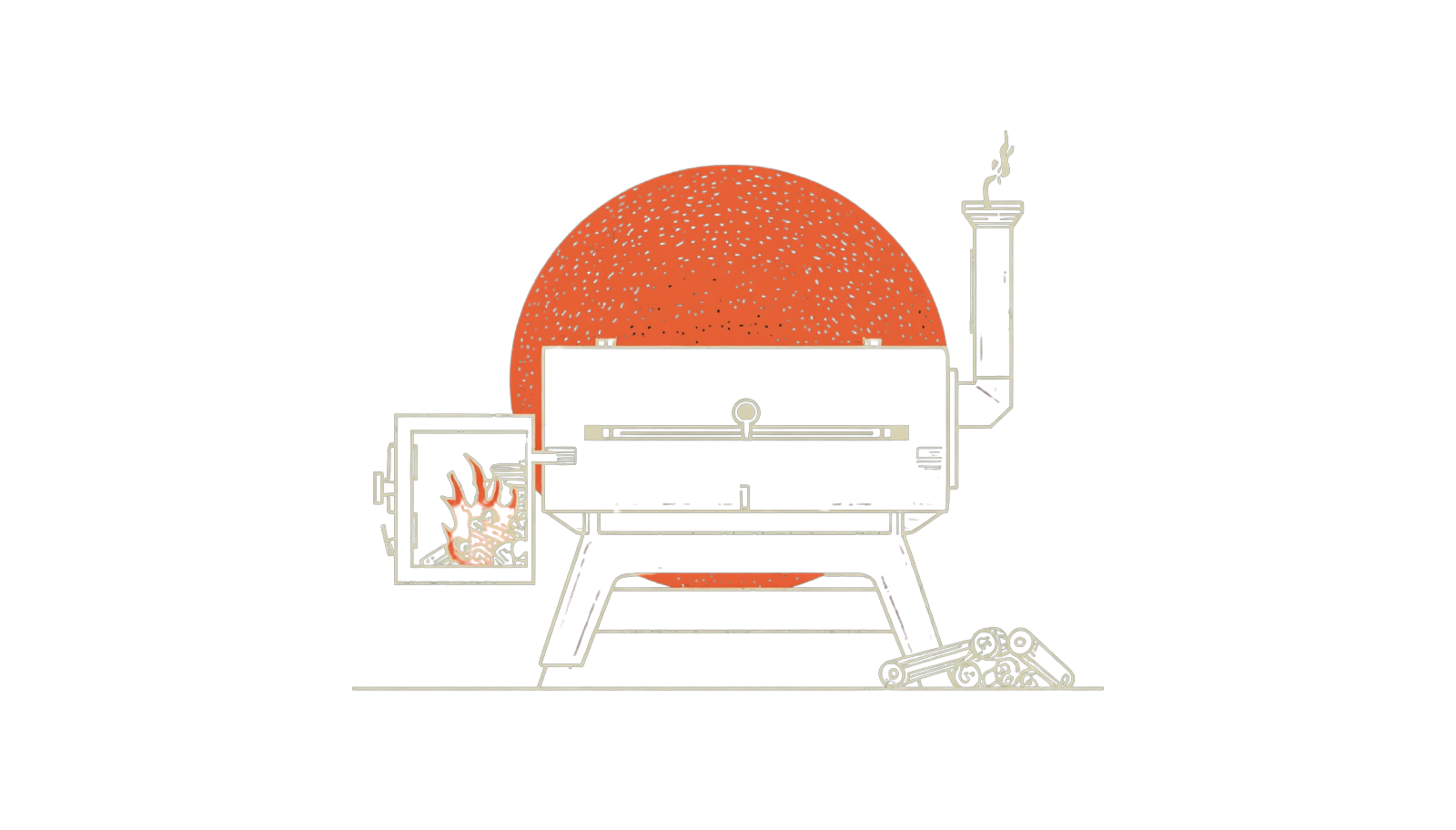
Offset Smoker
The offset smoker is the horizontal-barrel wood cooker with a firebox bolted to one side — the instrument of Central Texas brisket, and the rig Aaron Franklin made famous. The principle is pure indirect heat: a fire burns in the side firebox while the heat and smoke draft sideways through the long cooking chamber and out a chimney at the far end, so the meat never sees flame. That sideways draft is also the signature challenge — the firebox end runs hotter than the stack end, and holding a steady 250°F means feeding small splits of wood and reading the fire for hours. Run well, nothing else builds bark and clean smoke flavor like it — this is the cooker behind competition brisket and the low-and-slow tradition. Run poorly, a starved, smoldering fire coats the meat in acrid creosote. It's the most hands-on cooker in the backyard, and for a lot of cooks that's exactly the appeal.
- Fuel
- Hardwood splits (cheap models: charcoal + wood)
- Sizes
- 20″ backyard barrels → 1,000-gal competition rigs
- Price
- ~$300 thin-steel entry to $3,000+ thick-steel pits
- Temp range
- Run at 225–275°F for low-and-slow
- Best at
- Brisket & big cuts — deepest bark + hardwood smoke
- Skill level
- Advanced — hands-on fire-tending for hours
What it is
An offset smoker is a horizontal cooking chamber with a separate firebox attached to one side and a chimney at the other. The fire burns in the firebox, never under the food; heat and smoke draft sideways through the chamber and out the stack. It grew out of Texas oilfield country, where workers welded scrap pipe and steel barrels into pits, and it became the icon of Central Texas barbecue — the rig you picture behind a brisket joint's pit room.
The category splits hard on steel thickness, which is the real quality line. Cheap offset smokers (often shortened to “COS”) are thin big-box pits that leak heat and swing wildly; heavy backyard and competition pits use thick steel that holds temperature like a flywheel. Reverse-flow models route the smoke under a baffle and back over the meat for a more even chamber. Whatever the size — from a 20-inch backyard barrel to a 1,000-gallon trailer rig — the working principle is identical.
How the heat moves
An offset runs on draft. Air enters a vent on the firebox, feeds the fire, and the hot gas and smoke are pulled through the opening into the cooking chamber and out the chimney. You set the burn rate with the firebox intake and fine-tune the pull with the stack damper — but unlike a kettle, the fire is always off to the side, so the meat cooks on pure indirect heat.
Two facts dominate how an offset behaves. First, heat and smoke want to rise, not travel sideways, so the firebox end of the chamber always runs hotter than the stack end — often by 40–50°F. Second, the fire has to burn clean: a small fire with real flame and plenty of air burns hot and throws thin blue smoke, while a starved, smoldering fire throws thick white smoke that lays acrid creosote on the meat. Reading the fire and the gradient is the entire craft of running one.
Setting it up
Start by building a bed of coals — light a chimney of charcoal or burn a couple of splits down — then feed the fire one or two small splits of seasoned hardwood at a time, keeping it actively flaming rather than smoldering. Preheat the empty chamber to your target (usually around 250°F) and let the smoke run clean before the meat goes on. From there it's a rhythm: add a split, watch the temperature and the smoke, adjust the intake, repeat — every 30 to 60 minutes for the length of the cook.
Work with the gradient instead of against it. Put the thickest cut toward the cooler stack side and rotate the meat partway through; a baffle or set of tuning plates under the grate evens the chamber out, and a water pan adds thermal mass to steady the swings. This is the cooker the whole low-and-slow tradition is built around — long brisket cooks, the stall around 150–170°F, and a Texas crutch wrap to push through it.
Where it earns its keep
Nothing builds bark and hardwood smoke flavor quite like a well-run offset. The constant draft of clean wood smoke over a long cook is what gives Central Texas brisket its dark, peppery crust and deep smoke ring — it's the competition and pit-joint standard for a reason. It also scales: where a kettle taps out at a brisket or two, a full-size offset will feed a crowd.
For a lot of cooks the appeal is the craft itself. Tending a fire for twelve hours — reading the smoke, feeding splits, holding a line on the temperature — is the part they enjoy, not the part they want to automate away. An offset rewards that attention with results a hands-off cooker can't quite match.
Where it falls short
The offset is the most demanding cooker in the backyard. It is not set-and-forget: leave it alone for two hours and the fire dies or the temperature crashes. Plan to tend it every 30 to 60 minutes for the entire cook, which can mean a pre-dawn start on a packer brisket.
Cheap thin-steel offsets make that harder — they leak heat, run a brutal hot-to-cool gradient, and usually need sealing and a baffle before they hold a line at all. A good thick-steel pit fixes that but costs many hundreds to a few thousand dollars. And the learning curve is real: a dirty fire coats a cook in creosote, and that lesson usually costs a brisket or two.
So it's the wrong tool for a weeknight or a hands-off cook. If you want to set a temperature and walk away, a pellet grill does that; if you just want a versatile backyard cooker for smaller cooks, a kettle does more with less fuss. The offset earns its place only if the fire-tending is a feature to you, not a chore.
What goes wrong.
Burning a dirty, smoldering fire
The number-one offset mistake: starving the fire for air so it smolders and throws thick white smoke. That's creosote, and it makes meat taste acrid and ashy. Keep a small fire actively flaming with plenty of air — you want thin blue smoke you can barely see.
Treating it as set-and-forget
An offset is not a pellet grill. Skip a feeding and the fire dies, the temperature crashes, and the cook stalls out cold. Plan to add a split and check the fire every 30–60 minutes, start to finish.
Fighting the temperature gradient
The firebox end always runs hotter than the stack end — often 40–50°F. Don't expect it to be even. Put the thickest part of the meat toward the cool side, rotate partway through, and add a baffle or tuning plates to help level it.
Too much wood, or green wood
More smoke isn't better. Feed small splits of dry, seasoned hardwood one or two at a time; a chamber choked with green wood or too many splits oversmokes the meat and drags the fire dirty.
Trusting the stack thermometer
The dial mounted up on the stack reads neither end of the grate accurately. Run a digital probe at grate level — ideally one on each end — so you actually know the gradient you're cooking in.
What each of them says.
3 of the people we trust have covered this. Read or watch each in their own words.
- 01
 Meathead GoldwynAmazingRibs.com
An offset works by drafting heat and smoke from the side firebox, through the cooking chamber, and out the stack — but heat wants to rise, not travel sideways, so the firebox end runs 40–50°F hotter than the chimney end. On cheap offsets, burn charcoal rather than all wood (wood is harder to manage and easy to oversmoke), run a digital thermometer on both ends, and add a convection plate or baffle to deflect heat and even out the chamber.
- 02
 Aaron FranklinBBQ with Franklin / YouTube
The canonical offset voice on the thing that matters most: fire. Franklin treats a fire as a living thing you read and feed, walking through how he builds and holds a clean burn — the foundation under Franklin Barbecue's brisket.
- 03
 Mad Scientist BBQYouTube — Jeremy Yoder
Most people's first offset is a thin, cheap one — and this is the fire-management reality check for exactly that rig. Jeremy works the budget-offset problem with his usual myth-dispelling rigor: small clean fire, where to put the probes, how to fight the gradient.
Cook it. Save the record.
Every cook gets a permanent entry — cut, fuel, temp, time, photo, what worked. Next time you want to nail that exact crust, you'll have the receipt.