
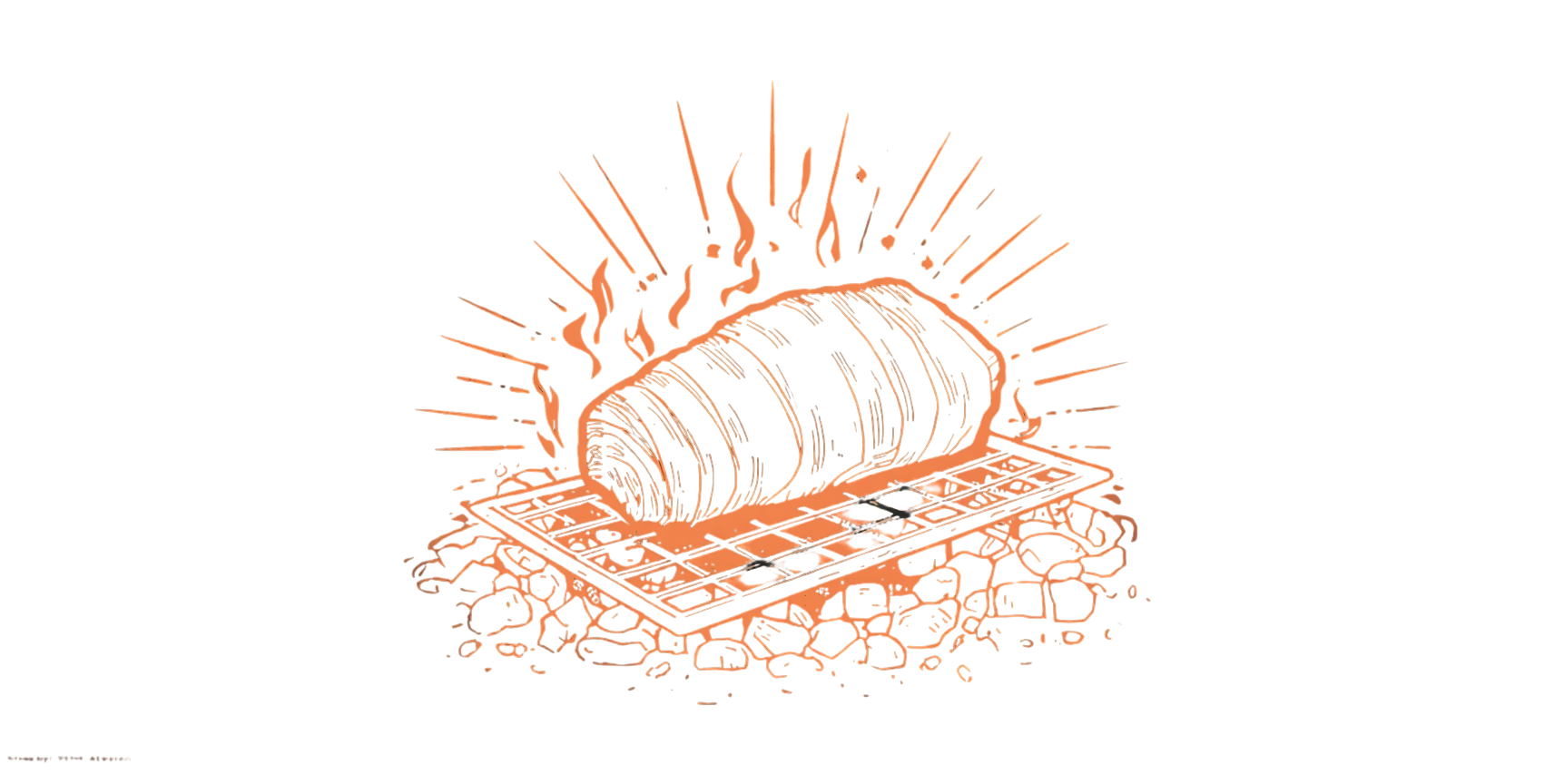
Hot and Fast
Hot and fast is the high-heat counterpoint to low-and-slow: instead of holding a pit at 225°F for twelve-plus hours, you run it around 300–350°F and bring a brisket or pork butt home in five or six. The higher pit temperature overpowers the evaporative cooling behind the stall, so the cook pushes through that plateau far faster — often with a foil wrap (the Texas crutch) to speed it further. The tradeoff is real: collagen still gelatinizes at the same finish temperature (~203°F), but there's less time at heat for intramuscular fat to fully render and less time for bark to set, so the slice eats a touch firmer and steakier. The method rose out of competition barbecue, where pitmasters needed turn-in times measured in hours, not overnight — and as more than one of them puts it, a hot-and-fast brisket beats no brisket at all.
- Pit temp
- 300–350°F (vs 225–275°F for low and slow)
- Brisket time
- ~5–6 hours — roughly half of low and slow
- Wrap point
- Foil or paper at 160–170°F to drive through the stall
- Finish temp
- Probe-tender, ~203°F (same target as low and slow)
- Tradeoff
- Firmer, steakier slice; thinner bark, slightly less rendered fat
- Best for
- Brisket, pork butt, ribs when the clock is tight
Before you cook.
- Equipment
- A smoker or grill that holds 300–350°F steadily, foil or butcher paper, and both an instant-read and a leave-in probe thermometer.
- Fire
- Build hotter than a low-and-slow fire — more lit coals, wider-open vents. Keep the meat indirect so high heat doesn't scorch the bottom.
- Day before
- Trim and season as usual. Hot and fast doesn't change the rub — just the clock.
- Day of
- Have the wrap ready before the stall hits (~160°F). On a fast cook the wrap is what keeps the lean end from drying out.
What to cook with it.
Other ways to do it.
Direct heat
Cook the brisket directly over the coals instead of offset from them — the hottest, fastest version, popularized by the Austin direct-heat crowd. Big payoff in speed and bark, but it demands attention so the bottom doesn't scorch.
Wrapped hot-and-fast
Foil or butcher paper at 160–170°F — the Texas crutch applied to a fast cook. It drives through the stall and locks in the moisture a shortened cook would otherwise lose.
Competition turn-in
The original use case — pitmasters running 300°F+ to hit a turn-in window, often with a tallow or butter wrap for a glossy, tender, judge-ready slice.
Hot, then hold
Run hot to punch through the stall, then drop the pit and let the meat coast to probe-tender — a middle path between hot and fast and low-and-slow.
What goes wrong.
Scorched bottom, bitter bark
300–350°F is hot enough to burn a sugar-heavy rub. Keep the meat indirect, and move it to a cooler spot if the bark darkens faster than it sets.
Dried-out flat
The lean end gives up moisture quickly at high heat. Wrap at 160–170°F and don't skip it — the wrap does the moisture work the long cook normally handles.
Pulled too early
Fast doesn't mean done. Collagen still has to reach ~203°F and probe like butter — a brisket that only looks done at 190°F will eat tough.
Treating it like low and slow
The vents and fuel load from a 225°F cook won't hold 325°F. Build a bigger fire and open the vents — undershooting gives you the worst of both: not slow enough to render, not hot enough to finish fast.
Expecting an identical brisket
Hot and fast is a different finished texture, not a shortcut to the same result. The slice is firmer and steakier with thinner bark — judge it on its own terms.
What each of them says.
4 of the people we trust have covered this. Read or watch each in their own words.
- 01
 Meathead GoldwynAmazingRibs.com
Taking a brisket up to 300–350°F lets the warm air overcome the cooling effect of evaporation, so you bust through the stall faster. People who've cooked both ways report only a small difference in the finished brisket — but for thick, tough cuts he still leans traditional low and slow, since extended time near 203°F is what melts fat and gelatinizes connective tissue.
- 02
 Steven RaichlenBarbecue Bible
Low and slow runs 225–275°F; hot and fast runs roughly 325–400°F with controlled smoke. Reach for hot and fast when time is tight, the cut is smaller, or you want a punchy bark and a firmer slice — brisket flats, smaller butts, ribs in a pinch. There's no single right way, only the one that fits your cut, cooker, and clock.
- 03
 Susie BullochHey Grill, Hey
Smoke the brisket at 275°F (nudging 300°F) and it comes together in about 5–6 hours — roughly half the time of a traditional cook. Wrap in foil once it hits 160–170°F internal, then take it to 204–208°F with a butter-soft probe feel. The result is a tender, steak-like brisket that trades some bark for speed.
- 04
 Mad Scientist BBQYouTube — Jeremy Yoder
Jeremy cooks a brisket fast over direct heat — the hottest end of the hot-and-fast spectrum — and tracks how the higher heat changes render, bark, and finish time.
Cook it. Save the record.
Every cook gets a permanent entry — cut, fuel, temp, time, photo, what worked. Next time you want to nail that exact crust, you'll have the receipt.