
Seafood
Seafood is the fastest category of cooks over live fire and the least forgiving of inattention. Rich fish like salmon and tuna behave almost like steaks — sear them hot-and-fast and pull at a precise internal temperature. Delicate whitefish, shellfish, and cephalopods all live or die in sixty-second windows. The canonical Pacific Northwest pairing for the headline cook is salmon over alder; strong smoke woods bury the fish. Sticking is the rookie failure mode — hot, clean, oiled grates are non-negotiable, and a fillet that resists when you try to lift it isn’t ready to flip yet.
- Cuts covered
- 17 — from salmon to squid
- Doneness profiles
- Fish (125-140°F by type) · Tuna seared rare (~115°F) · Shellfish (by opacity)
- Canonical pairing
- Alder smoke, salt + lemon — mild fruit woods only
- Hardest to nail
- Whole snapper — flip without losing the skin
- Easiest to start
- Salmon fillet, then shrimp on thin metal rods
- Cost range
- ~$8/lb tilapia and frozen shrimp to $40+/lb fresh tuna and lobster tail
What it is
Seafood is the category where fire cooking gets fastest and least forgiving. A brisket gives you a 20-minute window to pull it; a salmon fillet gives you 60 seconds. No other protein covers this much range — tuna that wants to come off the grate rare like a steak, and oysters that finish in their own shell over coals in under three minutes.
The American grilling canon for seafood is Pacific Northwest first — salmon over alder is the tradition that put grilled fish on backyards outside the coasts. Coastal Southern and Gulf cooking brings shrimp, whole snapper, and oysters; Mediterranean live-fire brings octopus and whole sea bass. Each tradition shares one rule: the wood is mild and the clock is short.
The practical skill of seafood is sorting its seventeen common items into four families — rich fish, delicate fish, shellfish, cephalopods — because the family tells you the method before you know anything else about the item.
The lineup
Seafood doesn’t map to a single animal’s anatomy the way beef or pork does. The category is a lineup of seventeen items across four families, each with its own clock and its own canonical method.
Rich fish (salmon, tuna, swordfish, mahi-mahi) are dense, fatty, and steak-like — they sear, they take heat, they hold together on the grate. Delicate fish (snapper, halibut, cod, trout, sea bass) are flaky and fragile — whole fish holds together better than fillets, and the skin is what saves you from sticking. Shellfish (shrimp, scallops, lobster tail, oysters, crab) are quick — minutes, not hours, with shell-on cooks finishing when the shell opens or chars. Cephalopods (octopus and squid) are the trick category: tough until transformed, with no middle ground — minutes cooked or an hour braised, never anything in between.
The hits
Seventeen items, four families. The family tells you the method before you know anything else.
Salmon · Tuna · Swordfish · Mahi-mahi
The steak fish. Salmon is the headline — fatty, forgiving, and the canonical Pacific Northwest cook over alder. Skin-side down on hot oiled grates, pull at 125-130°F for moist, 135-140°F for firmer. Tuna wants the steak treatment: oil, salt, sear hard on both sides, pull rare around 115°F — cooked through it’s cat food. Swordfish and mahi are the middleweights — firm enough to take direct heat without falling apart, finished at 130-135°F. Cedar plank-grilling shows up here too — theater more than flavor, but it solves sticking.
Snapper · Halibut · Cod · Trout · Sea bass
The flaky whitefish. As fillets they’re fragile — thin, prone to sticking, easy to overshoot past 140°F into chalky. The whole fish is the pro move: snapper, trout, and sea bass all hold together as a unit and the skin protects the flesh through the flip. Stuff the cavity with lemon and herbs, slash the skin three times per side so it doesn’t curl, and grill over a two-zone fire — sear-side first, then slide to the cool side to finish. Halibut and cod are the only ones that really earn the grill basket.
Shrimp · Scallops · Lobster tail · Oysters · Crab
Fast and hot. Shrimp on thin metal skewers cook in 2-3 minutes a side — pull at pink and opaque. Scallops want a screaming grate and a dry surface for the crust; wet-packed scallops steam and never sear. Lobster tail is split down the middle and grilled shell-side down until the meat goes opaque. Oysters go on the grate in the shell, cupped side down, until they pop open — the simplest, fastest seafood cook in BBQ. Crab gets pre-cooked or par-steamed and finished over coals for char and warmth, not done-ness.
Octopus · Squid
The trick category. Octopus is inedible cooked fast and transcendent cooked slow — pre-braise or pressure-cook for tenderness first, then char over screaming heat for 2-3 minutes to finish. The fire is for color and crust, not doneness. Squid is the rule cooks misremember: two minutes or forty-five, nothing between. Anything in the middle is a rubber band. Hot grate, fast cook, lemon and salt — Mediterranean live-fire at its simplest.
Cut & method
The quick-reference layer. Doneness targets are pull temperatures — carryover adds a few degrees. Shellfish go by opacity and visual cue, not probe.
| Cut | Best method | Doneness | Note |
|---|---|---|---|
| Salmon | Direct, skin-side down | 125-130°F (moist) / 135-140°F (firm) | Pull thin tail before thick center |
| Tuna | Hot sear, short | ~115°F seared rare | Treat like a steak; cooked through it’s ruined |
| Swordfish / mahi-mahi | Direct grill | 130-135°F | Firm enough to take heat without falling apart |
| Snapper / sea bass (whole) | Two-zone, skin-on | 135-140°F at the spine | Slash skin to prevent curling |
| Halibut / cod | Direct, in basket | 130-135°F | Chalky past 140°F — pull early |
| Trout (whole) | Direct, skin-on | 135-140°F at the spine | The friendliest whole fish for beginners |
| Shrimp | Skewered, direct | Pink & opaque | 2-3 min per side; double-skewer to stop spin |
| Scallops | Hot grate, dry | Opaque, just-firm | Dry-pack only; wet-pack never sears |
| Lobster tail | Split, shell-down | ~140°F / opaque | Butter at the end, not the start |
| Oysters | In shell, cup-down | Shell pops open | Simplest seafood cook in BBQ |
| Crab | Pre-cooked, finish over coals | Heat through | Fire is for char and warmth, not doneness |
| Octopus | Pre-braise then char | Tender first, then color | Skip the tenderizing and it’s a rubber band |
| Squid | Hot grate, fast | 2 min total / opaque | Two minutes or forty-five — nothing between |
Where to start
Three on-ramps, by what you’re trying to learn.
First fish on the grill
PickSalmonThe fattiest, most forgiving fish on the grate. Skin-side down on a hot, clean, oiled surface; pull at 125-130°F with an instant-read thermometer in hand. Alder smoke if you have it; nothing stronger.
First shellfish cook
PickShrimpThread onto thin metal rods so they don’t spin when you flip. Two to three minutes a side over direct heat, pull at pink and opaque. Cheap enough to practice with and fast enough to teach you the one-minute window.
Show-off centerpiece
PickWhole snapperA two-pound whole fish, slashed and stuffed with lemon and herbs, hits the table looking like somebody fished it themselves. The skin protects the flesh; cook it skin-down on the sear side, then finish over the cool side to 135-140°F at the spine.
Where it falls short
The seafood mistakes that waste expensive ingredients:
Sticking to the grate
The single most common seafood failure. Fish sticks when the grate is cold, dirty, or under-oiled — and once it sticks, the skin tears and the fillet falls apart. Hot, clean, oiled grates are non-negotiable. If the fish resists when you try to lift it, it isn’t ready to flip yet — give it another 30 seconds.
Walking away
Seafood overcooking happens in 60-second windows. Salmon going from moist to dry, tuna from rare to ruined, shrimp from snappy to rubber — all inside a minute. There’s no walk-away phase in a seafood cook. Tongs and a thermometer in hand, no exceptions.
Strong smoke woods
Hickory and mesquite bury fish — the smoke flavor swamps the meat the cook was trying to showcase. Mild fruit woods and alder only. When in doubt, less smoke than you think.
Wet-packed frozen scallops
Scallops sold in their own liquid are pumped with a phosphate solution that holds water in the muscle. On a hot grate that water comes out as steam — no sear, no crust, no Maillard, just a sad pale lump. Buy dry-pack (labeled “dry” or U/10, U/15) or skip the cook entirely.
Squid in the middle window
Squid is two minutes or forty-five — nothing between. The middle window turns it into a rubber band. Hot and fast on a screaming grate, or low and slow in a braise. If the cook plan lands in between, change the cook plan.
What each of them says.
4 of the people we trust have covered this. Read or watch each in their own words.
- 01
 Steven RaichlenBarbecue Bible
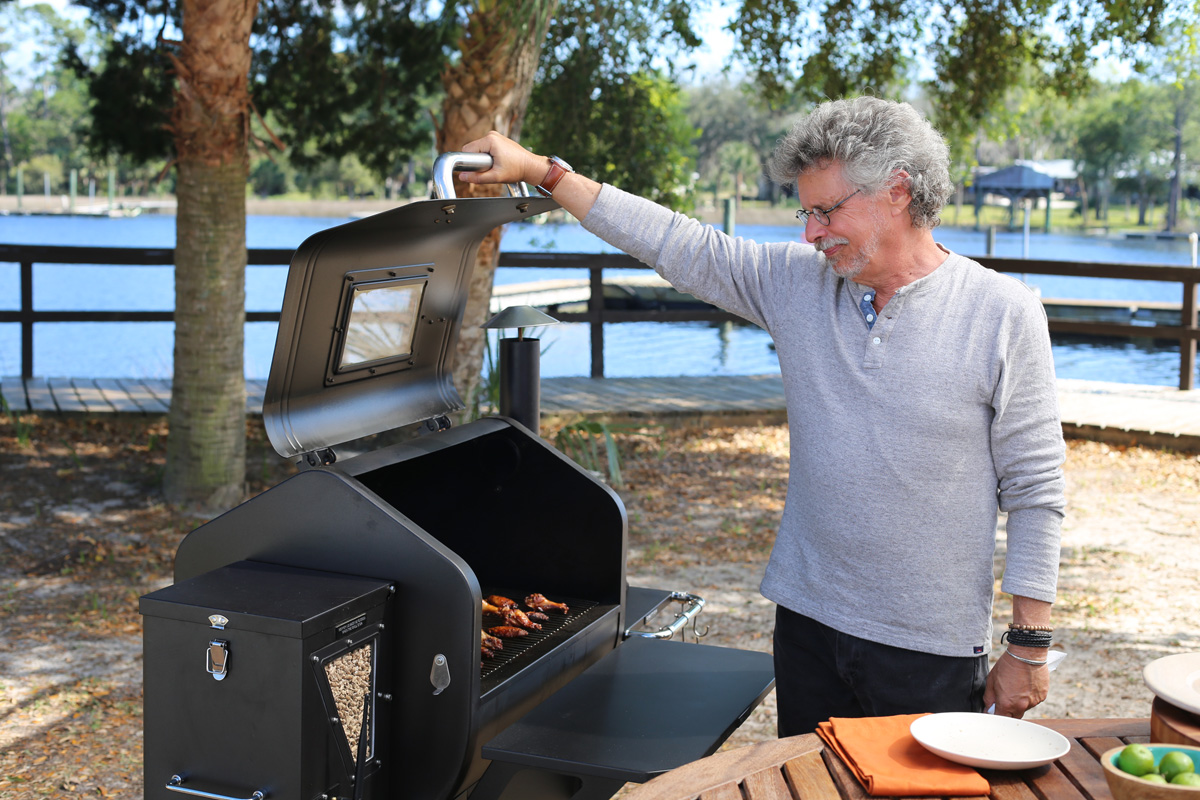
Raichlen targets 375-425°F (400°F ideal) and pulls salmon at 125-130°F for moist center, 135-140°F for firmer. Start skin-side down on scrupulously clean, oiled grates and don't move the fish until it releases on its own. Sugary glazes come at the end, never the beginning, and thin tail sections are pulled before thick centers — treating the fillet as one piece is the rookie error.
- 02
 Meathead GoldwynAmazingRibs
Meathead measured cedar planks before and after a 24-hour soak and found the water gained never turns to steam under the fish — the wood insulates too well and the fish stays too cold. Planking looks great but delivers almost no smoke flavor and no sear. His verdict: cedar planks keep salmon from sticking and look impressive, but if you want real flavor, hit it on hot oiled grates and skip the theater.
- 03
 Mad Scientist BBQChannel / YouTube
Jeremy Yoder walks through curing salmon before hot-smoking it — the technique that turns a fillet from grilled-fish into something closer to a smoked deli centerpiece. Useful counterpoint to the fast-and-hot grilled approach.
- 04
 Chud's BBQChannel / YouTube
Bradley Robinson cooks a salmon fillet over charcoal — the direct-heat counterpart to the cured-and-smoked approach. Watch the grate prep and the timing of the flip; that's where most home cooks lose their fish.
Cook it. Save the record.
Every cook gets a permanent entry — cut, fuel, temp, time, photo, what worked. Next time you want to nail that exact crust, you'll have the receipt.