
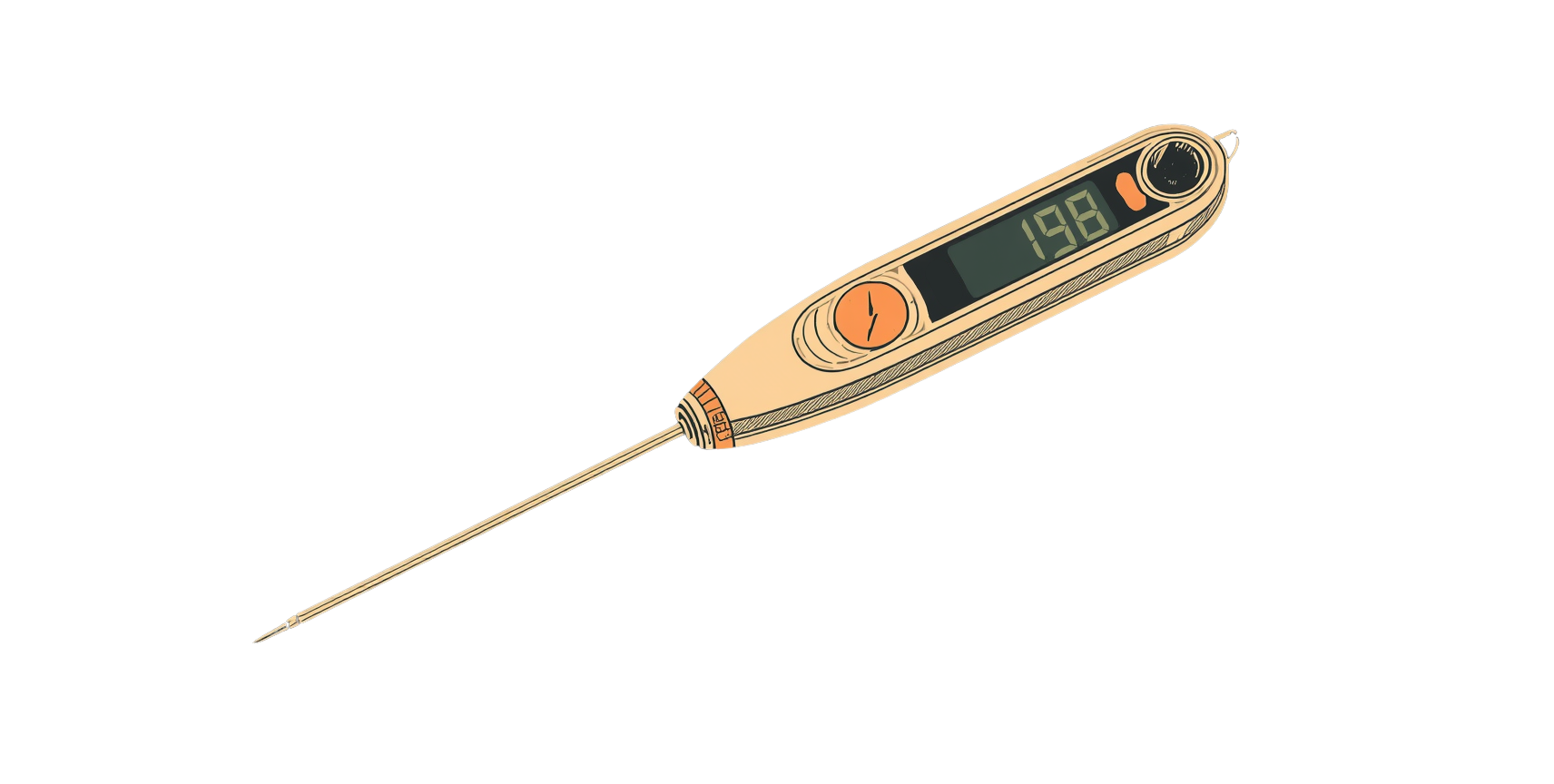
Instant-Read Thermometer
An instant-read thermometer is a handheld probe with a fast, accurate digital readout that lets you check the internal temperature of meat in a second or two — the spot-check tool every serious cook reaches for over a finger-poke or a timer. The category is dominated by the ThermoWorks Thermapen ONE, the unit AmazingRibs has used as the benchmark across more than 200 thermometers tested, and that reverse sear, low-and-slow, and hot-and-fast cooks all depend on. Three specs matter: speed (a quality unit stabilizes in 1–2 seconds so you can probe several spots before the lid is open long), accuracy (good thermometers run within ±0.5°F; cheap ones drift ±2–3°F), and waterproofing (cheap units flood at the sink and die young). It is the one tool almost every BBQ writer working today calls non-negotiable.
- Accuracy
- ±0.5–1°F (good) · ±2–3°F (budget)
- Speed
- 1–2 seconds (good) · 5–10 seconds (cheap)
- Probe
- Single fold-out or fixed needle-tip
- Price
- ~$15 generic · ~$30 Thermopop · ~$100 Thermapen ONE
- Best at
- Spot-checking doneness anywhere on the grate
- Benchmark
- ThermoWorks Thermapen ONE (AmazingRibs Platinum Medal)
What it is
An instant-read thermometer is a battery-powered handheld probe with a thin metal needle and a digital display that reads the internal temperature of food in roughly a second. You poke, you read, you pull it out. It's not a leave-in cable probe and it's not the dial gauge in the lid of your grill — it's the spot-check tool you bring to the grate when you need to know exactly what's going on inside the meat right now.
The category is defined by ThermoWorks' Thermapen ONE — a roughly $100 fold-out-probe unit that AmazingRibs has anointed its Platinum Medal benchmark and that nearly every serious BBQ writer working today owns. ThermoWorks' own Thermopop sits a tier below at around $30, slower and less waterproof but accurate enough for almost everyone. Below that, generic $15 units from Amazon are cheap, slow, and prone to drift — usable, but not the ones working cooks reach for.
How it works
The needle tip houses a thermistor or a thermocouple — a tiny temperature sensor whose electrical resistance changes with heat. The unit reads that change, converts it to a temperature, and shows the number on the display. The thinner the tip and the more responsive the sensor, the faster the reading settles.
Three numbers separate a great instant-read from a usable one:
Speed — how fast the reading stops climbing and settles on the real internal temperature. A Thermapen ONE locks in within a second or two, fast enough to probe three or four spots on a brisket before the lid's been open long. Cheap units take five to ten seconds, which is plenty of time to wash heat out of the cooker. Accuracy — how close the displayed number is to the actual temperature. Good thermometers stay within ±0.5°F; budget units can drift two or three degrees, which is the difference between a medium-rare steak and an overcooked one. Waterproofing — whether the unit survives a soapy sponge. Cheap units flood at the sink, the display goes hazy, and the tool dies young; an IP67-rated body is the marker for one that'll last.
Using it
Probe the thickest part of the meat, away from bone (bone conducts heat faster than muscle and reads high) and away from fat seams (which render at a different rate). Push the tip past the surface into the center, wait a beat for the number to stop climbing, then read. On steaks and chops, come in from the side along the long axis so the probe sits in the geometric middle.
Steaks, chops, burgers
Probe from the side into the center. Pull 10–15°F shy of your target finish temperature to leave room for carryover during the rest. The whole point of an instant-read is catching these short cooks before they tip over — 5°F is the difference between medium-rare and gray.
Poultry
Probe the thickest part of the breast and the deepest part of the thigh, both well clear of bone. Breast is done at 157–160°F (pasteurization holds at that temperature for long enough on a roasted bird); thighs want 175–185°F for tender, rendered dark meat.
Brisket, pork shoulder, big cuts
Probe in three or four spots across the cut, not just one. A big cut finishes unevenly, and on low-and-slow cooks the right answer is “probe-tender everywhere” in the 200–205°F range, not a single magic number.
An instant-read is for spot-checks; a leave-in cable probe is for monitoring temperature over hours without opening the lid. Serious cooks own both — the leave-in tracks the cook, the instant-read confirms doneness at multiple points when you think you're close. Neither replaces the other.
Where it earns its keep
The instant-read is the single tool that closes the loop between “I think it's done” and “I know it's done.” A steak is a five-degree window between pink and gray; a chicken breast is a ten-degree window between juicy and chalky; a brisket is fork-tender at one spot and still tight at another. A fast, accurate probe makes those calls for you in a second, and over a year of cooks it pays for itself many times over in meat you didn't ruin.
It also earns its keep on short, fussy cooks where a cable probe is overkill — a reverse sear, a quick hot-and-fast chicken, a rack of pork chops — and as the confirmation probe at the end of a long smoke when the cable probe says you're in range and you want to spot check three more places before pulling. Across the AmazingRibs database of 200+ thermometers tested, the Thermapen ONE remains the unit every other model is measured against.
Where it falls short
The instant-read is a spot-check tool, not a monitoring tool. Its limits are about scope, not quality:
Doesn't watch the cook for you
You have to open the lid and probe to get a reading. On a 12-hour brisket cook that costs you heat every check. Pair it with a leave-in cable probe at grate level for the long haul; use the instant-read only near the finish line.
Cheap units lie
A $15 generic that reads three degrees high will tell you a chicken breast is done at 162°F when it's really at 159°F — or worse, the other way. Speed and accuracy are the whole value proposition; if you cut them, you don't have an instant-read, you have a guess with a screen.
Battery dies at the worst moment
An instant-read with a dead battery is a useless piece of plastic. Keep a spare in the grill kit; the Thermapen ONE's shorter battery life vs. the older Mk4 is the one nit even fans bring up.
Not a probe-thermometer for big cuts
A whole turkey or a pork shoulder has multiple finishing points; a single spot-check from an instant-read is one data point, not a verdict. Probe several places, or run a leave-in alongside it for a trend line.
What goes wrong.
Probing against the bone
Bone conducts heat faster than muscle and reads high — a chicken breast that registers 165°F at the bone is often still raw in the meat next to it. Push the probe into the thickest meat, well clear of bone, and take the reading from there.
Pulling at target instead of carryover
Big cuts keep climbing 5–10°F after they leave the heat. Pull a steak at 125°F for a medium-rare finish around 130°F, not at 130°F on the grate — otherwise it overshoots during the rest. Critical on a reverse sear, where the meat is already at finish temperature before the sear adds another few degrees.
Single-point reading on a big cut
One probe in one spot doesn't tell you a brisket is done. Big cuts finish unevenly — probe three or four places across the cook, and trust the slowest one. Probe-tender everywhere in the 200–205°F range is the actual signal.
Drowning a non-waterproof unit
Cheap thermometers aren't sealed. A trip through the sink with the soapy sponge floods the display, and the unit dies. Wipe with a damp cloth and store dry; if you want sink-safe, buy IP67-rated (the Thermapen ONE is).
Trusting the lid dial instead
Every grill lid has a dial thermometer measuring the air high in the dome — often 25–50°F off from the temperature down at the grate where the food sits. An instant-read at grate level (or a leave-in clipped to the grate) is the only honest read on what the cook is doing.
What each of them says.
4 of the people we trust have covered this. Read or watch each in their own words.
- 01
 Meathead GoldwynAmazingRibs.com
Meathead's buying guide treats the instant-read as the single most important tool a griller owns — "forget old chef's tales of visual inspection or prodding with a finger; there are too many variables." He ranks speed first (a quality unit stabilizes in a second or two so you can find the coldest spot as the probe glides through), accuracy second (all but the cheapest are within a degree or two), and waterproofing third — cheap units flood the moment they hit a sink and die young. AmazingRibs has lab-tested 200+ thermometers; the Thermapen ONE is the Platinum Medal benchmark every other model gets measured against.
- 02
 Steven RaichlenBarbecue Bible
Raichlen calls the Thermapen the industry standard and frames the cost-of-entry argument plainly: "certainly cheaper than a ruined 7-bone prime rib." Highly accurate within 0.7°F in three seconds, backlit position-sensitive display, motion-sensing battery — for him this is the essential gadget every griller's toolbox needs, even at the premium price.
- 03
 Susie BullochHey Grill Hey
Bulloch's top pick across her best-meat-thermometers roundup is the Thermapen ONE — "the meat thermometer I always have on standby." She singles out the one-second read, the fold-away probe, and the accuracy as worth the premium, and uses it as her default on every recipe from steaks to whole-bird turkeys. The shorter battery life vs. the old Mk4 is her only nit.
- 04
 Mad Scientist BBQMad Scientist BBQ / YouTube
Jeremy Yoder's canonical kit-essentials run-down — the digital instant-read sits high on his Top 10 list of gear he actually reaches for every cook, alongside leave-in probes and a few other staples. Useful for putting the instant-read in context of the broader BBQ toolkit rather than as a standalone review.
Cook it. Save the record.
Every cook gets a permanent entry — cut, fuel, temp, time, photo, what worked. Next time you want to nail that exact crust, you'll have the receipt.