
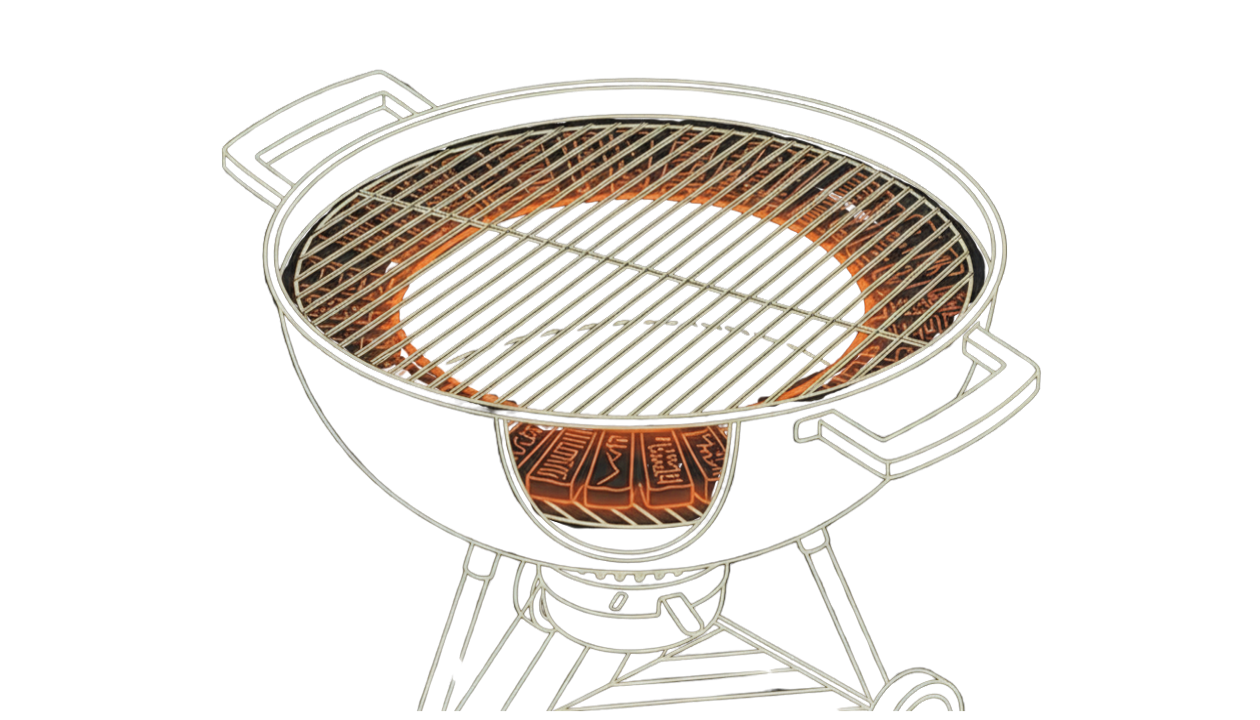
Snake Method
The snake method is a charcoal arrangement: unlit briquettes laid in a long arc around the perimeter of a kettle grill, two or three rows deep, lit at one end with a small chimney of hot coals. The fire creeps slowly around the snake, lighting the next coals as it goes. The result is 8-12 hours of steady low-and-slow heat on a Weber Kettle or similar — long enough to take a brisket from start to finish, or to push through the stall on a pork shoulder without intervention. Same two-zone idea as a standard banked-coal setup, but extended in time: the food sits on the cool side opposite the snake, the fire is always elsewhere. The technique emerged on home-BBQ forums in the early 2010s as an evolution of Jim Minion's earlier method for the Weber Smokey Mountain, and is now the canonical way to do low-and-slow on a kettle without specialty equipment.
- Arrangement
- C-shape, 2/3 to 3/4 around the perimeter, 2 rows of briquettes deep
- Ignition
- 8-12 lit coals from a small chimney, dropped on one end
- Wood
- Chunks tucked into the snake at intervals for sustained smoke
- Target temp
- 225–275°F (4 lit coals run cooler, 8 lit run hotter)
- Burn time
- 8-12 hours on a 22" Weber Kettle
- Best for
- Long unattended cooks — brisket, pork butt, ribs
Before you cook.
- Equipment
- Weber Kettle (22" canonical), chimney starter, wood chunks, instant-read or probe thermometer
- Fuel
- Briquettes only — lump charcoal is too irregular to chain-ignite reliably. B&B burns longer than Kingsford.
- Setup order
- Open all vents → arrange 2-row C-shape (2/3 around grate) → tuck wood chunks across the snake → light 8-12 coals in a chimney → dump on one end → close lid → set vents
- Water pan
- Optional aluminum pan with hot water in the center on the cool side. Adds humidity, dampens temp spikes, catches drippings.
What to cook with it.
Other ways to do it.
Double-stack snake
Two rows of briquettes instead of one (some pitmasters go three). Standard for 8-10 hour cooks; gives the longest hold. Single-row snakes are faster to set up but burn through in 4-5 hours.
C-shape vs U-shape vs full ring
Geometry choices. C-shape (3/4 around, opening on the food side) is the canonical setup. U-shape leaves a wider opening for a water pan in the center. Full ring is for the longest possible cooks but requires careful setup to avoid the snake closing on itself prematurely.
Light-both-ends (converging snake)
Light both ends of the snake at the same time and let them burn toward each other in the middle. Cuts cook time roughly in half. Useful when you started late or want to compress an 8-hour cook into 4.
Snake + Vortex / heat shield
Place a Vortex or inverted aluminum pan in the center of the cool side as a deflector. Smooths out hot spots, especially on a 22" Weber where the snake can radiate too directly under the food on the closest side.
What goes wrong.
Snake chains too fast
Too many lit coals, vents too open, or hot ambient weather. Result: a 4-hour burn instead of 10. Tighten the bottom vent partly, cap the top at ~50%, and start with fewer lit coals (4-6 instead of 12) on hot days.
Snake won't keep chaining (fire stalls mid-way)
Gap in the coal arrangement, wet briquettes, or vent too closed. The unlit coal next to the lit one has to actually touch. Rearrange so every briquette nudges the next, check briquette dryness, open the bottom vent fully to feed the fire.
Wrong charcoal
Lump charcoal is irregularly shaped and the snake breaks at random spots — the chain-ignition needs the consistent shape of briquettes. Use briquettes only; lump is fine for hot-fast cooks but not for snake setups.
Wood placement wrong
Big concentrated chunks choke the fire and produce thick acrid smoke. Spread small chunks across the snake at intervals (every 8-12 briquettes) for steady thin smoke that's actually pleasant. Soaked wood does nothing useful — chunks burn dry.
Forgot the water pan
Temp spikes are sharper without it. On long cooks (8+ hours), the buffering matters. An aluminum pan with hot water in the center on the cool side adds humidity and smooths the temperature curve.
What each of them says.
4 of the people we trust have covered this. Read or watch each in their own words.
- 01
 Steven RaichlenBarbecue Bible
The snake method's biggest variable is how many lit coals you use to start it. In testing, 4 lit coals climbed slowly but held a tight 200°F; 8 lit coals climbed faster but peaked at 290°F. Bias toward the slow start if you want a steady low temperature — the smoother hold is worth the extra ramp-up time.
- 02
 Susie BullochHey Grill, Hey
Arrange unlit briquettes in a 2-layer snake around the exterior of the charcoal chamber, light a small chimney of 10-12 briquettes, drop them on one end. Two layers hold 225–275°F. Airflow is the control lever — keep vents low to keep temperature down and the chain-ignition slow.
- 03
 Mad Scientist BBQYouTube — Jeremy Yoder
Jeremy tests snake method head-to-head against the Slow 'N Sear insert using identical kettles, charcoal weights, and thermostatic controllers. Peak Mad Scientist content — chemistry-teacher rigor applied to a backyard question.
- 04
 Chud's BBQYouTube — Bradley Robinson
Bradley applies the snake method to a full brisket cook on a Weber Kettle. End-to-end demonstration at backyard pace — no specialty equipment, no thermostatic controller.
Cook it. Save the record.
Every cook gets a permanent entry — cut, fuel, temp, time, photo, what worked. Next time you want to nail that exact crust, you'll have the receipt.