
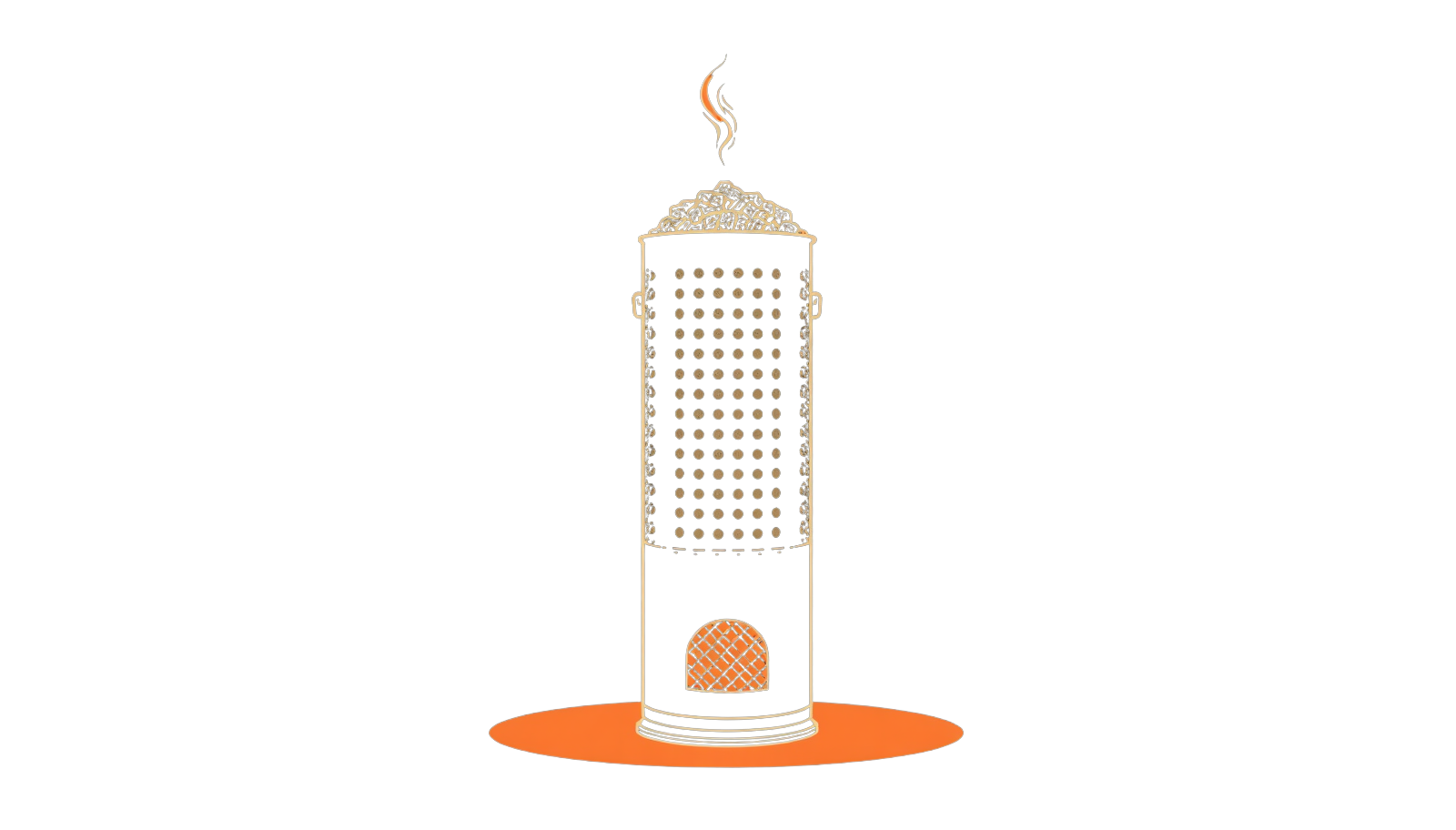
Chimney Starter
A chimney starter is a metal cylinder with a wire rack inside and a handle on the side — fill the top with charcoal, stuff crumpled newspaper or a fire-starter cube under the bottom, light the paper, and 15–20 minutes later the whole load is glowing and ashed over, ready to dump into the grill. The whole point is to skip lighter fluid, whose petroleum residue taints the smoke and lingers in the meat. Weber sells the iconic one and the category barely moves — Meathead Goldwyn's verdict on AmazingRibs is that there’s no reason to look further. The canonical lighting move for every kettle, kamado, and vertical smoker cook, and a quiet fire-size measuring cup once you know it: half a chimney targets 225°F, three-quarters to full hits 325°F+.
- Material
- Galvanized or aluminized steel cylinder with wire rack and heatproof handle
- Sizes
- Standard ~7.5" Weber (~80-briquette capacity) · Compact (~half-load) for smaller cooks
- Price
- ~$20–40 for a Weber; cheap knockoffs $10–15
- Best at
- Lighting charcoal cleanly with paper or a cube — no lighter fluid
- Time to coals
- 15–20 minutes from match to ashed-over
- Care
- Empty hot coals into the grill, then let it cool — that's the entire maintenance
What it is
A chimney starter is a tall metal cylinder — usually galvanized or aluminized steel — with a perforated metal grate set partway up the inside and a heatproof handle riveted to one side. Charcoal goes on top of the grate; crumpled newspaper or a fire-starter cube goes in the chamber below; light the paper and the rising heat ignites the bottom of the charcoal pile, the fire pulls air up through the perforations, and the column of coals lights itself top to bottom by convection.
The Weber Rapidfire Chimney Starter is the canonical one — ~7.5 inches across, a standard ~80-briquette capacity, and the model every BBQ writer benchmarks against. Compact versions hold roughly half a load for smaller kettles and weeknight cooks; off-brand knockoffs cost less but go through handles faster. Either way, the design has barely changed in decades because it didn’t need to.
How it works
A chimney works on the same draft principle as a wood-stove flue. Hot air rises, so the small flame from a sheet of newspaper or a paraffin cube under the grate pulls cold air in through the bottom perforations, heats it as it climbs past the charcoal, and exits the top. That convection current bathes the underside of the coals in flame and the upper coals in superheated air, lighting the column uniformly without ever touching most of it with the original match.
The signal you’re ready is visual. After 10–20 minutes the top of the load goes gray-white with ash, and the coals at the bottom glow ember-orange when you peek up from underneath. That ashed-over gray layer is the cue to dump — lump tends to be ready closer to the 10-minute mark, briquettes closer to 20. Pour the lit coals into the grill in whatever configuration the cook calls for (single-zone, two-zone, banked under a snake), set the empty chimney on a brick or concrete pad to cool, and the cook is on the clock.
The other use that quietly emerges with experience: a chimney is a measuring cup for fire size. Half a chimney banked to one side of a kettle holds about 225°F for low and slow; three-quarters to a full chimney runs 325°F+ for roasting and direct grilling. Once you internalize the load → temp relationship on your rig, fire sizing stops being a guess.
Setting it up
Three approaches cover the field; all three skip lighter fluid entirely.
Newspaper
Two or three sheets crumpled loosely — not packed tight, the fire needs airflow through the wads — stuffed into the bottom chamber. Free, abundant, and the original method. Light through the side holes with a long match or lighter. Works best when the paper is dry; damp newspaper is the most common cause of a chimney that fails to take.
Paraffin or wax cubes
One or two compressed wax-and-sawdust cubes (Weber lighter cubes, Royal Oak Tumbleweeds, generic fire-starter squares) set under the grate. They light with a match, burn 8–12 minutes with a clean flame, leave no ash, and tolerate wind and damp far better than newspaper. The reliable default once you buy a bag.
Electric loop / Looftlighter
An alternative to the chimney rather than a filler for it: an electric loop heating element buried in the coal bed, or a Looftlighter blowing superheated air into the pile. No paper, no cubes, no smoke. Slower than a chimney to fully light a load, and it needs an outdoor outlet, but it’s the cleanest start when you have power at the grill.
Meathead’s signature trick: balance a cooking grate directly on top of a fully-lit chimney and sear a steak straight over the open column. The unrestricted updraft hits 900°F+ at the grate — steakhouse-infrared territory on a kettle. Short, blistering, one cook at a time.
Where it earns its keep
The chimney is the cleanest fast path from cold charcoal to cooking coals, and the case for it is mostly about what it avoids.
No lighter-fluid taint
Petroleum-based lighter fluids burn incompletely and deposit a chemical aftertaste in the smoke; readers and writers across the trade describe it as the single fastest way to ruin an otherwise good cook. A chimney eliminates the question.
Even, predictable light
The whole load ashes over together rather than partial patches glowing while other coals stay raw — so when you dump, you’re working with a uniform fire instead of a hot spot surrounded by smoldering offgas.
Fire-size measuring cup
Half-chimney for 225°F, full chimney for 325°F+. Once you’ve cooked on the same rig enough times to calibrate, you stop guessing how much charcoal to load for a target.
Mid-cook fresh coals
On a long cook that needs a refuel, light fresh coals in the chimney off to the side, then add them already-glowing to the existing bed — no cold briquettes choking the fire, no white acrid offgas drifting onto the food.
Where it falls short
The chimney’s simplicity is mostly an advantage, but there are honest limits.
15–20 minute wait
Not slow in absolute terms, but it’s a hard floor — you can’t shortcut it. Plan the chimney light into your prep so the coals are ready when the food is, not the other way around.
Wind and weather sensitive
A strong gust can blow out the paper before it lights the coals; cold and damp slow the climb. Wax cubes tolerate weather better than newspaper, but the chimney is still a draft-fed open column.
Hot metal to handle
The chimney’s body runs 400°F+ when the coals are ready; the handle stays cool but the cylinder does not. Have a safe heatproof pad to set it on after the dump, and never set a hot chimney on a wood deck or dry grass.
Handles wear out on cheap models
Bargain chimneys use plastic-cored handles that crack and rivets that loosen after a season. Weber’s Rapidfire is the bench mark because the heatshield and handle hold up to years of dumps; the modest premium is the easiest one to justify in the whole kit.
What goes wrong.
Reaching for lighter fluid
The petroleum residue burns into the smoke and ends up in the meat — a chemical aftertaste that no rub or sauce hides. Newspaper or a wax cube under the chimney lights a full load in 15–20 minutes; there's no good reason to use accelerant on charcoal you're going to cook over.
Packing the paper too tight
Crammed-flat newspaper smothers its own flame before the coals catch — the chimney smokes, then dies. Crumple loose wads so air can pull through the chamber. Wax cubes don't have this failure mode, which is part of why they've become the default.
Dumping coals before they're ashed over
Coals dumped half-lit keep burning off raw smoke for another 10 minutes after they hit the grate, fouling whatever you put on. Wait for the visible gray-ash top layer with red glow underneath. Lump is usually ready around 10 minutes; briquettes closer to 20.
Adding cold briquettes mid-cook
Dropping unlit coals onto a hot bed kills the temperature and releases acrid white offgas as the new coals start cooking. Light the refuel in the chimney first, then add the fresh coals already glowing — or run the snake method so cold coals light gradually from the front.
Setting the hot chimney down on something flammable
The cylinder runs 400°F+ when you dump. A wood deck, a dry-grass patch, or a plastic table will scorch or worse. Have a brick, a concrete pad, or the lid of the grill staged as the landing zone before you light the paper.
What each of them says.
4 of the people we trust have covered this. Read or watch each in their own words.
- 01
 Meathead GoldwynAmazingRibs.com
Meathead's verdict — "there is no reason to look any further than the Weber charcoal chimney" — anchors a 5-star Platinum Medal review built on durability, ~80-briquette capacity, and elimination of lighter-fluid taint. He treats the chimney as the canonical lighting tool AND a measuring cup for fire size (half a chimney targets 225°F, three-quarters to full hits 325°F). The Afterburner Method — using a lit chimney with a grate on top for steakhouse-sear temperatures — is his signature trick.
- 02
 Steven RaichlenBarbecue Bible
Raichlen's standing recommendation: crumpled newspaper or paraffin fire starter in the bottom chamber, charcoal in the top, lit through the perforations. Ready in 15-20 minutes. He frames the choice in flavor terms — chimneys "eliminate the need for petroleum-based lighter fluid," whose incomplete combustion can leave a petroleum aftertaste. Acknowledges electric starters as a viable alternative for kamados but notes they're slower than a chimney.
- 03
 Susie BullochHey Grill Hey
"A charcoal chimney is my first choice and top recommendation for lighting your charcoal." Susie's family-table teaching frames the 10-15 minute wait as "comparable to preheating an oven" — multitask while it heats. She skips lighter fluid entirely in favor of wax-coated wood shreds (tumbleweeds) or fire starter cubes that burn clean without ash residue. The ready signal: red glow visible under a gray-ash top layer.
- 04
 Chud's BBQBradley Robinson / YouTube
Bradley Robinson's full Weber Kettle walkthrough — assembly, lighting with a chimney, and a first steak cook. The chimney sequence shows the canonical setup (fire starter under, lump charcoal on top, 15-20 minute light) in a real backyard pace. Useful to see the timing and ash-over visual cue play out in real-time on the iconic kettle.
Cook it. Save the record.
Every cook gets a permanent entry — cut, fuel, temp, time, photo, what worked. Next time you want to nail that exact crust, you'll have the receipt.