
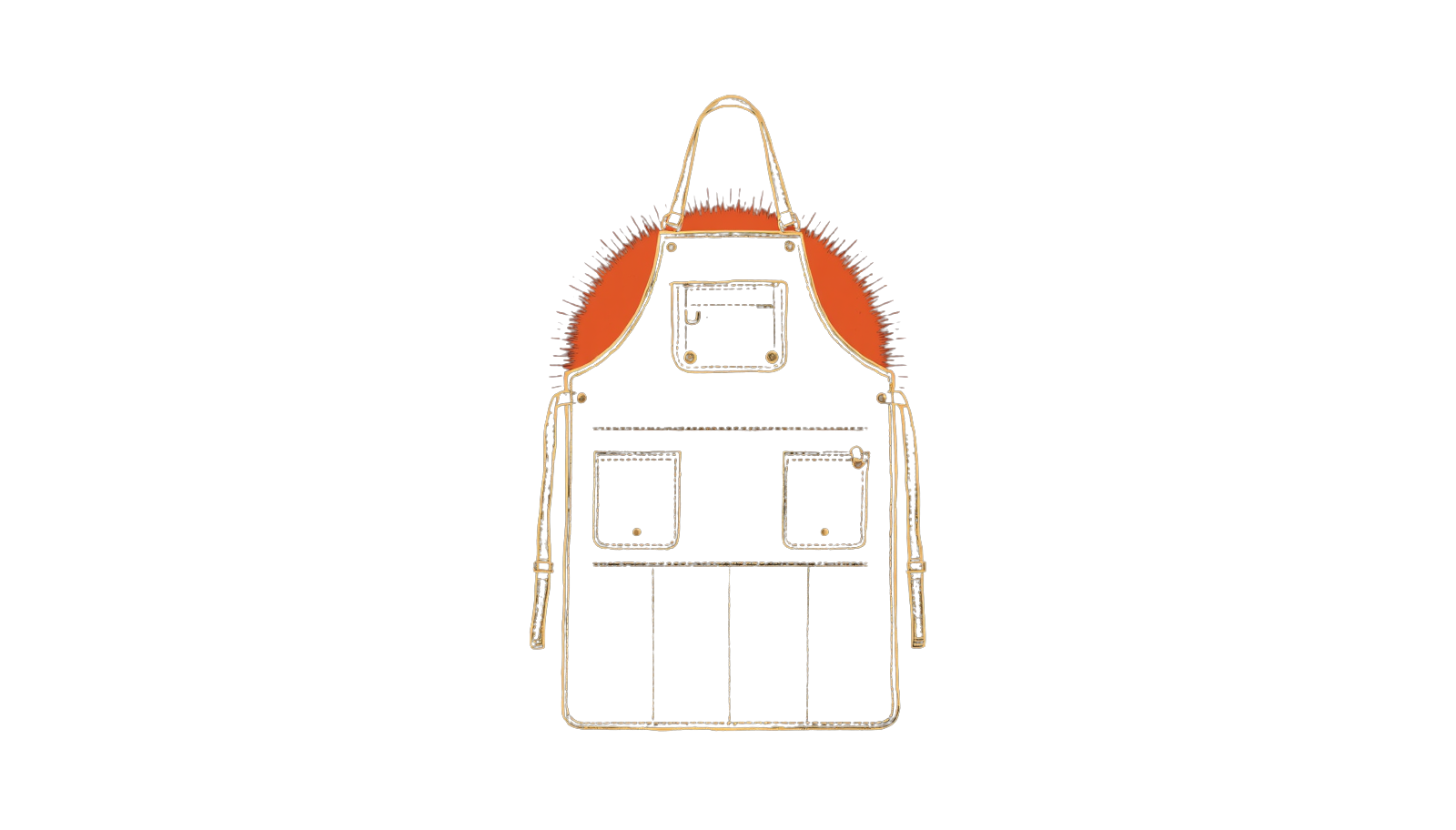
Apron
The apron is the pit cook’s working layer — heat and grease protection across the chest and lap, with pockets for the tools that need to live within arm’s reach. Heavy canvas is the most common shell, durable and cheap; waxed canvas adds water and grease resistance; full-grain leather is the premium option that handles direct radiant heat off an open fire better than any fabric. The features that matter are the same across materials: a bib that actually reaches the collarbone, an adjustable neck strap that doesn’t torque the spine, a tie-back waist (cross- back straps are easier on the shoulders), and pockets sized for an instant-read thermometer, a lighter, and a pair of nitrile gloves. Towel loops earn their keep over an offset smoker where you’re wiping hands constantly. Aaron Franklin’s leather bib is the iconic Texas-pit version — the apron Daniel Vaughn has spent two decades writing into the visual shorthand for the trade.
- Materials
- Heavy canvas (durable, cheap) · Waxed canvas (water/grease resistant) · Full-grain leather (premium, blocks radiant heat)
- Length
- Bib (chest-to-thigh, standard) · Waist (lap-only, light grill work)
- Features that matter
- Adjustable neck strap · Waist tie-back · Tool pockets · Towel loop
- Price
- $25–50 canvas · $50–100 waxed canvas · $100–250 leather
- Canonical pick
- Franklin Barbecue leather apron · Mad Scientist BBQ Amish-made leather · Chud’s cotton-and-leather signature
- Care
- Canvas: machine-wash cold, hang-dry · Waxed canvas: wipe, re-wax annually · Leather: wipe only, condition occasionally, never wash
What it is
An apron is a fabric or leather barrier worn over the front of the body to block heat, grease, sparks, and juice from the cook’s clothes and skin. The backyard-grill version is recreational; the pit-cook version is working gear. The two share a shape — a chest bib, a neck strap, a waist tie — but diverge hard on material, pocket layout, and how much abuse they expect to take.
Heavy canvas is the most common shell: 10–14 ounce cotton duck, tightly woven, machine-washable, and cheap enough to replace every couple of years. Hudson Durable Goods, Hedley & Bennett, and a wall of brand-merch versions all sit in this category. Canvas absorbs grease and juice rather than shedding it, which means it stains fast and needs regular washing.
Waxed canvas is the same fabric impregnated with a wax-and-oil finish that turns it water-and-grease-resistant. Spills bead and roll off instead of soaking in. The wax wears with use and needs a re-coat every year or two. Holds the creases from the day’s cook — the visible patina serious cooks earn.
Full-grain leather is the premium option and the pit-cook standard. The dense fiber matrix blocks direct radiant heat off an open firebox in a way no fabric can match, and it doesn’t ignite, melt, or scorch under sparks that would burn through canvas. Aaron Franklin’s shop-made leather bib is the iconic example; Jeremy Yoder (Mad Scientist BBQ) sells an Amish-made full-grain version; Bradley Robinson (Chud’s) builds a cotton-and-leather hybrid with the pocket layout of a working pitmaster. None of these are machine-washable. Wipe, condition, never soak.
Synthetic blends — poly-cotton twills, ripstop nylon, neoprene hybrids — sit at the bottom of the stack. Lighter, cheaper, machine-washable, and easier to find on a restaurant supply shelf. They give up heat resistance and visible character for convenience. Fine for a gas-grill weeknight; out of their depth at an open fire.
How it works
An apron does three jobs at once: blocks radiant and splash heat off the cooking surface, catches grease and juice before they hit clothes, and carries the tools the cook reaches for most often. Each job pulls on a different property of the material, which is why no single apron is great at all three.
Heat blocking is a function of fiber density and thickness. Leather and heavy canvas slow radiant heat by being poor conductors; the trapped air in the weave (or the dense tannin-bound fiber matrix in leather) is the actual insulator. Lighter synthetics conduct heat faster and soften under sustained radiant load — fine for brief stints at a gas grill, marginal over an open fire or an offset firebox you’re feeding every twenty minutes.
Grease and juice shedding is mostly about surface finish. Waxed canvas and leather bead spills; plain canvas absorbs them. That’s a trade, not a flaw — plain canvas washes; waxed and leather don’t. The cook who spills constantly will pick differently than the cook who works clean.
Pocket layout is the apron’s least-glamorous feature and the one that actually changes how the cook moves. A chest pocket holds a phone or a notebook; waist-level pockets hold tongs handles, a lighter, a wax cube, and a pair of nitrile gloves; a dedicated hip pocket sized for a probe thermometer keeps the most-reached tool within thumb’s reach. Towel loops at the waist save the cook from chasing a wadded towel into the fire when hands need wiping.
The neck strap and waist tie sound trivial until they aren’t. A single neck loop torques the cervical spine over a long cook; cross-back straps that yoke the load across both shoulders are the upgrade the cook notices on hour eight, not hour one. A long waist tie that wraps front-to-back-to-front keeps the apron flat against the body instead of hanging off and getting in the way.
Setting it up
Pick by job, not by branding. Three setups cover almost every backyard and pit-cook scenario.
Backyard rig (heavy canvas bib)
10–14 ounce cotton duck, full chest bib, adjustable neck strap, two waist-level pockets, a towel loop. Cheap, machine-washable, replaceable. The right answer for a kettle or gas-grill cook where the apron is going to catch splatter, not radiant heat.
Long-cook rig (waxed canvas, cross-back)
Waxed canvas bib with cross-back yoke straps, a chest pocket for the phone, hip pockets for thermometer and tongs, towel loop. Sheds grease and spritz; the cross-back yoke saves the neck over a low-and-slow cook. Re-wax every year or two.
Pit rig (full-grain leather)
Full-grain leather bib, riveted seams, leather or webbing straps, brass hardware. Blocks radiant heat off an open firebox better than any fabric. The pitmaster’s working apron and the one every BBQ photographer reaches for. Wipe with a damp cloth, condition the leather once or twice a year, never wash.
The pocket layout the working pitmaster reaches for: chest pocket for the phone, two waist-level inlaid pockets for tongs handle and towel, a dedicated hip pocket sized for a probe thermometer, a towel loop at the waist. Bradley Robinson’s Chud’s apron is built to exactly this spec — the backyard-cook’s version of how a competition pit apron actually gets used.
Where it earns its keep
The apron isn’t about looking the part. It earns its keep in three specific places where bare clothes fall short.
Open-fire and offset work
Leather blocks radiant heat off an open firebox the way no fabric can. Sparks that would burn pinholes through a t-shirt bounce off leather without a mark. The longer the cook and the closer the cook stands to the fire, the more the material grade matters.
Long cooks with a moving cook
On a twelve-hour brisket cook, the cook is in and out of the pit constantly — spritzing, probing, wrapping, slicing. The right apron is a rolling tool belt: thermometer in the hip pocket, lighter and nitrile gloves at the waist, towel on the loop. Saves the trip back to the kitchen every fifteen minutes.
Grease and juice management
Pulling a 200°F pork butt, slicing a brisket on the board, lifting a tray of ribs — the apron catches what would otherwise end up on the shirt. Waxed canvas and leather shed; plain canvas absorbs and washes. Either is better than burning through clothes.
Identity at the pit
Daniel Vaughn opens his Texas Monthly profile of Tootsie Tomanetz with the act of tying on the apron — the moment the cook becomes the pitmaster. The bib is functional, but it’s also the visual shorthand for the trade. The apron is what you put on when you step up to the pit.
Where it falls short
The apron is a partial barrier, not full PPE. The limits show up in predictable places.
Arms and forearms are exposed
An apron covers the front of the torso and nothing else. The forearms reaching over a hot grate or a lit firebox still take direct radiant heat. Pair the apron with a long-sleeve cotton shirt for open-fire work, and keep a pair of elbow-length BBQ gloves staged for the fire-handling moves.
Leather and the laundry cycle
A leather apron that takes a season of grease can’t be machine-washed back to clean. The patina is part of the appeal, but for a cook who wants apron-fresh between sessions, canvas is the honest pick. Match the material to how often the cook wants to launder.
Single-neck-strap shoulder fatigue
A cheap apron uses one loop over the back of the neck for the entire chest load. Over an eight- hour cook that loop torques the cervical spine and leaves the cook stiff the next day. Cross- back yoke straps spread the load across both shoulders — the upgrade the cook notices late in the cook, not at the register.
Pockets that aren’t sized for the tools
A merch-table apron with two shallow patch pockets isn’t built for an instant-read thermometer that wants to ride probe-up. Look for a dedicated thermometer pocket, or accept that the tool will live on the cart instead of on the cook.
What goes wrong.
Buying for branding, not for fit
A brand-merch apron looks the part at the register and disappoints at hour six — short neck strap, shallow pockets, thin fabric. The apron that earns its keep over a long cook is the one with a cross-back yoke, a real thermometer pocket, and material rated for the heat source. Pick by spec, not by logo.
Leather in the washing machine
A full-grain leather apron is built to be wiped and conditioned, not laundered. Soaking it stiffens the leather, cracks the finish, and ruins the hardware. Wipe with a damp cloth after each cook, condition once or twice a year, and let the patina build — that's the point of the material.
Synthetic apron at an open fire
Poly-cotton blends and ripstop nylon soften and melt under sustained radiant heat. A spark that bounces off leather will burn a pinhole straight through synthetic fabric. Fine for a gas-grill weeknight; out of their depth at an open fire.
No towel loop
Over an offset cook the cook is wiping hands constantly — grease, spritz, juice. Without a towel loop at the waist the towel ends up wadded on the cart or, worse, draped over the firebox handle. A loop or a clip is fifty cents of construction and it changes how the cook moves.
Bib too short for the cook
A waist-only apron leaves the chest exposed to splatter from grates above belly height — pulling ribs off a top rack, lifting a tray from a vertical smoker. Default to a full chest bib that reaches the collarbone. Waist-only aprons are for line cooks at a flat-top, not pit cooks at a grate.
What each of them says.
3 of the people we trust have covered this. Read or watch each in their own words.
- 01
 Daniel VaughnTexas Monthly
Vaughn opens his Snow's BBQ profile of pitmaster Tootsie Tomanetz with the act of tying on the apron — the moment the cook becomes the pitmaster. The piece treats the apron as part of the pitmaster identity, not just protection: it's what you put on when you step up to the pit. Across two decades at Texas Monthly, the leather or canvas bib has become the visual shorthand for Texas pit culture.
- 02
 Mad Scientist BBQYouTube
Jeremy Yoder launches his Amish-made, full-grain leather apron — walks through why leather, the spacious pockets for tools and thermometer, and the adjustable straps. The clearest argument for why pitmasters who stand over open fire reach for leather over canvas.
- 03
 Chud's BBQYouTube
Bradley Robinson designed his cotton-and-leather signature apron with the backyard cook in mind: breast pocket for phone, two waist-level inlaid pockets for tools and towels, dedicated hip pocket for a probe thermometer. Hand-made in small batches in the USA. The working pitmaster's pocket layout, not the merch-table version.
Cook it. Save the record.
Every cook gets a permanent entry — cut, fuel, temp, time, photo, what worked. Next time you want to nail that exact crust, you'll have the receipt.