Open Fire
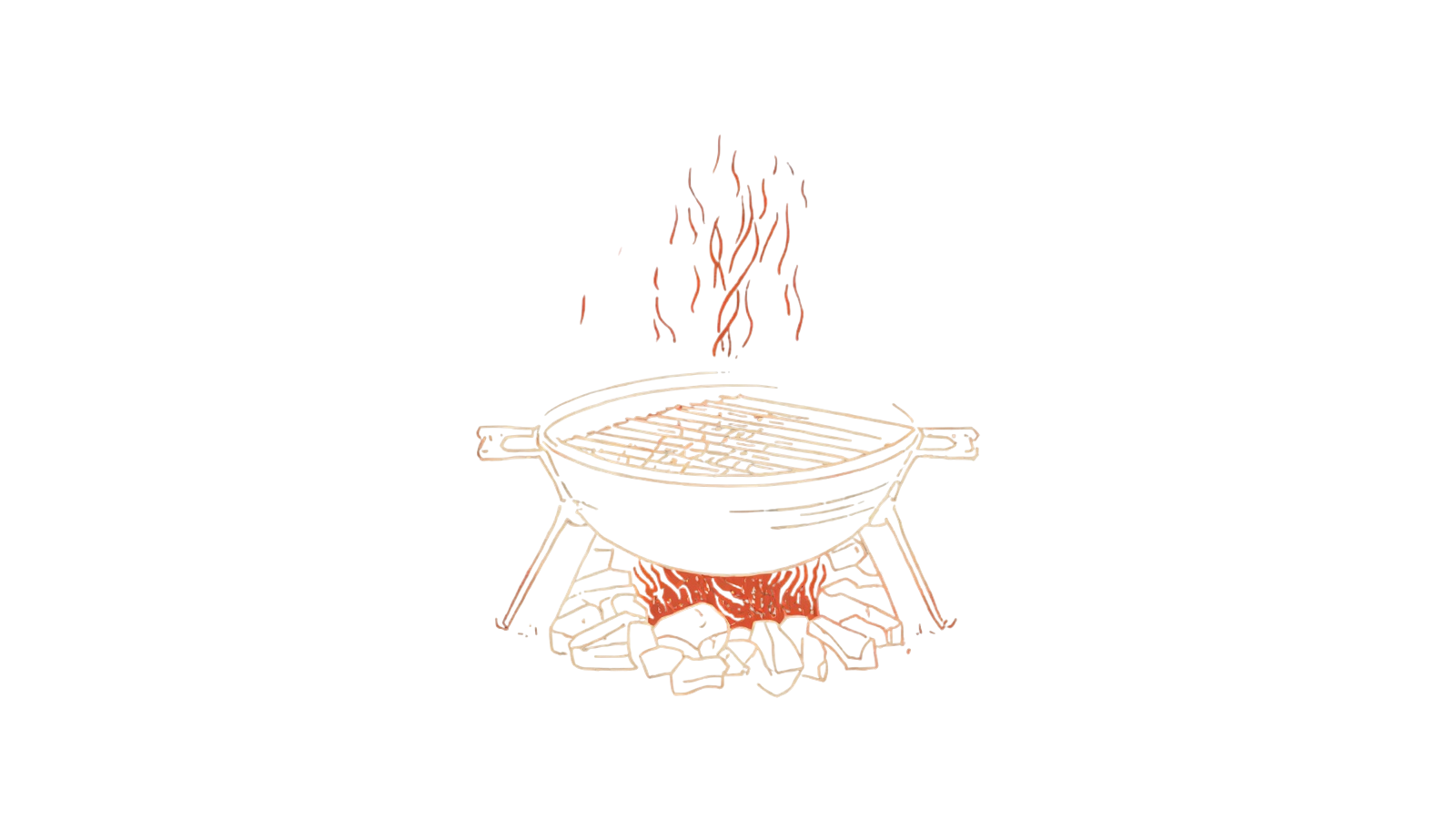
Open-fire cooking is the original: a live wood fire, a bed of coals, and as little iron as a grate or a spit between the fire and the food. It takes many forms — a grate over a fire pit, a California Santa Maria rig with a crank-raised grate, an Argentine parrilla, a Tuscan grill in a fireplace, or “caveman” style with the food laid right on the embers. You burn hardwood down to glowing coals (flames char and soot; the coals are the real heat) and control the cook by physics alone: grate height, how thick you rake the coals, and where you move the food. There's no vent and no thermostat, which makes it the most flavorful and the most skill-dependent way to cook there is — the live-fire craft Francis Mallmann built a following on and Steven Raichlen has spent a career teaching.
- Fuel
- Seasoned hardwood, burned down to coals
- The gear
- A grate, a spit, or nothing — minimal iron over fire
- Heat control
- Grate height, raking coals, moving the food
- Temp range
- Searing flame down to gentle ember edges
- Best at
- Flavor, spectacle, whole animals & fire-roasted vegetables
- Skill level
- Advanced — pure fire-reading, no dials
What it is
“Open fire” is the broad family of cooking on a live, uncovered wood fire with minimal equipment — the way people cooked for hundreds of thousands of years before there was a grill to buy. The common thread is a wood fire, a bed of coals, and at most a piece of iron between the fire and the food.
It shows up in many named forms: a simple grate over a fire pit; the California Santa Maria grill, whose grate cranks up and down over a bed of oak coals; the Argentine parrilla at the center of an asado; the Tuscan grill, a grate on legs set into a fireplace; the spit; and caveman cooking, where food is laid directly on the embers. Francis Mallmann is the method's modern icon, and Steven Raichlen its most prolific evangelist.
How the heat moves
An open fire cooks with radiant heat, almost all of it from coals rather than flames. You burn hardwood down to a bed of glowing embers before you cook over it — live flames lick the food with soot and acrid smoke, while a clean ember bed throws steady, even radiant heat. The fire is constantly changing, so the cook is never really done tending it.
Control is entirely physical. There are no vents and no lid; you manage heat by how high the grate sits above the coals, how thickly you rake the embers under one area versus another, and simply by moving the food. Banking the coals deep on one side and thin on the other is the original two-zone fire — every modern grill is just a more convenient version of it.
Setting it up
Build a hardwood fire and let it burn down — or run a separate burn pile or barrel and shovel coals to your cook area as you need them, the way an asador feeds a parrilla. Wait for a real bed of glowing, ashed-over coals before anything goes on; cooking too early, over flames, is the single most common mistake. Then set your grate height or rake the embers into a hot zone and a cool zone.
For caveman cooking, blow the loose ash off a bed of hardwood-lump coals and lay the steak straight onto them — the tight contact sears hard, and surprisingly little ash sticks. However you cook, keep the fire fed from a burn pile so the coal bed doesn't fade out halfway through, and keep a cooler patch open so you have somewhere to retreat when fat makes the fire flare.
Where it earns its keep
Flavor and occasion. Nothing matches the char and clean wood smoke of food cooked straight over a live fire, and the cook itself is the event — a whole-lamb asado, a fire-pit dinner, sweet peppers and onions buried right in the embers. It's endlessly versatile in a way no single machine is: a steak seared caveman-style, a side of salmon on a plank leaned toward the flames, a whole fish in a hinged basket.
It's also the root that every other cooker grows from. Learn to read coals and manage heat by hand over an open fire and every grill afterward feels easy — you already understand the thing the vents and dials are quietly doing for you.
Where it falls short
Control, or the lack of it. There's no dial and no thermostat: the heat is uneven, it flares when fat drips, and it shifts with the wind and the weather, so an open fire is the least repeatable and most skill-dependent way to cook. Two cooks over the same wood can turn out very differently.
And it's work. You build the fire, burn it down, tend it, and feed it for the length of the cook, and you need the space and the wood to do it safely. It's the wrong tool for a precise low-and-slow brisket or a hands-off weeknight dinner — reach for a smoker or a gas grill for those. Open fire is for when the cooking is the point.
What goes wrong.
Cooking over flames instead of coals
Open flames coat food in soot and acrid smoke and burn the outside before the inside cooks. Be patient: let the wood burn down to a bed of glowing, ashed-over embers, then cook over the coals — not the fire.
Too small a coal bed
A thin scatter of embers fades fast and leaves you with weak, dying heat mid-cook. Build a generous bed, and keep a separate burn pile going so you can shovel in fresh coals to hold the heat.
No way to escape the heat
A flat, even bed at a fixed height gives you nowhere to go when something cooks too fast or flares. Rake a hot zone and a cool zone, or use a grate you can raise and lower, so you can always move the food.
Flare-ups from dripping fat
Fat dripping onto open coals flames up and chars the food. Keep a cooler zone clear to move things to, go easy on fatty cuts directly over the hottest spot, and stay at the fire — this is not a walk-away cook.
Burning the wrong wood
Softwoods like pine, and any painted, stained, or pressure-treated lumber, throw resin, creosote, and toxic smoke. Burn only seasoned hardwood — oak, hickory, fruitwoods — that you'd be happy to taste in the food.
What each of them says.
2 of the people we trust have covered this. Read or watch each in their own words.
- 01
 Meathead GoldwynAmazingRibs.com
The key to cooking over a live wood fire is patience: burn the wood down to a bed of glowing embers before the food goes on, because too much flame and too much smoke both ruin it. You control the heat not with vents but by managing where the coals sit and how high the grate rides above them — standing over the fire and moving food between hotter and cooler spots. It's primitive and attention-intensive, and it delivers a smoky flavor, and a connection to cooking's roots, that nothing else quite does.
- 02
 Chud's BBQYouTube — Bradley Robinson
Live-fire cooking in its element: Bradley Robinson runs an open-fire meat-up — grates and iron over wood coals, no manufactured cooker in sight. A good look at how serious cooks actually build and work an open fire outdoors.
Cook it. Save the record.
Every cook gets a permanent entry — cut, fuel, temp, time, photo, what worked. Next time you want to nail that exact crust, you'll have the receipt.