
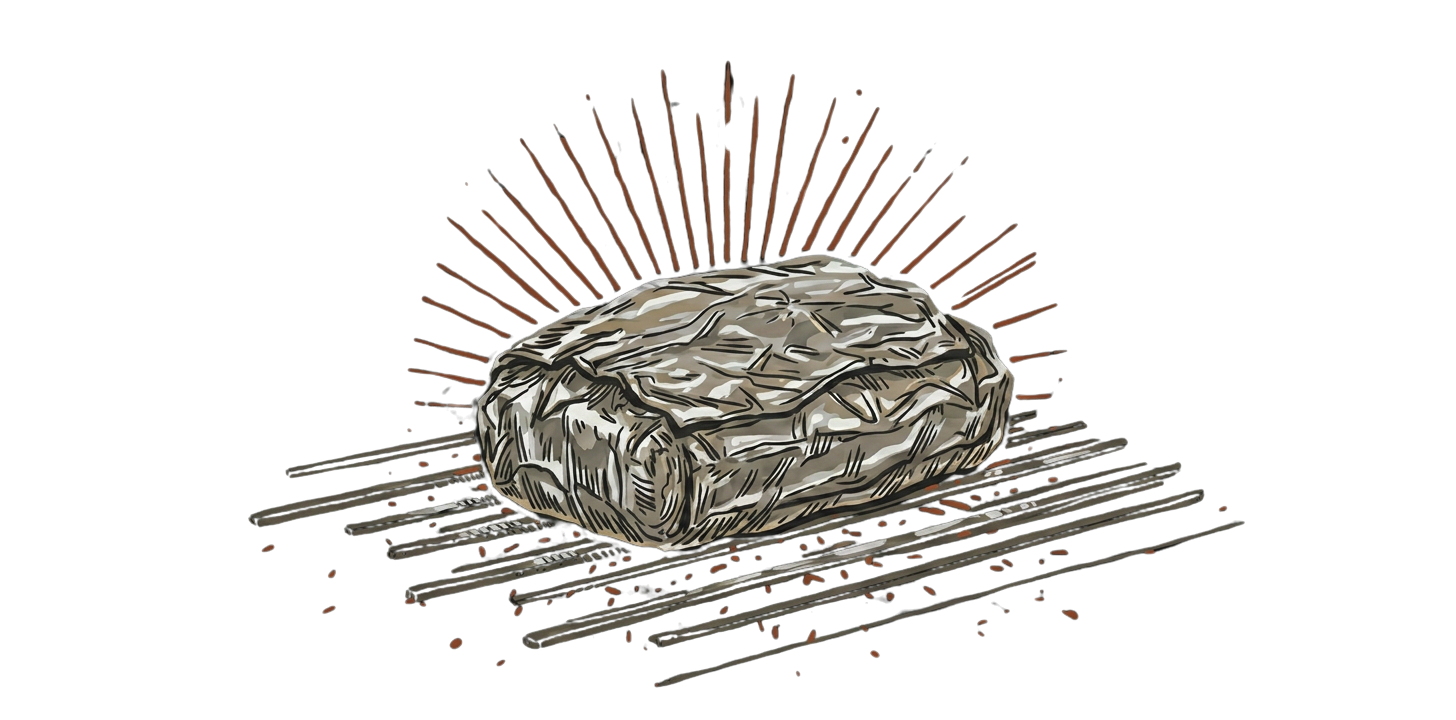
Texas Crutch
The Texas Crutch is a wrap technique: cooked brisket or pork shoulder gets wrapped in foil or butcher paper partway through a long smoke, usually around the time the meat hits the stall. Wrapping cuts evaporative cooling — the thing that makes the stall happen in the first place — so the internal temp resumes climbing and the cook finishes hours faster than it otherwise would. The term originated in 1990s competition circles where foil was the standard; Aaron Franklin's pink-butcher-paper variant emerged later and is now the canonical Texas-brisket approach. Foil pushes through the stall fastest and steams the meat tender, at the cost of softening the bark. Paper breathes, preserves bark, and is slightly slower. No wrap (cooking unwrapped through the stall) gives the deepest bark and biggest smoke flavor at the cost of the longest cook and the most moisture loss.
- When to wrap
- 160–170°F internal (the stall temperature band)
- Foil
- Fastest through the stall, steams meat tender, softens bark
- Butcher paper
- Breathes, preserves bark, slightly slower than foil
- No wrap
- Deepest bark + most smoke flavor, longest cook, most moisture loss
- Final pull temp
- 203°F internal (probe-tender, all three options)
- Brisket cook time
- ~8-10 hours wrapped, ~12-14 hours unwrapped (at 225°F)
Before you cook.
- Equipment
- Heavy-duty foil OR pink unlined butcher paper (food-grade), instant-read or probe thermometer
- Materials
- 24"+ wide paper roll or extra-wide foil. Standard rolls aren't wide enough for a packer brisket.
- Wrap timing
- Monitor internal temp; plan to wrap when probe reads 160-170°F (the stall hits here)
- Pre-wrap surface
- Keep bark as dry as possible at wrap time — wet bark steams off; paper bark holds better than foil bark
What to cook with it.
Other ways to do it.
Foil wrap (original Texas Crutch)
Heavy-duty foil tight around the brisket at 160-170°F internal, sometimes with a splash of beef tallow or beer inside the wrap. Pushes through the stall in 30-60 minutes. Softens bark but yields the most tender interior. The 1990s competition-circuit origin.
Pink butcher paper wrap (Aaron Franklin)
Wide rolls of unlined pink butcher paper at 160-170°F, folded tight around the brisket. Breathes more than foil so bark holds. Now the canonical Texas-brisket approach. Pushes through stall in 60-90 minutes.
No wrap (naked / unwrapped)
Full cook unwrapped through the stall. Produces the deepest bark, biggest smoke flavor, and most authentic Central-Texas style. Adds 2-4 hours to the cook. Significant moisture loss compared to wrapped — the trade-off purists accept for the crustier exterior.
Wrap-then-unwrap finish
Wrap at the stall, then unwrap the last hour back on the smoker to let the bark firm up before pulling. Hybrid that captures most of the speed benefit without sacrificing as much bark as a full-wrap cook.
Foil boat (Mad Scientist's recent invention)
Partial foil wrap around the bottom and sides of the brisket only, leaving the top exposed to smoke. Hybrid that preserves bark while limiting moisture loss from the bottom. Newer method, popularized by Jeremy Yoder around 2022-2023.
What goes wrong.
Wrapping too early
Wrapping before the bark has fully set (color not dark yet) traps a soft pale crust under the wrap. Wait until the bark is dark and firm — typically around 160-165°F internal AND visually dark — before wrapping. The temperature alone isn't the signal; the color is.
Wrong paper
Pink butcher paper must be food-grade and UNLINED (no wax, no plastic coating). Lined paper is for fish counters and grocery wrapping, not BBQ. Look for "unlined" or "natural kraft" labeling on the roll.
Wrap too loose
Air gaps inside the wrap defeat the purpose. The wrap should hug the meat tightly — so steam doesn't escape on a foil wrap, or so the paper holds heat in on a paper wrap. Loose wraps don't push through the stall fast.
Forgetting to monitor after the wrap
Wrapped meat climbs in temperature significantly faster than unwrapped. Set a probe alarm at 195°F internal and start checking probe-tender every 15 minutes from there. Pull at probe-tender (usually around 203°F), not by reaching a number.
Cutting too early after the cook
Wrapped brisket holds heat well; let it rest at least 1 hour after pulling, longer if possible (faux cambro in a dry cooler with towels can hold for 4+ hours). Cutting too early loses the juices the wrap helped retain in the first place.
What each of them says.
6 of the people we trust have covered this. Read or watch each in their own words.
- 01
 Meathead GoldwynAmazingRibs.com
The Texas Crutch wraps meat in foil or butcher paper to push through the stall — typically saves an hour or two on a long cook. Foil is the original crutch; paper is more forgiving on bark. Wrapping in foil and holding in a faux cambro is essential for tender, juicy brisket — brisket is the only meat I consistently crutch.
- 02
 Steven RaichlenBarbecue Bible
Side-by-side test on 12-pound packers, seasoned identically, cooked over oak in an offset, wrapped at 160-170°F internal. Butcher paper produced crispier, crustier bark — the textbook specimen of what brisket should look and taste like. Foil-wrapped was extra tender from steaming in its own juices. The choice depends on what you're optimizing for.
- 03
 Daniel VaughnTexas Monthly
Pink butcher paper became a Texas-brisket signature largely through Aaron Franklin's rise in Austin. Before Franklin, butcher paper was already in old Lockhart and Luling meat-market BBQ joints — used to wrap raw meat at the counter, then doubling as cooked-meat serving paper. Franklin made paper the modern Texas-brisket cooking medium.
- 04
 Susie BullochHey Grill, Hey
The Texas Crutch wraps meat during smoking to speed cooking and trap moisture. Aluminum foil is the original — used to push smoked meat through the stall. Wrap at 160-170°F internal; brisket finishes at 203°F. The result is incredibly juicy and tender with a softer bark than unwrapped.
- 05
 Aaron FranklinBBQ with Franklin / YouTube
Franklin walks through paper-wrap technique on his official channel — when to wrap (after color sets), how to fold tight, what paper to use (pink unlined, food-grade). The canonical Franklin Barbecue paper-wrap demonstration on camera.
- 06
 Mad Scientist BBQYouTube — Jeremy Yoder
Jeremy compares foil vs paper vs no-wrap on identical briskets cooked side-by-side. Methodical Mad Scientist treatment — temperature curves, bark texture, moisture loss measured across the three options.
Cook it. Save the record.
Every cook gets a permanent entry — cut, fuel, temp, time, photo, what worked. Next time you want to nail that exact crust, you'll have the receipt.