
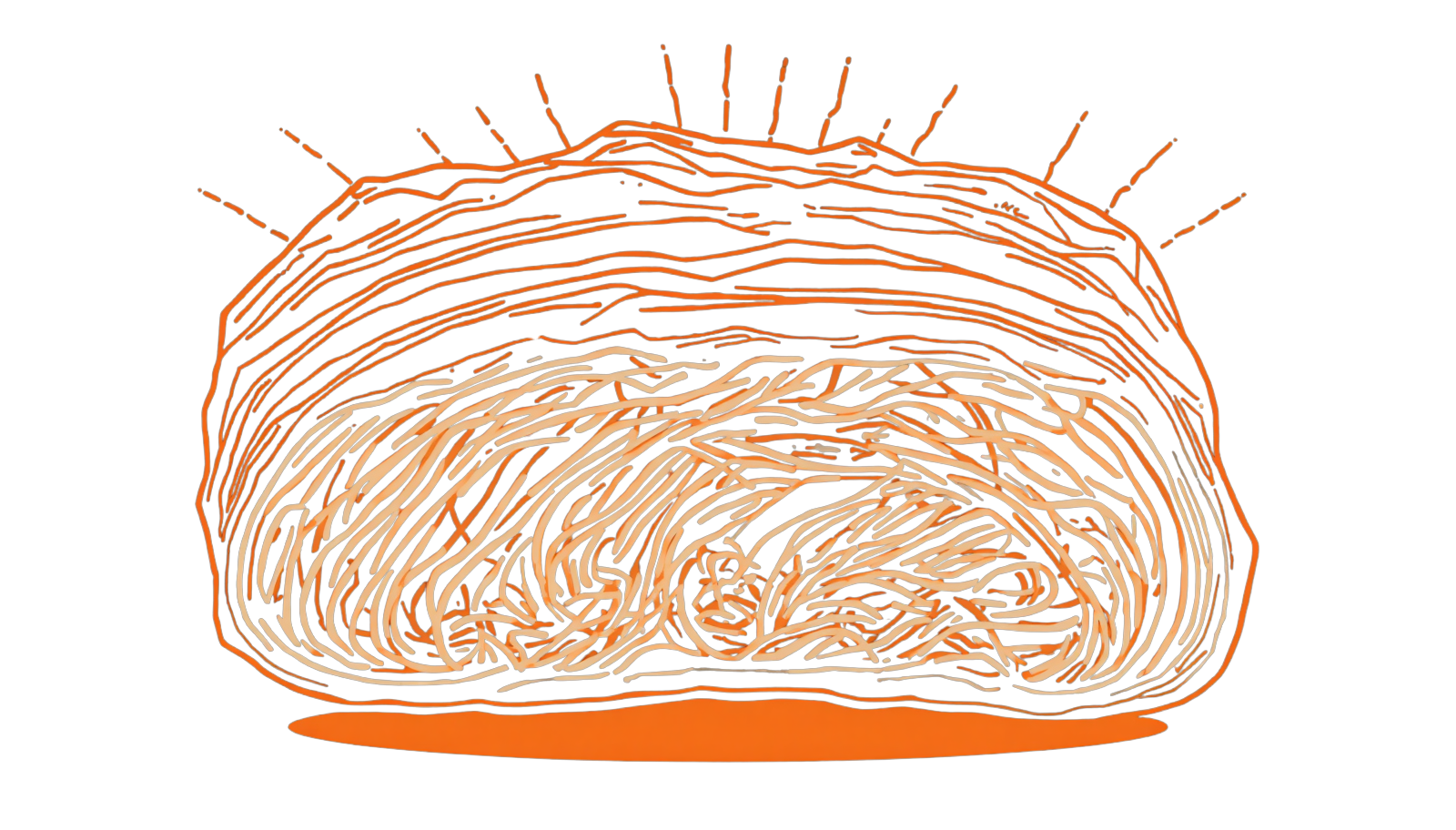
Collagen
Collagen is the tough connective tissue protein that holds muscle fibers together in cuts like brisket, pork shoulder, chuck roast, and ribs. Raw, it's chewy and unpleasant. But when meat is held at 160°F+ for hours, collagen slowly hydrolyzes— it breaks down into gelatin, the silky, water-binding protein that makes long-cooked meat taste tender and moist. This is the entire reason low-and-slow cooking exists. Meathead explains the chemistry: collagen-to-gelatin conversion needs both temperature AND time — you can't shortcut it with high heat alone. Brisket and pork shoulder hit probe-tender around 200–205°F because that's where collagen has fully converted; pull earlier and the meat is still tough. Pre-conversion, collagen used to get blamed for the stall — that turned out to be evaporative cooling, but collagen conversion is what's actually happening in the background.
- What it is
- Connective tissue protein binding muscle fibers
- Found in
- Brisket, chuck, pork shoulder, ribs, lamb shanks, oxtail
- Converts to
- Gelatin (silky, water-binding mouthfeel)
- Starts converting
- ~160°F internal — slowly, over hours
- Fully converts
- ~200–205°F probe-tender; brisket finishes here
- What it isn't
- Fat. Different protein, different structure entirely.
The phenomenon
You cook a brisket at 225°F for 12 hours and pull a piece apart. It comes apart in long, glistening strands — no chewing required, the muscle separates cleanly with light finger pressure. A piece of beef tenderloin won't do this no matter how long you cook it. Neither will chicken breast. The difference is collagen.
Collagen is the tough connective tissue that binds muscle fibers together in cuts that do a lot of work in the animal's body — the brisket muscle holds up a cow's chest, the pork shoulder powers the front legs. Raw, that connective tissue is what makes those cuts chewy and difficult. Cooked properly, that same tissue transforms into gelatin and becomes the source of the silky, almost-juicy tenderness that defines great BBQ.
The science behind it
Collagen is a triple-helix protein wound tightly around itself. When you cook meat at high temperatures — grilling a steak, searing a chop — the heat is applied too briefly for that structure to relax. The collagen stays intact, and a high-collagen cut stays tough.
But at temperatures around 160°F and above, held over hours, something different happens: hydrolysis. The collagen triple-helix slowly unravels and breaks apart into individual protein strands. Those strands bind to water molecules and form gelatin— the same stuff in Jell-O, in the wobbly skin of a beef stock, in the bind of a good demi-glace.
Gelatin doesn't taste like much by itself. What it does is bind moisture into the meat and coat the muscle fibers in a soft, slippery layer. That coating is why properly cooked brisket feels "moist" even though it's lost a third of its water during the cook — the gelatin is holding what's left and lubricating every bite.
For decades, the BBQ community blamed collagen conversion for the stall — the long temperature plateau during brisket cooks. Greg Blonder's 2016 experiments at Meathead's request showed the stall is actually evaporative cooling. But collagen-to-gelatin conversion IS happening throughout those long hours; it just isn't what holds the temperature back.
In the cook
Collagen content varies dramatically by cut. The high-collagen cuts are the ones that benefit from low-and-slow; the low-collagen cuts get ruined by it.
| Cut | Collagen | Pull-at temp | Approx time at 225°F |
|---|---|---|---|
| Brisket | High | ~203°F | 12–14 hrs |
| Pork shoulder / butt | High | ~203°F | 10–12 hrs |
| Beef chuck | High | ~200°F | 8–10 hrs |
| Spareribs | Moderate | ~195°F (bend test) | 5–6 hrs |
| Tenderloin / chicken breast | Low / none | Cook to doneness, not collagen | Minutes, not hours |
Two practical implications: First, you have to give it time. Pull a brisket at 180°F because you're hungry and it'll be inedible — collagen isn't finished converting. You need to hold the meat at >160°F for 4–6 hours minimum for it to fully break down. Second, wrapping the meat (foil or paper) at the stall doesn't hurt collagen conversion — the wrap keeps the meat above conversion temperatures and the steamy environment is fine. Wrapping just trades some bark for speed.
When it's done
Collagen conversion is complete when the meat is probe-tender. That's not a temperature; it's a feel. A probe slid into a finished brisket should pass through like the meat is room-temperature butter — almost no resistance. If you have to push, the collagen isn't done yet, even if the internal temp reads 203°F.
| Probe feel | Slides in like butter — no resistance |
| Internal temp | Usually 200–205°F (the range, not an exact number) |
| Jiggle test | Shake the brisket gently — finished meat wobbles |
| Pull / bend test (ribs) | Bone slides clean; rack bends to ~90° with crackle on top |
Collagen-converted meat is unusually forgiving past the finish line — pulling at 203°F vs 207°F doesn't ruin anything (it just gets slightly softer). The danger is the other direction: pulling early, before conversion is done, leaves the meat tough. When in doubt, give it another 30 minutes and probe again.
What people get wrong.
Collagen breaks down at any temperature given time
Below ~160°F, collagen conversion is so slow it's essentially nothing — a sous-vide steak at 130°F for 24 hours won't break down the connective tissue meaningfully. You need both temperature AND time in the right range (160–205°F over hours) for the chemistry to actually happen. Low temperature alone doesn't substitute for crossing the conversion threshold.
All meat has collagen worth breaking down
The technique only applies to high-collagen cuts — brisket, pork shoulder, chuck, ribs, lamb shanks. Lean cuts like beef tenderloin, pork loin, chicken breast have almost no collagen to convert. Cooking them at 225°F for hours doesn't make them tender; it dries them out. Low-and-slow is a tool for the right cuts, not a universal upgrade.
Collagen and fat are the same thing
Different proteins, different structures, different roles. Fat is triglycerides — what melts off as the meat renders. Collagen is connective tissue protein — what converts to gelatin. They're both important for finished texture (rendered fat = juicy mouth-feel; gelatin = silky structure), but they're chemically distinct and react to temperature differently.
The stall is collagen converting
This was the popular wrong explanation before 2016. Physicist Greg Blonder's experiments showed the stall is evaporative cooling at the meat surface — not collagen breakdown absorbing energy. Collagen IS converting throughout the stall, but it isn't what holds the temperature back. The two phenomena happen simultaneously; they aren't cause and effect.
What each of them says.
3 of the people we trust have covered this. Read or watch each in their own words.
- 01
 Meathead GoldwynAmazingRibs.com
When you cook tough cuts of meat with lots of connective tissue — ribs, brisket, shoulder — it's important to liquefy the meat's connective tissue into gelatin. That's what makes these tough meats taste tender. They need to go up to 200 to 205°F to gelatinize collagen and melt fats. Once collagen melts, the cooked muscle fibers are no longer bound together; they're coated with a soft, gelatinous lubricant — that's where the silky, juicy mouthfeel comes from.
- 02
 Steven RaichlenBarbecue Bible
Brisket reaches its transformation at around 205°F internal — that's where the tough collagen has fully rendered into gelatin and the fat has fully rendered. The whole point of low-and-slow is to give the meat time at the right temperature range (160–205°F) for collagen to hydrolyze. Skip the time or rush the temperature and the meat stays chewy regardless of how done the thermometer says it is.
- 03
 Mad Scientist BBQYouTube — Jeremy Yoder
Jeremy walks through brisket science with chemistry-teacher rigor — including collagen hydrolysis and gelatinization. His framing of the collagen-to-gelatin conversion as the central transformation of long brisket cooks is the clearest video explanation in the BBQ-YouTube canon.
Cook it. Save the record.
Every cook gets a permanent entry — cut, fuel, temp, time, photo, what worked. Next time you want to nail that exact crust, you'll have the receipt.