
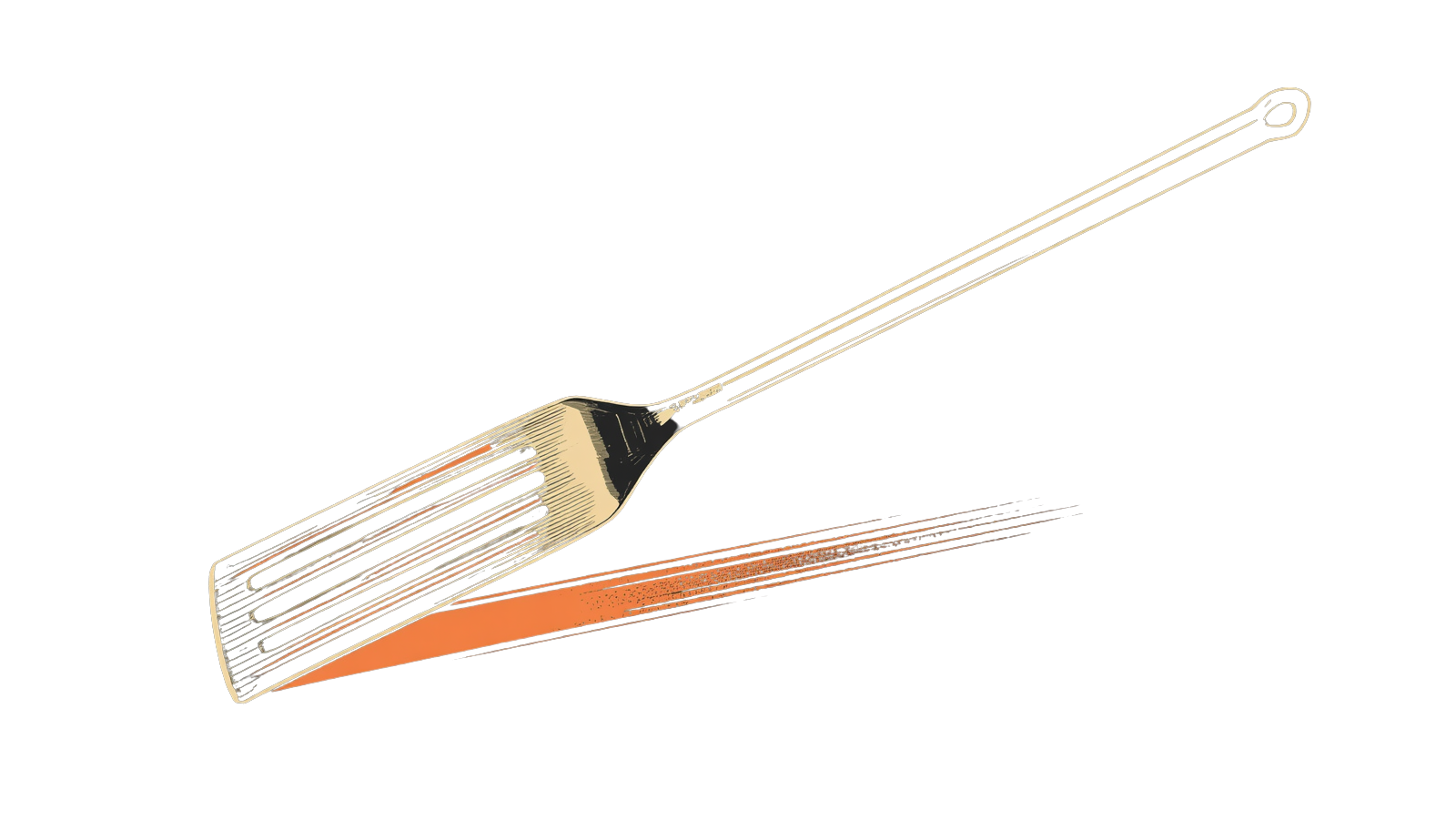
Spatula
A spatula is a flat metal blade on a long handle — the tool you reach for when tongs can’t do the job without crushing the food or losing it through the grates. Three working variants cover the field. A long grill spatula (12–18″, wide stiff stainless blade) is the burger-and-steak flipper, big enough to support a whole patty mid-air. A fish spatula (thin, slotted, flexible blade with a tapered front edge) slides under delicate proteins without tearing them. A griddle scraper (wide, flat-edged, low-profile) is the smash-burger and flat-top tool, built to release a lacy beef crust from steel without lifting it. Stainless head and a wood or silicone handle on all three. Meathead Goldwyn’s rule: skip the narrow kitchen turner, get something extra-wide and stiff, and (if you’re game) hit the leading edge with a bench grinder so it slips cleanly under whatever the fire has grabbed onto.
- Variants
- Long grill spatula · Fish spatula · Griddle scraper
- Material
- Stainless steel blade · wood, silicone, or composite handle
- Length
- 12–18″ overall for the grill spatula; 10–12″ for fish; 6–8″ blade on a griddle scraper
- Price
- $15–25 (basic) · $40–80 (heavy-duty pit / restaurant-grade)
- Best at
- Flipping burgers, fish, smashburgers, anything that won't survive being pinched
- Care
- Hand-wash, dry, store flat — dishwashers warp thin blades and loosen handle rivets
What it is
A spatula is a flat metal blade fixed to a handle, designed to slide under food and lift or flip it without piercing. On a grill the blade is wide and stiff, the handle is long enough to keep the cook’s hand out of the heat, and the leading edge is thin enough to wedge under a crust that’s welded to the grate. The category split is real — there’s no single “grill spatula” that does all three jobs well, which is why most working cooks own a long flipper, a fish spatula, and (if there’s a griddle in the rotation) a scraper.
Handle materials run wood (warm, traditional, eventually charrs near the bolster), silicone or composite (heat resistant, dishwasher tolerant, slightly bouncy), and welded stainless (commercial / restaurant pit handles, indestructible, gets hot if you leave it lying on the grate). Blades are almost always stainless — carbon steel turners exist on the flat-top side but rust if you don’t oil them after every cook. The hanging hole at the butt of the handle isn’t cosmetic; a grill spatula lives on a hook on the side of the cart, not flat in a drawer.
The canonical writers all converge on the same baseline: after long tongs, a wide stiff spatula is the second tool you put in the kit. Meathead picks one specifically for burger-and-fish width; Susie Bulloch ties tongs and spatula together as the two essentials of every backyard cook’s starter set.
How it works
The spatula’s job is to substitute a wide flat surface for the pinch of a pair of tongs. Tongs work by gripping — fine for chicken thighs and sausages, ruinous for a soft burger or a flaking fillet. A blade slides horizontally under the entire footprint of the food, supports its weight as a unit, and flips it onto the other face without ever asking the food to hold itself together against a pinch. The wider and stiffer the blade, the larger the load it can carry without folding mid-flip.
Three blade geometries matter. A thick, stiff, wide blade (the long grill spatula) won’t flex under a half-pound burger or a hanger steak. A thin, flexible, slotted blade (the fish spatula) bends slightly to match the contour of the grate and the underside of a fillet, which is how you get under a piece of skin-on salmon without tearing the skin off. And a low, flat, square-edged blade (the griddle scraper) presses flush with the steel of a flat-top, which is how a smashburger crust releases in one piece instead of leaving its lacy underside stuck to the surface.
Edge geometry is the part most home cooks miss. Meathead’s trick — taking the leading edge to a bench grinder and putting a slight bevel on it — turns a so-so spatula into one that slips under a welded crust in a single pass instead of scraping at it. Restaurant-grade flippers ship with that bevel already ground; cheap ones don’t. Length sets the working distance from the heat: 12″ is the minimum over a gas grill, 14–16″ is comfortable over a charcoal two-zone fire, 18″ starts to make sense over a long offset.
Setting it up
Three working variants cover the field. Most cooks end up with two of the three; serious griddle cooks own all three.
Long grill spatula
The default. A wide (3–4″), stiff stainless blade on a 12–18″ handle, often with a beveled or slotted leading edge. This is the burger, steak, chop, and bone-in chicken flipper — the one you reach for over a hot-and-fast charcoal sear. If you own one spatula, this is it. A cheap, narrow kitchen turner from the silverware drawer is the wrong tool: too thin to carry a half-pound patty, too short to keep your forearm hair out of a hot fire.
Fish spatula
Thin, slotted, flexible, with a tapered front edge and an offset bend in the neck so the blade sits flat on the grate while the handle clears the lip. The flex is the whole point — it lets the blade follow the curve of a fillet and slide under without tearing skin or breaking flakes. Slots drain fat and liquid so the lift stays clean. Worth owning the moment you cook fish on the grill more than twice a year; pulls double duty for soft burgers, eggs, and delicate vegetables. The OXO and Wüsthof versions are both standards.
Griddle scraper
Low-profile, wide (4–6″ blade), with a flat, square, sharpened leading edge ground close to parallel with the surface. The Blackstone-style scraper is the icon. Built for the griddle workflow: smash a ball of ground beef into a hot flat-top, wait for the crust to lock in, then press the edge under the lacy beef and release it without lifting it off the steel. Doubles as the end-of-cook tool for scraping fond and grease into the trough. Useless on a grate (the blade won’t fit between bars), essential on steel.
Meathead’s signature move on any of the three: touch the leading edge to a bench grinder and put a slight bevel on it. The blade then slips under welded crust the way a fish-knife slips under skin — one pass, no scraping, no tearing. Stock spatulas ship with edges blunt enough to be drawer-safe; sharpen yours and the flip changes character.
Where it earns its keep
The spatula’s value is whatever you can’t flip with tongs, and the list is bigger than it looks at first.
Burgers
A pinch from a pair of tongs squeezes a soft patty flat and crushes the crust you just built. A wide blade slides under the whole footprint and flips it as a unit — this is the canonical spatula job and the one Susie Bulloch names first when she pairs spatula with tongs as the two essentials.
Skin-on fish
Salmon, trout, branzino — flesh that flakes the moment you pinch it. The thin flex of a fish spatula gets under the skin-grate bond without shearing the skin off, which is how the fillet comes off the grate intact instead of in pieces.
Smashburgers and griddle work
The lacy crust on a smashburger is what makes it worth doing — lose the crust and you have fried hamburger. A flat-edged griddle scraper presses flush against the steel and releases the crust in one piece. Chuds BBQ’s smashburger workflow lives on this tool.
Soft vegetables and grilled fruit
Halved peaches, slabs of grilled bread, planked zucchini, eggplant rounds — foods that fall apart under a pinch. The wide flat support of a blade keeps soft produce intact through the flip off the grate.
Where it falls short
A spatula isn’t the universal grill tool tongs are. The honest limits:
Round and rolling foods
Sausages, hot dogs, asparagus spears, kebabs — the blade has nothing to grip and the food rolls off the edge. Long tongs do this work every time; the spatula stays in the hook.
Whole heavy roasts
A whole pork shoulder, a packer brisket, a spatchcock turkey — loads no single spatula was designed to carry. Use heatproof gloves, slide a sheet pan or peel underneath, and lift with both hands. A spatula bent under a 9-pound load is the fastest way to drop the cook.
Wrong blade for the surface
A griddle scraper bridges across grate bars uselessly; a long stiff grill spatula can’t hug a flat-top close enough to release a smashburger crust; a fish spatula flexes under a half-pound burger and dumps it on the coals. Each blade fits its surface — match them.
Cheap, flimsy turners
A bargain spatula bends mid-flip, snaps at the rivet, or loses its handle in a hot fire. Susie Bulloch’s line: don’t cheap out — a flimsy spatula is the fastest way to fumble dinner onto the coals. The $40 spread between a working blade and a junk one is the easiest premium in the kit.
What goes wrong.
Using a narrow kitchen turner over a hot fire
A 9″ nonstick turner from the silverware drawer is too short to keep your forearm out of a charcoal sear and too narrow to support a burger or fillet. Meathead’s rule is wide and stiff. Twelve inches of handle is the floor; fourteen to eighteen is the working standard over a two-zone fire.
Lifting too soon
Pulling at a burger or fillet before the crust has set tears the surface and leaves half the food welded to the grate. Let the proteins release on their own — when the blade slides under easily, the food is ready to flip. If you have to scrape, give it another 30–60 seconds.
Treating one spatula as all spatulas
A long grill spatula isn’t a fish spatula and isn’t a griddle scraper. Cooking salmon with a stiff wide blade tears the skin; smashburgering on a griddle with a long grill spatula crushes the crust. Pick the blade geometry that matches the food and the surface.
Skipping the bevel
Stock spatulas ship with leading edges blunt enough to be drawer-safe — that bluntness scrapes at a welded crust instead of slipping under it. Hit the front edge on a bench grinder or a sharpening stone to put a slight bevel on it. Restaurant-grade flippers come pre-beveled; that's why they feel different.
Throwing it in the dishwasher
Repeat dishwasher cycles warp thin blades, corrode rivets, and split wood handles. Hand-wash, dry, hang on the hook. A $30 spatula lasts a decade that way and a season otherwise.
What each of them says.
3 of the people we trust have covered this. Read or watch each in their own words.
- 01
 Meathead GoldwynAmazingRibs.com
Meathead's rule for grill spatulas: skip the narrow kitchen turner and get an extra-wide, stiff metal blade — big enough to support a whole burger or fish fillet without it folding mid-flip. He took his own to a bench grinder and sharpened the leading edge so it slips cleanly under food that's grabbed onto the grates. A wide, stiff, sharp-edged spatula is the burger-flipper's other essential tool after long-handled tongs.
- 02
 Susie BullochHey Grill Hey
Susie pairs the spatula with tongs as the two essentials every backyard cook needs — because tongs can't flip a burger without crushing the patty or losing it through the grates. She reaches for a spatula for burgers, for delicate work like fish, and for any quick flip where you need to support the whole footprint of the food. The takeaway: don't cheap out — a flimsy spatula is the fastest way to fumble dinner onto the coals.
- 03
 Chud's BBQYouTube
Bradley Robinson works the griddle-scraper variant — thin, wide, flat-edged — to smash, slide, and release smashburgers without tearing the crust. The clearest demo of why the smash/griddle spatula is a different tool from the long grill turner: it's all about edge geometry and getting under that lacy beef crust without lifting it off.
Cook it. Save the record.
Every cook gets a permanent entry — cut, fuel, temp, time, photo, what worked. Next time you want to nail that exact crust, you'll have the receipt.