
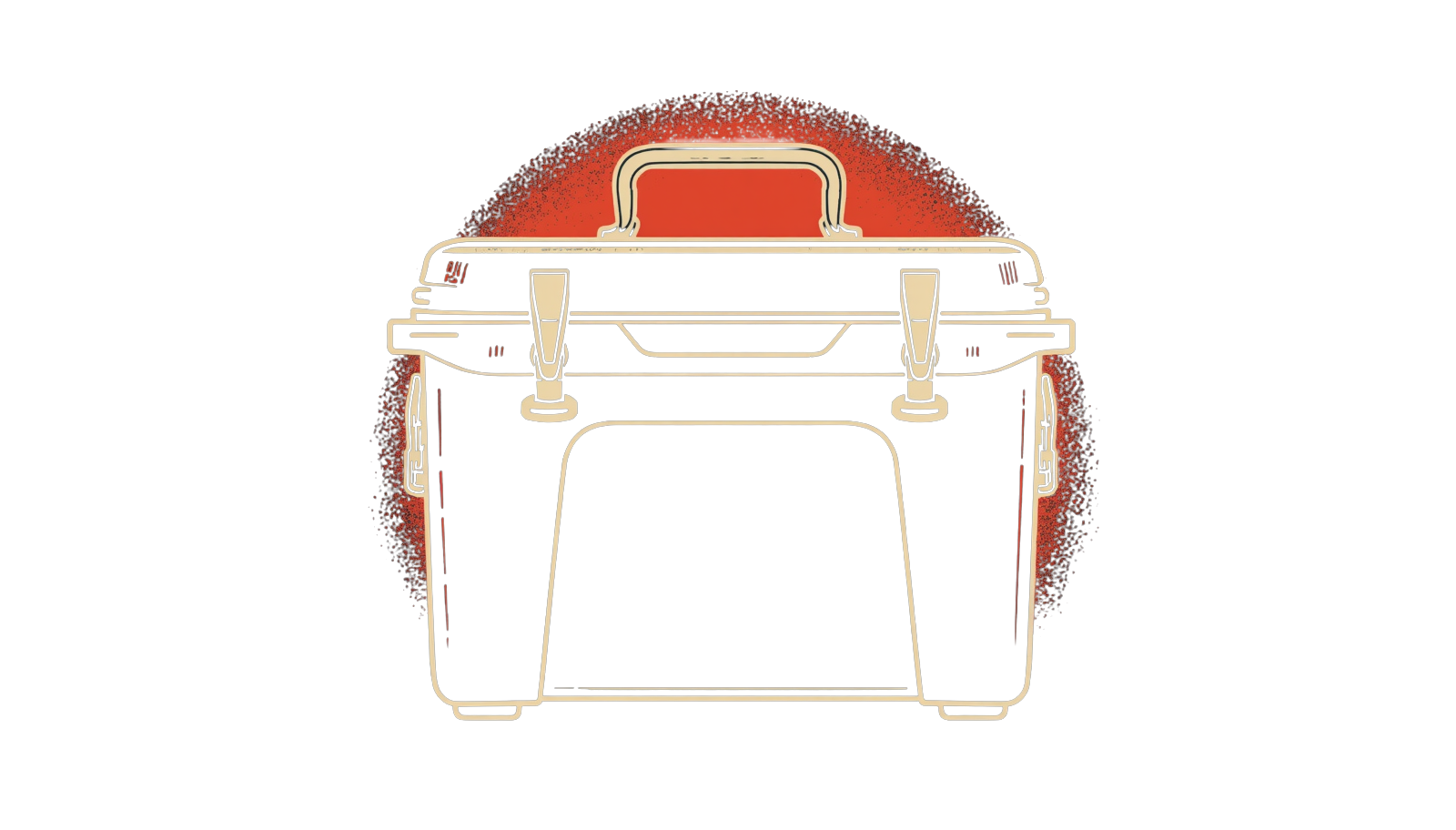
Cooler Rest (Faux Cambro)
The cooler rest — the “faux Cambro” or FTC (foil-towel-cooler) — is the home-cook's answer to the Cambro hot-holding boxes restaurant pits use to hold finished brisket and pork shoulder at safe-zone temperatures for hours after the cook. Wrap the meat in foil or butcher paper, swaddle it in clean towels, and nest it in a hard-sided insulated cooler you've preheated with hot tap water. The cooler does the rest: the dense thermal mass and trapped air hold the meat well above the 140°F food-safety floor for four to six hours, sometimes longer, while collagen finishes converting, juices redistribute, and the bark sets. Any decent insulated cooler works — a $30 Coleman, a $400 Yeti — the principle is identical. The technique rewrites the schedule of a low-and-slow cook: pull the brisket early, park it in the cooler, and dinner is a moving target instead of a deadline.
- Material
- Hard-sided insulated cooler — foam-injected walls, gasketed lid
- Sizes
- 48-qt for a single brisket; 65-qt+ for multiple cuts
- Price
- ~$30 for a basic Coleman to $400+ for a Yeti Tundra
- Hold time
- 4–6 hours above 140°F; longer with a thicker cooler
- Best at
- Buffering a long cook — pull early, hold safely until service
- Care
- Drain and air-dry after every use; meat juices breed odor fast
What it is
A cooler rest is exactly what it sounds like: an everyday insulated cooler — the kind you fill with ice for a tailgate — pressed into service as a hot-holding box. The technique goes by a few names. Pitmasters call it an FTC — foil, towel, cooler — for the three layers that make it work. Meathead Goldwyn coined faux Cambro for the same trick, after the Cambro-brand insulated hot boxes restaurant pits use to hold finished brisket at service temperature.
The hardware is unfussy on purpose. A hard-sided cooler with foam-injected walls and a gasketed lid — a 48-quart Coleman, an Igloo Marine, a Yeti Tundra, an RTIC — all do the same job. The Yetis hold heat a few hours longer because the walls are thicker, but for the 4-to-6-hour holds most home cooks need, a $30 cooler from the hardware store is enough. What you're paying for when you go up the line is duration, not capability.
How it works
An insulated cooler works as a hot box for the same reason it works as a cold box: foam walls and a sealed lid slow heat transfer in either direction. The wrapped meat is the heat source. The towels around it fill the dead air space and act as a thermal buffer, soaking up swings and giving the system enough mass that opening the lid for a glance doesn't crater the temperature.
The number that matters is 140°F. Below that, you're in the food-safety danger zone where bacteria multiply quickly; the USDA wants hot-held food above it. A brisket pulled at 203°F and packed correctly into a preheated cooler will sit well above 150°F for three hours, and above 140°F for several more — the same window a real Cambro is designed to cover. Meanwhile the meat is doing useful work: collagen continues to convert to gelatin at those temperatures, and the juices that got driven out of the muscle fibers during the cook have time to redistribute.
Setting it up
The setup is the same regardless of cooler brand. Three layers, in this order:
Preheat the cooler
Fill the empty cooler with hot tap water, close the lid, and leave it for 20–30 minutes while the meat finishes. Dump the water just before the meat comes off. A cold cooler is a heat sink — preheating brings the walls up so they hold the meat's temperature instead of stealing it.
Wrap and nest the meat
Wrap the brisket or pork shoulder in foil or butcher paper — the same wrap you'd use for a Texas crutch works. Drop the wrapped package into a foil pan or half-sheet to catch any juice that escapes, then nest the whole thing in clean, dry towels at the bottom of the cooler. The towels fill the dead air so the meat isn't sitting in a cold pocket.
Pile towels on top and close
Pack more towels above the package until the cooler is full — you want the meat surrounded, not floating in a half-empty box. Close the lid and don't open it. Every peek vents heat the cooler can't put back. Drop a leave-in probe through the gasket if you want to track the temperature without opening.
§ A note on resting vs holding
The cooler rest does the work of a hot-hold, not a rest. Pitmasters working at scale rest brisket on a counter or in a warm spot until the carryover settles, then move it into a Cambro for hours-long holding above safe-zone temperature. The faux Cambro substitutes for the second step, not the first. Treat it as a buffer for service timing — not a shortcut around the rest itself.
Where it earns its keep
The cooler rest pays off any time the cook clock and the dinner clock don't line up. Brisket and pork shoulder finish when they finish — a packer brisket can shave two hours off the projected cook or run two long — and most home schedules can't flex that hard. The cooler buys back the slack. Pull the meat a few hours early, park it, and serve when guests show up instead of when the stall decides to break.
It also does real flavor work. The extended warm hold lets collagen finish converting on cuts that came off just shy of probe-tender, gives the juices time to redistribute through the muscle so they don't run out on the cutting board, and lets the bark settle into something less brittle and more cohesive. A brisket that came off the smoker tight will eat noticeably better after a three-hour cooler hold. For a backyard cook running a long brisket on a weeknight, a$200 cooler does what a real Cambro does — at a tenth of the price and on a shelf you already own.
Where it falls short
The cooler rest has real limits, and most of them are about staying in the safe zone for the length of the hold.
It only holds, it doesn't heat
A cooler is a passive box. It slows heat loss but doesn't add any back — once the meat drifts below 140°F, you can't coax it back up. For holds beyond six hours, a real Cambro or a temperature- controlled hold (a low oven, a holding cabinet, a pellet grill set to 170°F) is the right tool.
Cold cooler, lost hold
Skip the hot-water preheat and the cooler walls absorb enough heat from the meat to shorten the hold by an hour or more. A cooler stored in a cold garage is worse. The preheat isn't optional.
Bark softens under foil
A long hold in foil traps steam against the crust and softens the bark you spent eight hours building. For bark-forward cooks, wrap in butcher paper instead, or unwrap the meat and let it vent on the counter for ten minutes after pulling it from the cooler.
Dedicate the cooler
Meat juice that escapes the wrap soaks into the cooler walls and the towels, and the smell doesn't leave. Keep a dedicated cook cooler for FTC duty — the same box that holds your beer for the tailgate next weekend is going to remind everyone of brisket day.
What goes wrong.
Skipping the hot-water preheat
The single biggest cooler-rest mistake. A room-temperature cooler sucks heat out of the meat the moment it goes in, and a cold cooler kills the hold within an hour or two. Fill it with hot tap water for 20–30 minutes while the meat finishes, dump it, and the walls are pre-charged.
Half-empty box
Leaving the cooler mostly empty around a single brisket leaves a big air pocket the meat has to warm up before it can hold. Pack towels above, below, and around the wrapped meat until the cooler is full — the towels are thermal mass, not padding.
Lifting the lid to check
Every peek vents the warm air the cooler can't put back, and you can't fix the temperature once it drifts. Drop a leave-in probe through the gasket if you need to track the meat — same discipline as a long low-and-slow cook.
Holding past the safe window
A cooler isn't a hot-holding cabinet. After about six hours, even a thick-walled cooler drifts toward 140°F, and once you cross under it you're cooling food in the danger zone. If you need to hold longer than that, switch to a low oven or a pellet grill set to 170°F.
Wrapping bark-forward cuts in foil
Foil traps the steam coming off the meat and softens the crust against it. For brisket where the bark is the point, wrap in butcher paper for the cooler hold, or vent the foil-wrapped package on the counter for ten minutes before serving to let the surface dry back out.
What each of them says.
4 of the people we trust have covered this. Read or watch each in their own words.
- 01
 Meathead GoldwynAmazingRibs
Meathead coined the canonical 'faux Cambro' write-up. Pre-warm a cheap insulated cooler with hot tap water for 30 minutes, then nest a foil pan and clean towels around the wrapped meat. He's measured meats holding well above 150°F for three hours, comfortably clearing the 140°F food-safety floor that real Cambro hot-holds target.
- 02
 Daniel VaughnTexas Monthly
Vaughn draws the critical line most home cooks miss: resting and holding are not the same thing. A beer-cooler faux Cambro keeps meat hot for hours, but don't mistake that for a true rest. Aaron Franklin rests his briskets for several hours, then holds them just above health-department temperature in an Alto-Shaam — the cooler is a substitute for that second step, not the first.
- 03
 Mad Scientist BBQChannel / YouTube
Jeremy Yoder runs the temperature-controlled experiment on long-form holds: how late you can pull, how long the meat actually stays above safe-zone in a real cooler, and what overnight rest does to texture compared with a short FTC.
- 04
 Chud's BBQChannel / YouTube
Bradley Robinson preheats a Yeti with hot water, wraps the brisket in butcher paper plus a towel for insulation, and rests it for ~10 hours. Dedicated video on the cooler-rest workflow from a former Franklin/Leroy & Lewis cook.
Cook it. Save the record.
Every cook gets a permanent entry — cut, fuel, temp, time, photo, what worked. Next time you want to nail that exact crust, you'll have the receipt.