
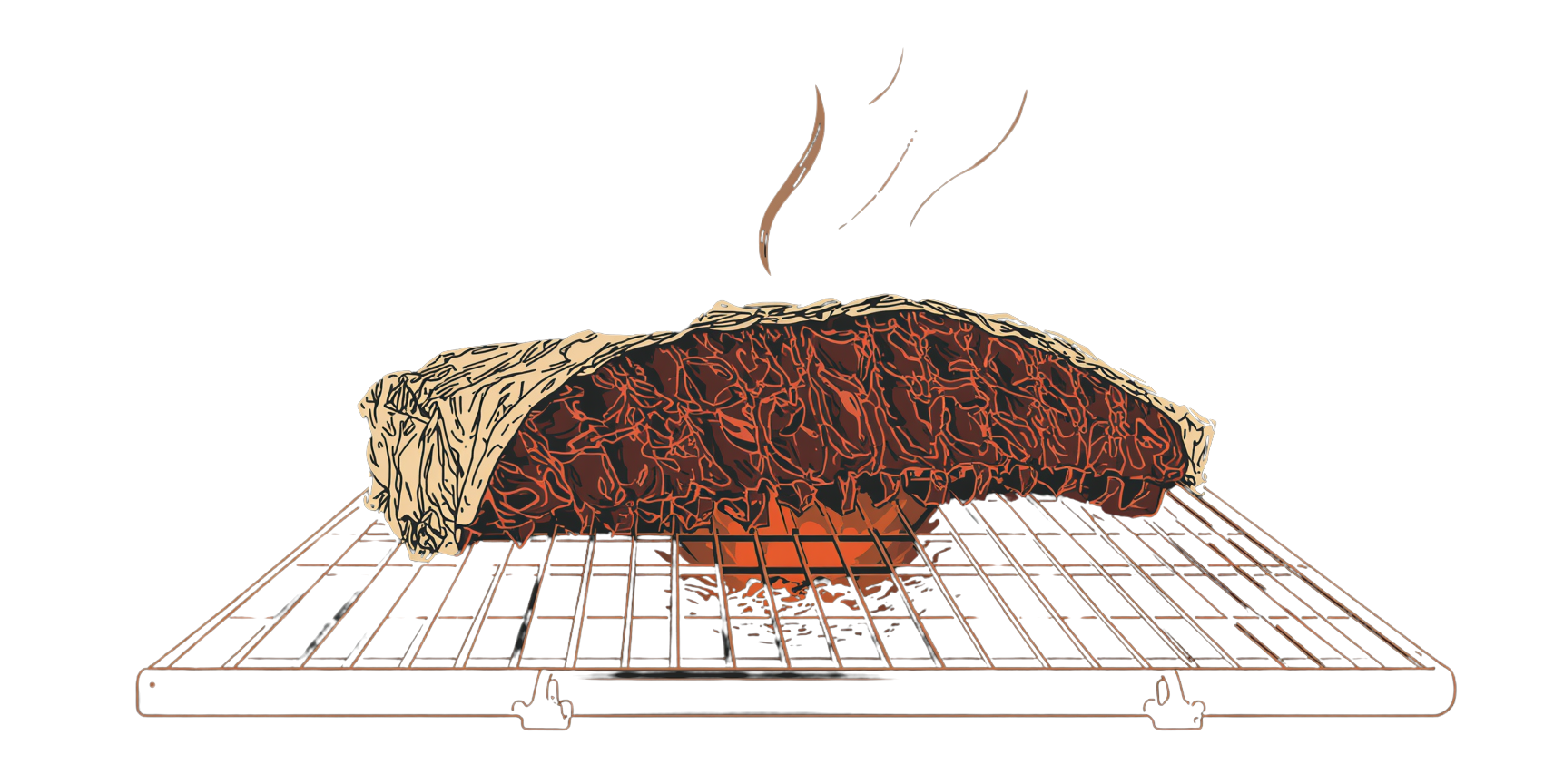
3-2-1 Ribs
3-2-1 is a timed formula for smoking a rack of pork ribs at around 225°F, split into three phases: 3 hours unwrapped on the smoker to build smoke and bark, 2 hours wrapped in foil (usually with a little liquid, fat, and sugar) to render the collagen and steam them tender, and 1 hour unwrapped and sauced to set a glaze. It's essentially low-and-slow plus a timed Texas crutch, packaged as a clock instead of a feel — which is exactly why it's the go-to for beginners: it replaces “cook until done” with three numbers you can follow. The honest catch is that those numbers are calibrated for full-size spare (St. Louis) ribs; run the full 2-hour wrap on smaller baby backs and they often overshoot into mushy, fall-apart territory that competition cooks consider a fault. Most experienced cooks treat 3-2-1 as training wheels — it teaches the rhythm of the cook — then shift to judging ribs by the bend test, bone pullback, and toothpick feel rather than the clock. Use it to learn the phases, then adjust the middle number down for thinner racks.
- The formula
- 3 hrs unwrapped → 2 hrs wrapped → 1 hr unwrapped & sauced
- Temp
- ~225°F low and slow throughout
- Best cut
- Full-size spare / St. Louis ribs (what it's calibrated for)
- Baby backs
- Cut it to 2-2-1 or 2-1-1 — the full wrap overcooks them
- The wrap
- Foil with a little liquid + fat + sugar to braise
- Real doneness
- Bend test & toothpick feel beat the clock; ~195–203°F
Before you cook.
- Equipment
- A smoker holding 225°F, foil or butcher paper, an instant-read thermometer, and a spritz bottle (optional).
- The ribs
- Remove the membrane from the bone side, trim, and season with a rib rub. Spare / St. Louis ribs are the cut this formula is built around.
- The wrap kit
- Have foil ready with your braising add-ins — a little liquid (juice, cider), fat (butter), and sugar (brown sugar, honey) — for the 2-phase.
- Set expectations
- Watch the clock for the first phase, but plan to check feel at the wrap and the finish — thinner racks get there faster.
What to cook with it.
Other ways to do it.
2-2-1 for baby backs
Smaller racks need less time at every stage, so 2-2-1 (or even 2-1-1) keeps thinner baby backs from over-softening on the wrap.
3-3-1 for big spare ribs
Extra-meaty St. Louis racks can take more braising — stretch the wrapped phase to push them all the way to tender.
No-wrap (cook to feel)
Skip the formula entirely: smoke unwrapped the whole way and pull when the bend test and toothpick say so. More bark, more bite, no mush — the direction most pros go.
Longer unwrapped finish
Extend the final phase and go light on sauce to firm the bark back up after the wrap softens it.
What goes wrong.
Mushy, fall-apart ribs
The #1 3-2-1 failure — too long wrapped. Shorten the wrap by 30–60 minutes and use less liquid in the foil. Baby backs especially can't take the full 2 hours.
Ran it on baby backs
3-2-1 is built for spare / St. Louis ribs. Baby backs are thinner and overcook — drop to 2-2-1 or 2-1-1.
Bark went soft
Wrapping braises and softens the bark. Lengthen the final unwrapped phase, go easy on the sauce, and let the surface firm back up before pulling.
Followed the clock past done
The numbers are a guide, not a guarantee — pits and racks vary. Check feel at the wrap and the finish: bend, bone pullback, toothpick. Pull when it's tender, not when the timer says.
Too much liquid in the wrap
A heavy pour of juice or cider turns the wrap into a braise that washes out bark and over-softens. A few tablespoons is plenty.
What each of them says.
4 of the people we trust have covered this. Read or watch each in their own words.
- 01
 Meathead GoldwynAmazingRibs.com
Meathead advises against the rigid 3-2-1: two hours in foil is too long and pushes ribs into mushy, overcooked territory. Cook to feel as much as the clock — set the smoker to 225°F and look for a good bend, bone pullback, and a toothpick that slides in with light resistance. Ribs usually finish around 195–205°F, but tenderness matters more than any single number or schedule.
- 02
 Steven RaichlenBarbecue Bible
The 3-2-1 method is the classic baseline for St. Louis–cut spare ribs: 3 hours of smoke, 2 hours wrapped in foil to accelerate tenderness, and 1 hour unwrapped to set the bark and glaze. Wrapping braises the ribs, which softens the bark and speeds tenderness — powerful, but easy to overdo. For smaller baby backs, shorten it to 2-2-1 or even 2-1-1 to avoid over-softening.
- 03
 Susie BullochHey Grill, Hey
Smoke the ribs low and slow for 3 hours, wrap them with a little liquid for 2 hours, then finish sauced for the final hour — a foolproof route to fall-off-the-bone ribs. If you're running full St. Louis spare ribs rather than baby backs, you'll likely need more braising time, so the schedule shifts toward 3-3-1.
- 04
 Mad Scientist BBQYouTube — Jeremy Yoder
Jeremy traces how 3-2-1 became the internet's default rib method and why so many serious cooks have moved past it — a clear-eyed look at where the formula helps and where it overcooks.
Cook it. Save the record.
Every cook gets a permanent entry — cut, fuel, temp, time, photo, what worked. Next time you want to nail that exact crust, you'll have the receipt.