
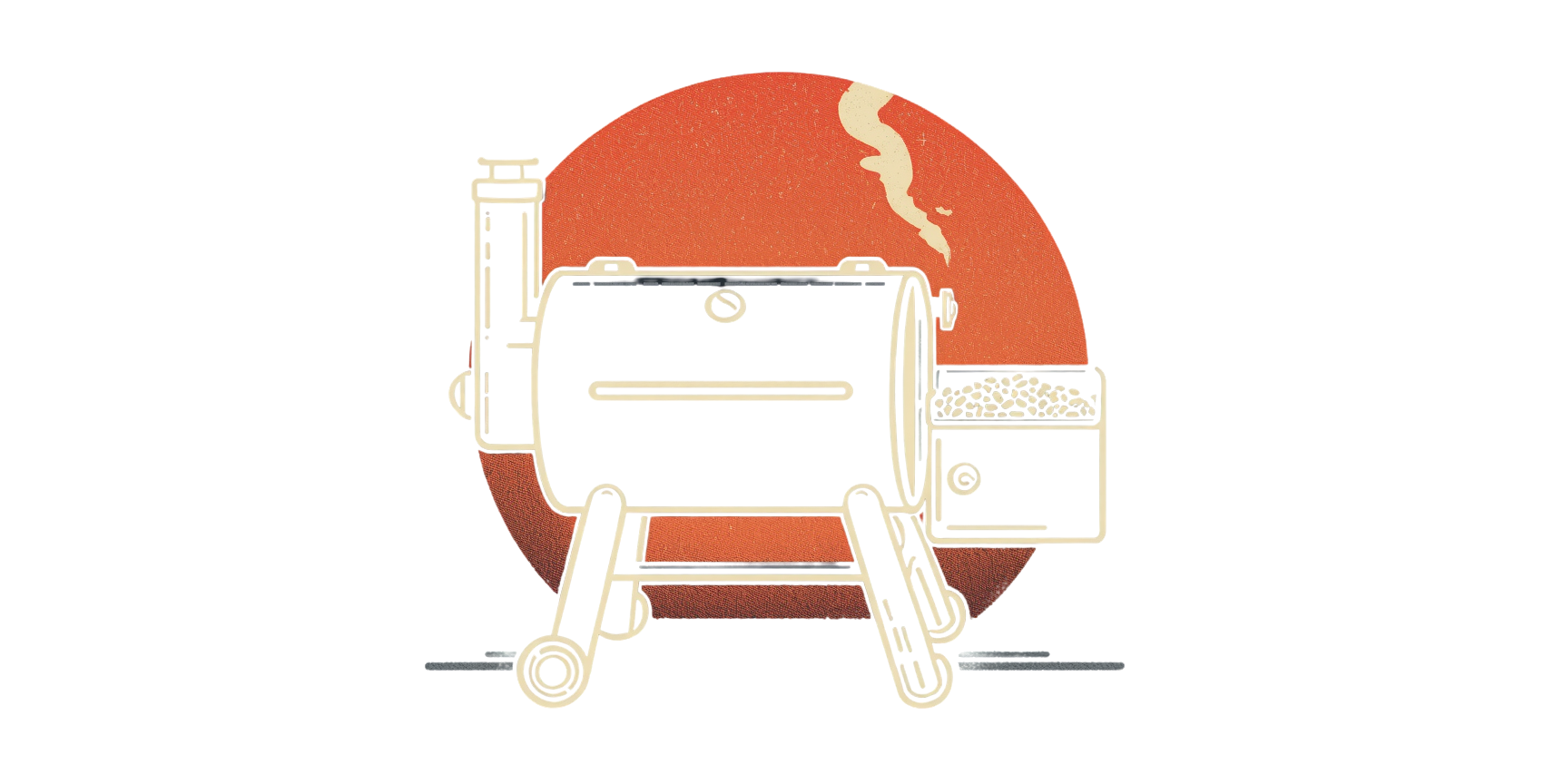
Pellet Grill
A pellet grill is a wood smoker that runs itself. Compressed hardwood pellets sit in a hopper; an auger feeds them into a fire pot where an igniter and a fan burn them, and a thermostat — on better models a PID controller — holds your set temperature within a few degrees by feeding more or fewer pellets. You dial in 225°F, walk away, and it cooks like an outdoor convection oven that happens to burn wood. Joe Traeger invented the category in 1985, and after his patent expired in 2007 the field exploded. The catch is the smoke: a pellet grill makes real wood smoke, more than gas, but lighter than a charcoal or stick fire — and least of all at high heat, so it's a low-and-slow smoker first and a grill a distant second.
- Fuel
- Compressed hardwood pellets (+ electricity)
- Sizes
- Portable up to large cabinet & cart rigs
- Price
- ~$400 to $2,000+; the controller is what you pay for
- Temp range
- ~180–450°F; few sear much hotter
- Best at
- Hands-off low-and-slow with real wood smoke
- Skill level
- The easiest smoker — set it and forget it
What it is
A pellet grill is an electric-fed wood smoker. Compressed sawdust pellets sit in a side hopper; a motor-driven auger feeds them into a small fire pot, an igniter rod lights them, and a fan keeps them burning while circulating heat and smoke through the chamber. A digital controller runs the whole thing to a temperature you set on a dial or a phone app — essentially an outdoor convection oven fueled by wood.
Joe Traeger built the first one in 1985 and held the patent until 2007, which is why “Traeger” is still shorthand for the category; once the patent lapsed, Pit Boss, Recteq, Weber, and a dozen others poured in. The piece that actually separates a good pellet grill from a frustrating one isn't the body — it's the controller.
How the heat moves
The controller is the brain. Set a target and it runs a duty cycle — turning the auger and fan on and off — to feed exactly enough pellets to hold that temperature. The best controllers are PID units that learn the feed rate and hold within about 5°F, tighter than many indoor ovens; cheaper “low/medium/high” controllers swing much more. A fan makes it a convection cooker, so the heat is indirect and even, never a direct flame under the food.
That same clean, fan-fed combustion is why smoke output drops as the temperature climbs: burn hot and the pellets combust completely with little smoke; hold it down under 250°F and they smolder out plenty of mild, sweet smoke. It's the opposite of an offset, where the cook reads and feeds a live fire by hand.
Setting it up
Fill the hopper with dry pellets, set your temperature, and let it run through its startup until the smoke settles clean. There's very little to do after that — which is the entire point. For more smoke, run it as low as your cook allows, or drop in a smoke tube, a perforated steel tube of pellets you light separately to add extra smoke. WiFi models let you set and watch the temperature from your phone.
The one discipline a pellet grill demands is dry fuel and a clean fire pot. Pellets are just compressed sawdust, so any moisture swells them into mush that jams the auger and kills the smoke; keep them sealed and dry. And vacuum the ash out of the fire pot between cooks so the next startup lights cleanly.
Where it earns its keep
Convenience is the whole pitch, and it's a big one. A pellet grill gives you real wood smoke and genuine low-and-slow results with the effort of using an oven: set 225°F, put the meat on, and go to bed. For ribs, pork butt, and weeknight smoking by people who don't want to tend a fire for twelve hours, nothing is easier, and the consistency makes it hugely forgiving for beginners.
It splits a difference no other cooker quite does. Where a gas grill gives convenience with little smoke and an offset gives deep smoke for constant work, a pellet grill gives real smoke for almost no work — the most beginner-proof on-ramp to barbecue there is.
Where it falls short
The honest gap is smoke depth. Pellet smoke is real but lighter and cleaner than a charcoal or wood fire, and it thins out the hotter you cook — purists can taste the difference on a brisket against a stick burner. You can narrow it with low temps and a smoke tube, but you can't fully close it. And it's a poor griller: the fan-driven convection heat browns and roasts but doesn't sear like radiant fire, so a steak usually wants a hotter finish — a reverse sear off the pellet grill and onto a flame.
It's also the most failure-prone cooker in the backyard, because it's the most mechanical. It needs electricity, so no outlet means no cook; the auger, igniter, fan, and controller are all parts that can fail; and you're committed to buying pellets. It's the right tool if hands-off smoke is what you want — and the wrong one if you're chasing the deepest possible flavor or a hard sear.
What goes wrong.
Expecting stick-burner smoke
Pellet smoke is real but lighter than charcoal or wood — and it thins out the hotter you run. If you want more, cook at lower temps or add a smoke tube; don't expect a 350°F pellet cook to taste like an offset brisket.
Letting pellets get damp
Pellets are compressed sawdust — any moisture swells them into mush that jams the auger and chokes the smoke. Store them sealed and dry, and don't leave them sitting in the hopper exposed to weather between cooks.
Trying to sear on it
A pellet grill is a convection smoker, not a searing grill — the heat is hot air, not radiant flame. Build the crust elsewhere: finish a reverse sear on a hot grate or skillet.
Neglecting the fire pot
Ash and unburned pellets build up in the fire pot and cause failed or smoky startups and temperature swings. Vacuum it out regularly so each cook lights clean.
No power, no backup
It's an electric appliance: a tripped breaker, a dead extension cord, or an empty hopper stops the cook cold. Check the outlet and the pellet level before a long cook, not during.
What each of them says.
2 of the people we trust have covered this. Read or watch each in their own words.
- 01
 Meathead GoldwynAmazingRibs.com
A pellet smoker feeds pellets by auger into a burn pot, lights them with an igniter, and a fan and thermostat hold the temperature — the best PID controllers stay within about 5°F, tighter than many indoor ovens. They make plenty of mild, elegant smoke under 250°F but very little at high heat, because hotter combustion is cleaner. They're primarily indirect convection smokers and don't sear well; the single most important thing to buy on is the quality of the controller, not the badge.
- 02
 Mad Scientist BBQYouTube — Jeremy Yoder
An even-handed accounting from a serious-smoke obsessive: Jeremy lays out exactly what a pellet grill gives you (convenience, consistency, real-enough smoke) and what it costs you (smoke depth, searing, mechanical complexity) — the honest case for and against.
Cook it. Save the record.
Every cook gets a permanent entry — cut, fuel, temp, time, photo, what worked. Next time you want to nail that exact crust, you'll have the receipt.