
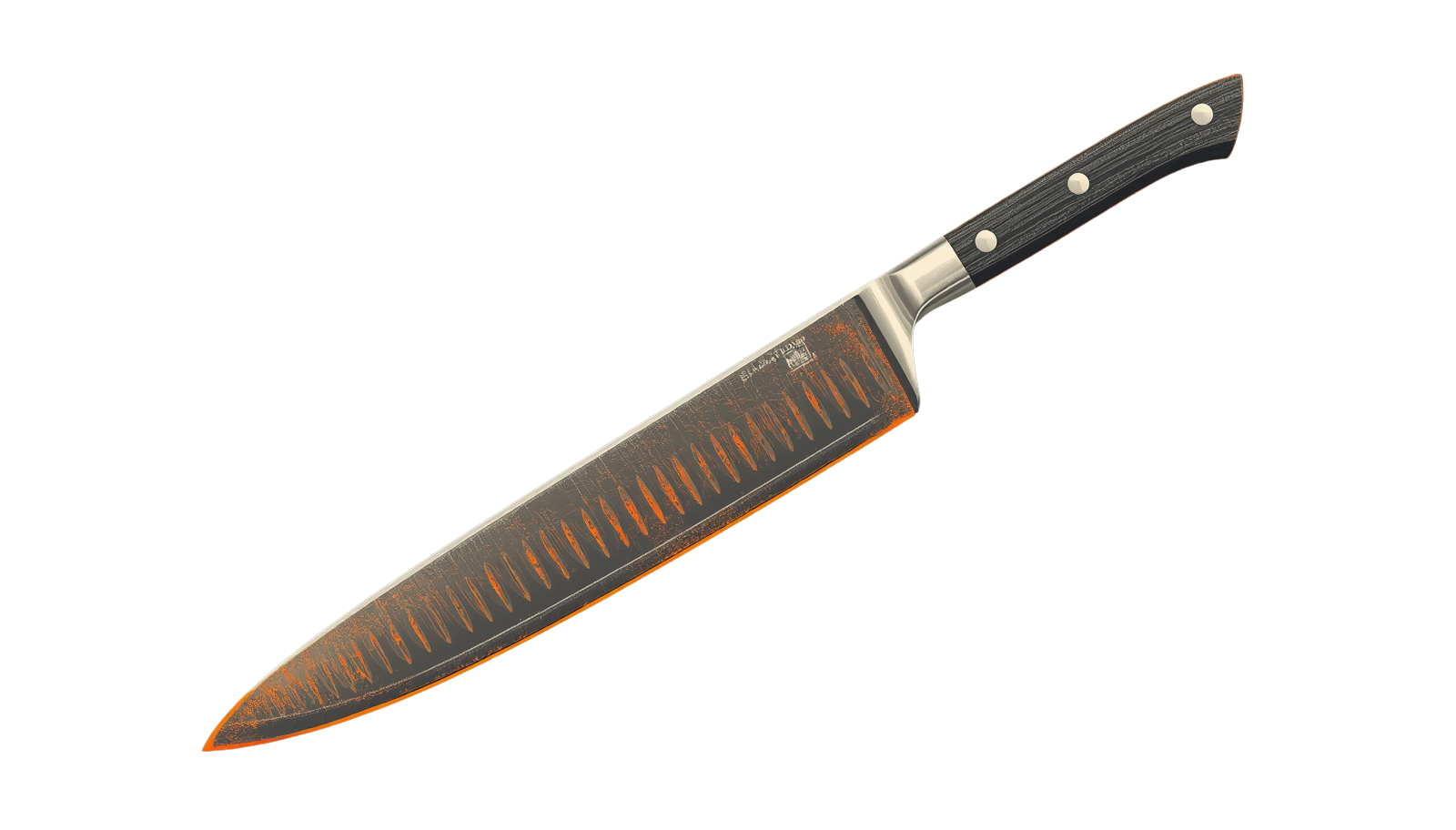
Slicing Knife
A slicing knife is a long, thin, slightly flexible blade — typically 10–14 inches — built for one job: cutting cooked brisket (and other large smoked roasts) against the grain in clean, even slices. Length is the whole point. A 12-inch blade lets you finish a brisket flat in a single uninterrupted pass instead of sawing in stages that tear the bark and crush the slice. Most working slicers have a granton edge— oval scallops ground into both sides of the blade — that introduces air pockets between the steel and the meat so slices fall away cleanly instead of sticking. Aaron Franklin’s choice is a Dexter-Russell butcher knife and that brand has become canonical in Texas barbecue; AmazingRibs gives its Platinum Medal to the sub-$20 Mercer Culinary 11″ Granton Edge, a sub-$20 knife their team has used for over a decade. The common thread: length plus granton edge plus a screaming-sharp bevel matters far more than the brand or the price tag. It is the knife that turns a finished low-and-slow cook into the iconic image of barbecue: the slice peeling away, smoke ring visible, juices beading on the cutting board.
- Blade
- Long, thin, slightly flexible — usually granton (scalloped) edged
- Length
- 10″ (short end) · 12″ (standard) · 14″ (full single-pass on a brisket flat)
- Material
- High-carbon stainless steel · plastic, wood, or composite handle
- Price
- ~$20 Mercer Culinary · ~$30 Victorinox Fibrox · ~$40 Dexter-Russell
- Best at
- Slicing brisket, pork shoulder, and large roasts against the grain in clean even pieces
- Canonical brands
- Dexter-Russell (Aaron Franklin’s pick) · Mercer Culinary · Victorinox Fibrox
- Care
- Hand-wash, dry immediately, hone before each cook, whetstone or sharpener every few cooks
What it is
A slicing knife — also called a brisket slicer or a carving knife in adjacent contexts — is a long, thin, relatively flexible blade with a rounded or pointed tip and a straight cutting edge. The blade is longer and narrower than a chef’s knife and noticeably more flexible than a butcher’s steak knife: the geometry exists to glide across a wide cooked roast in one continuous draw rather than chop or rock through it.
Length is the defining spec. Ten inches is the floor for brisket work; twelve inches is the comfortable working standard; fourteen inches earns its length on a full-packer flat where a single uninterrupted pass across the whole width of the slice keeps the bark intact and the slice even. Past fourteen the blade gets unwieldy for home use and starts to flex too much under its own weight.
Most working slicers have a granton edge — oval scallops ground into both sides of the blade just above the cutting edge. The scallops create small air pockets between the blade and the meat so suction doesn’t form on the cut face; slices fall away instead of sticking and tearing. It’s the same principle as the dimples on a Swiss-style cheese knife, scaled up.
The brands working pitmasters reach for are durable and cheap rather than exotic. Dexter-Russell — an American-made commercial-kitchen brand — is Aaron Franklin’s pick and is sold through the Franklin Barbecue shop as the canonical Texas brisket slicer. Mercer Culinary earns AmazingRibs’ Platinum Medal at a sub-$20 price point. Victorinox Fibrox sits in the same affordable tier with a slip-resistant handle that holds up to wet hands. All three are workhorses; none of them are showpieces.
How it works
A slicing knife works by drawing — not chopping — through cooked meat. The long, thin blade gives you a smooth glide across the full width of a slice in one motion, so the cut face stays flat and the bark on top doesn’t crumble. Each pull travels most of the blade’s length, which is why the granton edge matters: those air-pocket scallops keep the meat from gripping the steel halfway through the draw and dragging the slice apart.
The grain question is what makes the long blade non-negotiable. A whole packer brisket is two muscles — the flat and the point — whose fibers run in different directions. You separate the two muscles, find the grain on each, and slice perpendicular to it: pencil thickness on the flat, roughly double that on the chewier point. Cut with the grain instead of across it and the slice eats stringy and tough no matter how perfectly the meat was cooked.
The slicer only earns its keep if it’s actually sharp. A dull long blade tears bark and crushes the slice; the same blade screaming-sharp peels through a finished brisket like it isn’t there. Most working cooks hone with a steel between slices and put the knife to a whetstone every few cooks; Bradley Robinson at Chud’s BBQ runs a belt sander when the edge is fully gone. The sharpening cadence is part of the tool, not optional.
Setting it up
Three setups cover most home brisket and large-roast slicing — pick by what’s in your kit and what size cook you’re finishing.
10″ granton slicer
The short-end starter for a half-brisket or a pork shoulder. Reaches across the flat in two clean passes rather than one. Cheaper, easier to store, easier to control if you haven’t put many hours behind a long blade. The right answer if you don’t cook full packers often.
12″ granton slicer
The all-purpose backyard standard. Long enough to take a flat in a single pass, short enough to control comfortably with one hand. Mercer Culinary, Victorinox Fibrox, and Dexter-Russell all sit in this length at the working-cook price point. The default recommendation for someone buying their first dedicated slicer.
14″ granton slicer
The full-packer competition / serious-cook length. Earns the extra inches when you’re finishing 16-pound briskets, whole pork loins, or roasts wider than a 12-inch blade can clear in one pull. Heavier and flexier under its own weight — needs a steadier hand and a long cutting board to match.
The sharpest knife in the world won’t save a brisket sliced too early. Let the cook hold in a cooler rest wrapped in butcher paper for at least an hour after pulling. Slicing into a hot brisket pours the juices straight onto the board; resting lets them redistribute back into the meat. The slice you photograph is the rested one.
Where it earns its keep
A long granton slicer is built for one cook above all — brisket — but it earns its place in the drawer on every large rested roast.
Brisket
The headline use. Separate the flat from the point, find the grain on each, and slice across at pencil-thickness on the flat, roughly double on the point. A 12–14″ granton blade finishes the flat in one pass, with the bark intact and the smoke ring visible on a clean cut face. This is the moment the whole 12-hour cook is graded on.
Pork shoulder slicing (when you’re not pulling)
Pulled pork is the default, but a long blade also carves a smoked pork shoulder into clean slices for plate service — chopped instead of pulled is a Carolina move that needs the same long edge.
Whole turkeys, hams, prime rib
Holiday roasts are the other home for a long carving blade. The same granton edge that releases brisket slices clean cuts crisp-skinned turkey breast and prime rib at the table without crushing the cap or shedding fat.
Smoked salmon, gravlax, large fish fillets
A flexible 12″ slicer does double duty on cured and cold-smoked fish — the same long, thin draw cuts paper-thin slices on the bias for service. The flex is the feature here, not the limit.
Where it falls short
The slicer is a specialist tool — long, thin, and built around the brisket job. The limits sit at the edges of that job.
Bone-in cuts and joints
Thin flexible slicers chip and bend against bone. Separate ribs, joint a chicken, or break down a shoulder with a stiffer boning knife or cleaver first, then come back to the slicer for the final cuts on the meat itself.
Prep work and produce
A 12″ granton blade is the wrong tool for chopping onions, mincing garlic, or breaking down vegetables. The length and flex that make it sing on a brisket make it clumsy on a cutting board full of prep. Keep a chef’s knife for everything that isn’t a long rested roast.
Dull = useless
A long blade with a dulled edge tears bark, crushes slices, and ruins the cook’s final image. Slicers need real maintenance — a hone before each cook, a whetstone or pull-through sharpener every few cooks. If you won’t put the time in, a cheaper short blade you keep sharp beats a long blade you let go dull.
Storage and dishwasher abuse
A long thin blade rattling loose in a drawer dulls fast and chips at the tip. Magnetic strip, in-drawer knife dock, or a blade guard — pick one. The dishwasher destroys the edge and bakes residue into the granton scallops; hand-wash and dry immediately, every cook.
What goes wrong.
Slicing with the grain instead of against it
The single most common slicing mistake. Brisket fibers in the flat run one direction; in the point they run another. Find the grain on each muscle before you slice and cut perpendicular to it. Cut with the grain and even a perfectly cooked brisket eats stringy and tough.
Slicing too early
A brisket sliced straight off the cooker bleeds juices onto the cutting board instead of into the meat. Let the cook rest in a cooler rest for at least an hour wrapped in butcher paper before the knife comes out. The slice you photograph is the rested one.
Sawing instead of drawing
Short back-and-forth strokes tear bark and crush the slice. A long blade is built for a single smooth pull across the full width of the meat. Let the knife do the work — light pressure, long stroke, one direction. If you have to saw, the blade isn't sharp enough.
Letting the edge go dull
A 14-inch blade you can't keep sharp is worse than a 10-inch blade you can. Hone with a steel before each cook and put the slicer to a whetstone or a pull-through sharpener every few cooks. Bradley Robinson at Chud's BBQ runs a belt sander when the edge is fully gone — the sharpening cadence is part of the tool.
Slicing too thick (or too thin)
Pencil thickness on the brisket flat is the working standard — thick enough to hold structure on the plate, thin enough that the bite stays tender. Slice the chewier point at roughly double that thickness so the fibers are short enough to eat clean. Too thin and the slice falls apart; too thick and the bite turns chewy.
What each of them says.
3 of the people we trust have covered this. Read or watch each in their own words.
- 01
 Meathead GoldwynAmazingRibs.com
AmazingRibs gives the Mercer Culinary 11" Granton Edge a 5-star Platinum Medal — a sub-$20 knife their team has used for over a decade. The 11-inch blade lets you slice a brisket in one clean motion, and the granton (scalloped) edge cuts air pockets between blade and meat so slices fall away instead of sticking. Their take: length + granton edge matter more than brand; Aaron Franklin's Dexter-Russell is the other canonical contender at the same price point.
- 02
 Mad Scientist BBQYouTube
Jeremy Yoder walks through slicing a finished brisket — separating the flat from the point, finding the grain on each muscle (they run different directions), and pulling the long single-pass cuts that a 12" slicing knife makes possible.
- 03
 Chud's BBQYouTube
Bradley Robinson tours his working knife roll and shows how he keeps the slicer sharp — honing rod between cuts, whetstone weekly, belt sander when the edge is gone. The slicing knife only earns its keep if it's actually sharp.
Cook it. Save the record.
Every cook gets a permanent entry — cut, fuel, temp, time, photo, what worked. Next time you want to nail that exact crust, you'll have the receipt.