
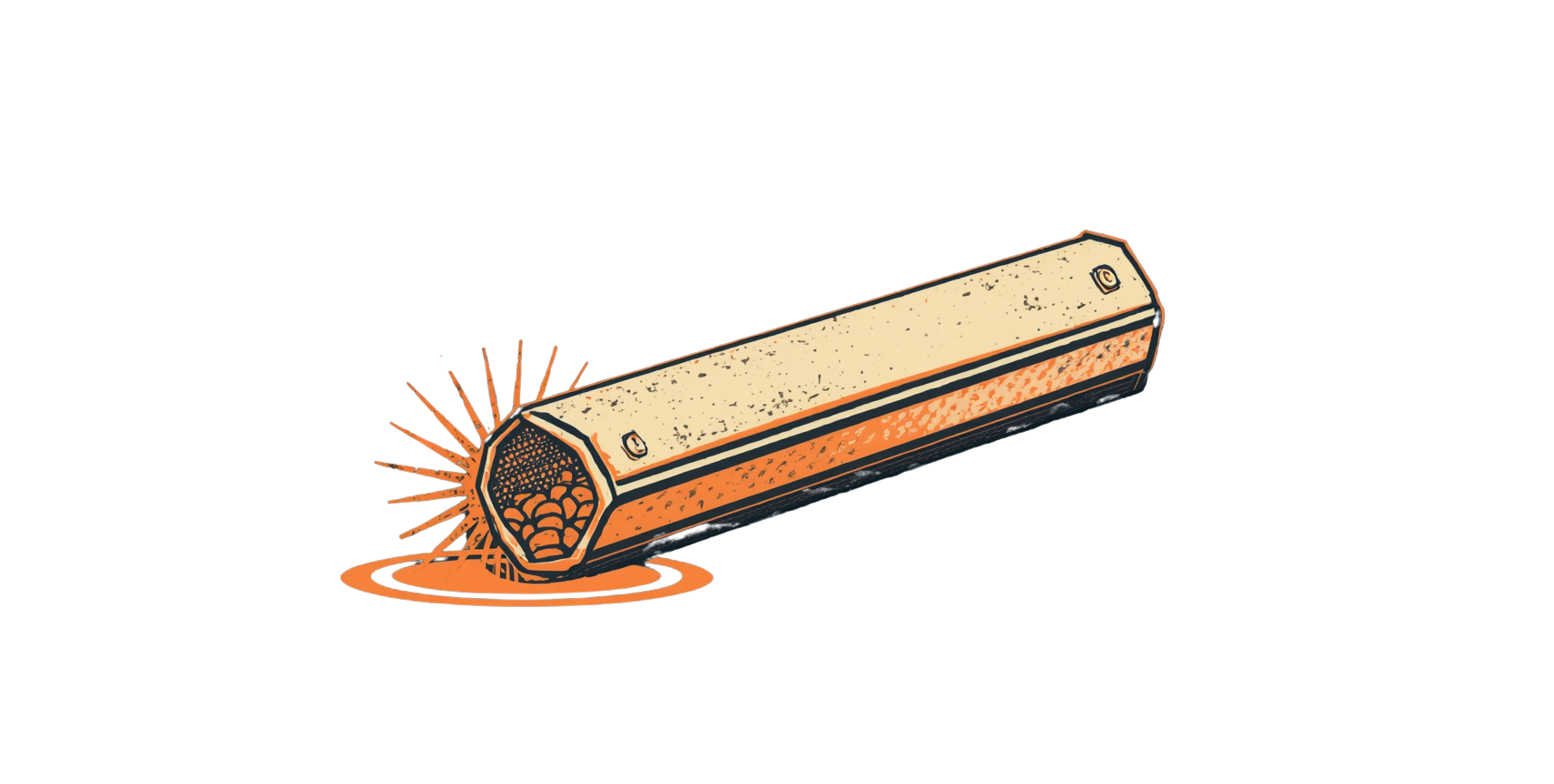
Pellet Tube
A pellet tube is a perforated stainless steel tube — usually a 12-inch hexagon — you fill with hardwood pellets, light at one end with a torch, and set on the grate. Once the flame burns down, the pellets smolder slowly from end to end and throw smoke for four to eight hours with no fire, no fuss, and almost no heat — cool enough to cold-smoke cheese at fridge temperature, and clean enough to add real wood smoke to a gas grill or a pellet grill that runs too clean at low temps. A-MAZE-N popularized the category in the late 2000s and is still the canonical name; a full tube costs about $25 and lasts the better part of a decade.
- Material
- 304 stainless steel, perforated
- Variants
- Hexagon (won't roll) and cylindrical · usually 6″ or 12″
- Price
- ~$20–35 for the canonical A-MAZE-N tube
- Best at
- Cold smoke for cheese · supplementing gas & pellet cookers
- Fuel
- Hardwood pellets — single-species or competition blend
- Burn time
- 4–8 hours per full tube, no tending
What it is
A pellet tube is a small perforated stainless steel tube — usually 6 or 12 inches long — designed to hold a charge of hardwood pellets and smolder them slowly into smoke. There's no electronics, no moving parts, no flame once it's going: just a metal shell, a ventilation pattern of small holes, and a glowing column of pellets working its way from one end to the other.
The category was popularized by A-MAZE-N — whose 12-inch hexagonal tube has become the default reference — and a wave of imitators followed once smoked cheese, cold-smoked salmon, and pellet-grill supplementation went mainstream on YouTube. Hexagonal tubes won't roll off the grate; cylindrical ones are cheaper but tip. Most are 304-grade stainless that survives years of use for the price of a bag of pellets.
How it works
Fill the tube with dry hardwood pellets, stand it on end, and hit one open face with a propane or butane torch for about 90 seconds until you've got a real flame at the top. Let it burn that way for 5 to 10 minutes, then blow the flame out so the pellets are left glowing but not flaming. Lay the tube flat on the grate and it will smolder slowly along its length, drawing just enough air through the perforations to keep the ember alive without breaking back into open fire.
That smoldering combustion is the whole trick. A live flame burns pellets hot and clean, with almost no smoke; a slow smolder burns them cool and dirty, producing steady, thick smoke at almost no heat output. A full 12-inch tube throws smoke for 4 to 8 hours depending on pellet density and airflow, and adds only a few degrees to the chamber temperature — cool enough to cold-smoke cheese sitting on the same grate.
Setting it up
The tube earns its keep in three setups, each with its own rhythm:
Cold smoking on a gas or charcoal grill
Burners off, lid closed, tube smoldering on the far side of the grate — sometimes with a pan of ice to keep the chamber under 90°F. This is how cheese, butter, salt, nuts, and cured fish get smoked without ever cooking. A 3- to 4-hour smoke window is typical for cheese, followed by a week of vacuum-sealed fridge rest so the smoke mellows into the curd instead of hitting like an ashtray.
Adding smoke to a gas grill
Burners on two-zone, tube tucked over the unlit side, food on indirect. The cheapest, simplest way to put real wood smoke on a gas-grilled chicken, pork loin, or rack of ribs — the move that makes a backyard gasser do honest BBQ work it otherwise can't.
Boosting a pellet smoker
A pellet grill's clean combustion makes thin smoke at higher temps. Drop a lit tube on the grate next to the food and you double up the smoke supply without changing anything about the cook — the standard fix for cooks who feel a stock pellet grill doesn't taste “smoky enough.”
§ On pellets
The tube takes the same hardwood pellets a pellet smoker burns — oak, hickory, apple, cherry, pecan. Single- species pellets give a more defined flavor; competition blends (often oak-based) are milder and more forgiving. Pellets have to be bone-dry or the smolder dies. Store them sealed; a damp tube won't stay lit no matter how long you torch it.
Where it earns its keep
The pellet tube's case is range for $25. Cold-smoked cheese on a sub-100°F grate, smoked salt and butter, cured-then-smoked salmon, smoked nuts — none of these are possible on a hot grill, and a tube is the cheapest dedicated cold-smoke source you can buy short of building a smokehouse. The same tube also rescues a gas grill from its biggest weakness: no real smoke flavor.
The economics are absurd. A $25 stainless tube and a $20 bag of pellets get you years of cold smoking and smoke supplementation with no electricity, no controller, no moving parts, and nothing to break. Reviewers who've tested it for years keep landing in the same place: it throws a layer of real wood smoke onto food without the overpowering bitterness a poorly-managed live fire can leave, and it's the gateway accessory for anyone curious about smoke who isn't ready to buy a dedicated smoker.
Where it falls short
It's smoke, not heat
A tube adds smoke to whatever heat source is already running — it doesn't cook anything by itself. If you wanted a smoker, buy a smoker. A tube is an accessory to a grill, not a replacement for one.
Easy to over-smoke delicate foods
A full tube throws smoke for hours, and cheese, fish, and butter pick it up fast. Three to four hours is plenty for cheese; longer often turns it acrid. The one-week fridge rest after smoking isn't optional — fresh-off-the-tube cheese tastes like an ashtray; mellowed cheese tastes like the thing you wanted.
Hard to relight if it goes out
Damp pellets, too little airflow, or putting the lid on too soon can kill the smolder. Once it's out mid-cook, you have to pull the tube, torch it again for the full 90 seconds plus burn window, and put it back — usually with a colder food than you started with.
Won't fix a bad pellet cooker
A tube helps a clean-running pellet grill taste a little smokier, but it can't turn a pellet cook into an offset cook. If you want stick-burner depth on brisket, the answer is a stick burner, not a tube.
What goes wrong.
Blowing the flame out too early
Hit the pellets with the torch for 90 seconds, then let them burn with a real flame for 5–10 minutes before you blow it out. Skip that burn window and the pellets aren't fully lit — the smolder dies inside an hour and you find a cold tube halfway through the cook.
Using damp pellets
Pellets are compressed sawdust; any moisture swells them and kills the smolder. Store the bag sealed, and don't fill a tube from pellets that have been sitting open in a hopper for weeks — the same dry-fuel discipline a pellet grill asks for.
Smoking cheese without the fridge rest
Cheese fresh off the tube tastes like an ashtray — sharp, harsh, almost chemical. Vacuum-seal it and rest it in the fridge for at least a week, ideally two; the smoke compounds redistribute and mellow into something you actually want to eat. This isn't a nicety; it's the difference between a wasted block and a great one.
Choking off airflow
The tube needs a little air to keep the ember alive. Closing every vent or laying it against a wall of foil suffocates the smolder. Set it where there's some airflow across the perforations — open exhaust vent, lid closed but not sealed.
Letting it touch food directly
A working tube sits at 400–600°F at the burning end. Lay it against a brisket or directly under a cheese block and you get a scorch mark, not smoke. Keep it off to one side with empty grate between the tube and the food.
What each of them says.
3 of the people we trust have covered this. Read or watch each in their own words.
- 01
 Meathead GoldwynAmazingRibs.com
Clint Cantwell at AmazingRibs gives the pellet smoking tube a Gold Medal — calls it the cheapest, simplest way to add real wood smoke to a gas grill or supplement a pellet smoker. He recommends the hexagon-shaped 304-stainless model over cylindrical ones because it won't roll on the grates, and notes the slow smolder delivers a layer of smoke flavor without overpowering the food the way burning splits often do.
- 02
 Mad Scientist BBQChannel / YouTube
Jeremy Yoder runs a blind taste test on ribs cooked with and without a smoke tube to settle whether adding one to a pellet smoker actually improves the bark and smoke flavor — or just adds bitterness.
- 03
 Malcom ReedHowToBBQRight / YouTube
Malcom Reed walks through cold-smoking cheese with an A-MAZE-N pellet tube — covers heat management (ice pan / deflector), 3-4 hour smoke window, and the 7-day fridge cure that lets the smoke mellow into the cheese.
Cook it. Save the record.
Every cook gets a permanent entry — cut, fuel, temp, time, photo, what worked. Next time you want to nail that exact crust, you'll have the receipt.