
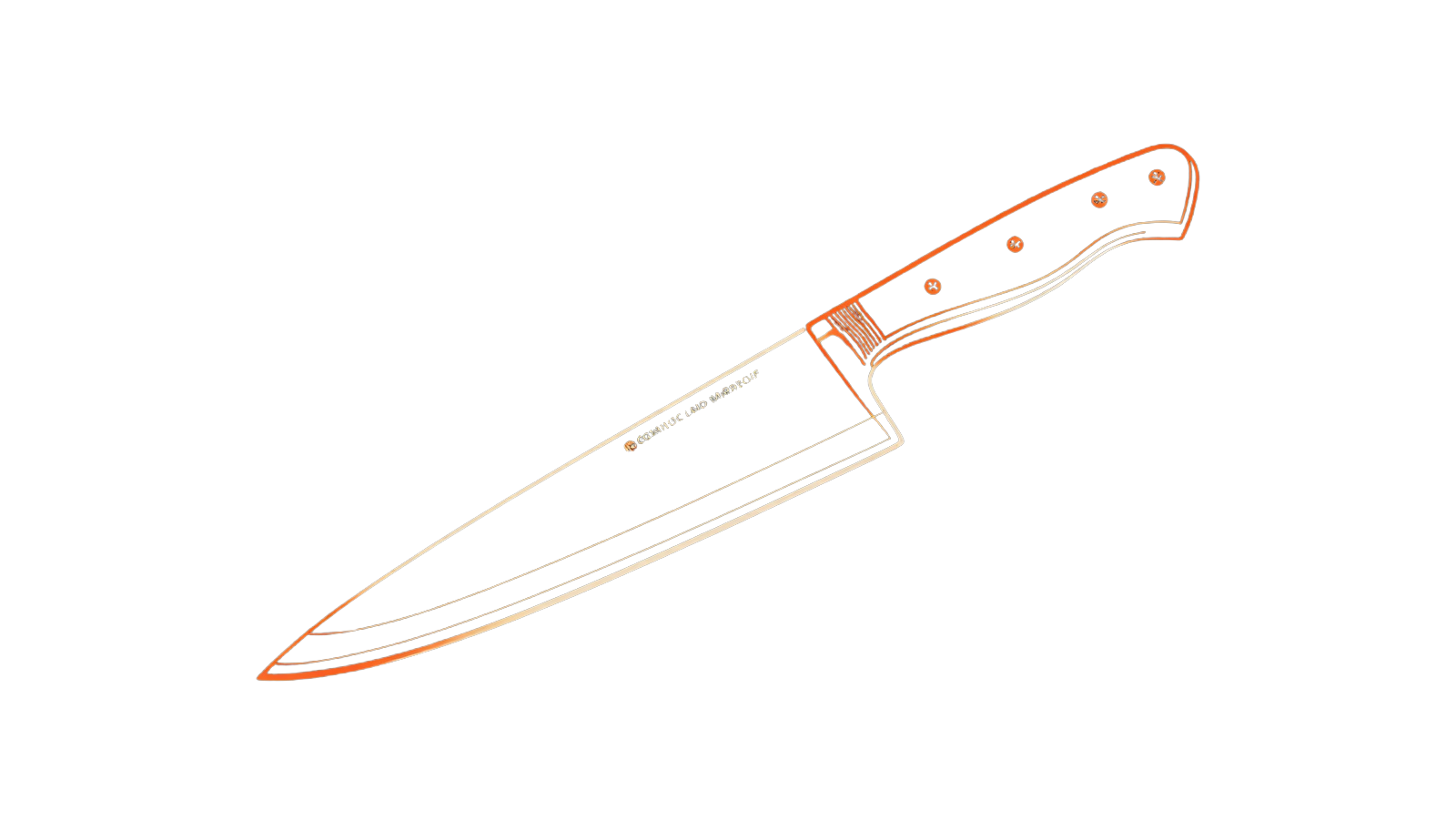
Boning Knife
A boning knife is a slim, curved 5–7″ blade with a fine point, built for the raw-prep work that happens before the meat ever sees fire. The curve lets the edge follow the contour of a muscle into a fat seam without gouging the meat underneath; the narrow profile slides under collagen and silver skin so you can lift and peel rather than saw. Flex is the spec that splits the category in two: a stiff boning knife drives through hard brisket fat and pork-shoulder connective tissue without wandering, while a flexible blade bends around a chicken carcass or fillets a fish. Aaron Franklin’s prep knife — a stiff, curved 6-inch Dexter-Russell — is the canonical low-and-slow brisket-trim knife; Victorinox’s Fibrox 6″ is the twenty-dollar workhorse that does the same job in every backyard kit. Paired with a long butcher-paper wrap and a slicing knife at the back end, the boning knife is the first half of the brisket two-knife setup.
- Blade
- Curved, 5–7″ — 6″ is the brisket-prep standard
- Flex
- Stiff (brisket, pork shoulder) · Flexible (poultry, fish, silver skin)
- Material
- High-carbon stainless steel — most kits run NSF-rated commercial steel
- Price
- $15–25 (Victorinox Fibrox, Dexter-Russell) · $40–80 (Mercer, Wüsthof)
- Best at
- Raw trimming — fat cap, silver skin, jointing, deboning
- Canonical pick
- Dexter-Russell 6″ stiff (Franklin BBQ shop) · Victorinox Fibrox 6″ (every-kitchen workhorse)
What it is
A boning knife is a narrow, curved blade built for the prep work that turns a whole packer brisket, a bone-in pork shoulder, or a whole chicken into something ready for the pit. The blade runs 5 to 7 inches — long enough to reach into the deckle seam of a brisket, short enough to control inside a chicken cavity — with a gentle curve along the cutting edge and a fine point that works into the joint between bones. The spine tapers from a thick heel to a needle tip, which is what lets the point lead a cut and the heel finish it.
The defining variable is flex. A stiff boning knife behaves almost like a small slicer — it holds its line through hard fat and dense connective tissue and drives where you point it, which is what you want when you’re removing the cap on a brisket or the silver skin on a pork shoulder. A flexible boning knife bends along the contour of a rib cage or a fish frame, which is what you want for jointing poultry or fileting. Most backyard cooks settle on the stiff version because the brisket trim is the harder job; pitmasters who break down whole chickens regularly keep a flexible one alongside.
The canonical workhorses are commercial-kitchen steel: Victorinox’s Fibrox 6″ (the twenty-dollar standard in every restaurant prep kitchen), Dexter-Russell’s 6″ stiff (the knife in Aaron Franklin’s Austin shop bundle), and Mercer Culinary’s NSF-rated lineup. They all share the same posture: hard-working high-carbon stainless, non-slip polymer handles, dishwasher-tolerant builds. Anything fancier is a knife enthusiast’s preference, not a functional requirement — the prep job is the same.
How it works
The whole point of the curve is contour-following. A straight blade has to be lifted and re-set every time the cut changes angle — against the rounded surface of a brisket point or the dome of a deckle, that means a series of choppy, gouging passes. The curve on a boning knife lets you sweep the edge along the underside of a fat layer in a single smooth motion, with the tip leading the cut and the belly of the blade finishing it. The edge rides the seam between muscle and fat without jumping into either one.
Flex changes what the blade does against resistance. A stiff blade transmits the force of your hand straight to the edge: when it hits hard fat or a sheet of silver skin, it cuts through cleanly and stays on the line you set. A flexible blade absorbs that force, bowing slightly against the resistance, which lets the edge follow a curved rib bone or a chicken thigh joint without wandering off into the meat. Neither one is “better” in general — they’re tuned for different jobs. On a brisket cap you want stiffness so the blade tracks the seam; on a chicken backbone you want flex so the blade rides the curve.
The narrow profile matters as much as the curve. A wide chef’s knife can’t fit under a half-millimeter sheet of silver skin or into the narrow gap between two ribs — the spine of the blade hits the meat before the edge gets to the membrane. A boning knife’s thin tip slides in flat against the muscle, lifts the membrane onto the edge, and peels it off in one piece. That “lift and peel” motion is what separates the tool from any chef’s knife or paring knife you already own.
Setting it up
Three jobs cover most of what a backyard cook does with a boning knife. The technique is similar across all three, but the flex preference and the angle change.
Brisket trim
Stiff blade, 6″. Cold brisket on a board. Start by squaring the edges — trim the thin hanging flap, the silver skin on the lean side, and any loose hard fat. Then thin the fat cap to roughly a quarter-inch over the point and a sixteenth over the flat. Hold the blade nearly parallel to the meat, point leading; let the curve follow the dome of the deckle. The cap should peel up in long strips, not crumble in chunks. A wandering cut usually means the brisket has warmed up — chill the meat back down and try again.
Silver skin & membrane
Flexible or stiff, 5–6″. The membrane on the back of a rack of ribs and the silver skin on a pork tenderloin both come off the same way: slide the tip flat under one corner, lift just enough to get a grip with a paper towel, and pull the membrane up onto the blade as you draw the knife along the underside. The edge does almost no cutting — it’s a guide. Going slow keeps the membrane in one piece; rushing tears it into strips you have to chase one at a time.
Jointing & deboning
Flexible blade, 6″. Spatchcocking a chicken, separating a thigh from a drumstick, removing a shoulder blade from a pork butt — all of it works the same way: find the joint or the bone surface with the tip, ride the curve along the bone, let the flex follow the shape. The knife should never be doing the hard work; if you’re pushing through bone, you’ve missed the joint — back off and feel for the gap with the tip.
The canonical Texas pit kit is two knives: a stiff, curved 6″ boning knife for the raw trim, and a long, granton-edged slicer for the cooked brisket. The boning knife does the work before the pit; the slicer does the work after. Franklin’s Austin shop sells them as a bundle for exactly this reason. One pair of knives, one cook, two distinct jobs.
Where it earns its keep
The boning knife earns its place in the kit on the prep side of every long cook — the work that happens before the meat ever hits the grate, where a wrong cut shows up in the finished bark or the eating texture hours later.
Brisket fat-cap trim
The headline job. A thinned, even cap renders through the long cook and lets the rub form bark on the meat surface underneath. A thick or uneven cap leaves you with raw fat at the slice. The curve and stiffness of the boning knife are what let you take the cap down to a uniform layer without gouging the muscle.
Silver skin removal
Silver skin doesn’t render. Left on a pork tenderloin or the back of a rack of ribs, it tightens during the cook and ends up as a chewy band the eater notices. The narrow tip of a boning knife is the only blade in a typical kitchen that fits under it cleanly.
Spatchcock & joint
Splitting a chicken open along the backbone for spatchcocking, separating ribs from the spine on a rack, removing a shoulder blade from a pork butt — all bone-adjacent work that needs the curve to follow the contour and the tip to find the joint. A flexible blade pays off here.
Cheap insurance against a bad cook
A $20 Victorinox Fibrox or Dexter-Russell is the highest-leverage purchase in the prep kit. A poorly trimmed brisket can’t be fixed on the smoker; a well-trimmed one runs an easier cook and slices cleaner. The knife pays for itself in one cook.
Where it falls short
The boning knife is purpose-built for raw prep on boneless and bone-adjacent cuts — ask it for something else and the limits show fast.
Not for cutting through bone
A boning knife works around bone, not through it. Driving the edge into a chicken backbone or a rib bone chips the edge, bends the tip, and ruins the blade geometry. For bone-splitting, use kitchen shears or a cleaver and leave the boning knife for the soft tissue alongside.
Not a slicing knife
Six inches is too short to slice a finished brisket cleanly across the grain — the blade saws instead of gliding, and the slice tears at the bark edge. Cooked brisket and pork shoulder belong under a long, thin granton-edged slicer. The boning knife is the prep half of the pair.
Dulls fast against hard fat
Cold brisket fat is harder than most cooks expect, and trimming a packer puts more wear on the edge than a week of vegetable prep. A boning knife needs a hone every few cooks and a real sharpening once or twice a season. A dull boning knife is genuinely dangerous — it skids off fat and slides toward the hand instead of cutting through.
Fine-tip vulnerability
The needle tip that does the work is also the part most likely to snap if the blade gets twisted in a joint or dropped on a tile floor. Treat the tip as the working point of the knife; don’t use it as a pry bar against bone, and store the blade in a sheath or a knife block rather than loose in a drawer.
What goes wrong.
Trimming a warm brisket
Cold fat cuts clean; warm fat smears and tears. Pull the brisket straight from the fridge for the trim, work fast, and put it back if it starts to soften. A 30-minute freezer rest is fine if the cap is being stubborn.
Trying to cut bone with the boning knife
The blade is built to ride along bone, not through it. Splitting a chicken back or cutting between ribs belongs to kitchen shears or a cleaver — use the boning knife for the soft-tissue work alongside, and pick up shears for the bone. A snapped tip or chipped edge from one bad cut takes the knife out of rotation until it’s re-ground.
Using a wide chef's knife for silver skin
A chef’s knife is too thick at the spine to slide flat under a sheet of silver skin — the blade hits meat before the edge gets to the membrane, and the membrane tears into strips. The narrow profile of the boning knife is what lifts the membrane onto the edge in one piece. If you don’t own a boning knife, use the tip of a paring knife and pull with a paper towel; a long chef’s blade is the wrong tool.
Letting the edge go dull
A sharp boning knife glides along a fat seam with almost no pressure; a dull one needs force to make any cut at all, and force on a curved blade against slick fat is how the edge skids toward your hand. Hone before every brisket trim, sharpen once or twice a season. Cheap commercial-kitchen steel (Victorinox, Dexter) sharpens easily and forgives heavy use.
Sawing the cooked brisket with the prep knife
Six inches of blade can’t cross a packer brisket in a single stroke, and a sawing motion tears the bark at the edge of every slice. The cooked-side tool is a long, thin slicer — the boning knife’s partner in the brisket two-knife setup, used after the cook rests in butcher paper. Use tongs to lift, the slicer to cut.
What each of them says.
4 of the people we trust have covered this. Read or watch each in their own words.
- 01
 Aaron FranklinFranklin BBQ / MasterClass
Franklin uses a stiff, curved 6-inch Dexter-Russell boning knife for all his raw trimming — brisket fat cap, turkey, pork butts, anything boneless. The curve lets him follow the contour of the meat into the fat seam without gouging the muscle underneath, and the stiffness drives through hard fat without wandering. It's the prep knife in the Franklin Barbecue shop bundle — paired with his slicer, it's the full brisket two-knife setup.
- 02
 Meathead GoldwynAmazingRibs.com
Meathead reaches for a Rapala fillet knife over the expensive German and Japanese steel in his kitchen — a thin, dangerously sharp flexible blade that slides under fat and silver skin so you can lift and peel rather than fight the meat. It's not strong enough to cut bone, but for everything you do AROUND bone — removing ribs from peppers, silver skin from meat, fat from brisket — he calls it the best fifteen dollars in the drawer. Same job as a flexible boning knife, half the price.
- 03
 Mad Scientist BBQChannel / YouTube
Jeremy Yoder makes the case directly: a proper boning knife gives you control and is safer because you're not fighting a stiff kitchen blade through fat. Watch how the flex lets him follow the curve of the deckle as he peels back the cap.
- 04
 Chud's BBQChannel / YouTube
Bradley Robinson works a flexible boning knife through a whole packer — useful for seeing the silver-skin pass and the deckle-fat removal in real time. The knife disappears into the seam; watch the angle of the blade against the muscle.
Cook it. Save the record.
Every cook gets a permanent entry — cut, fuel, temp, time, photo, what worked. Next time you want to nail that exact crust, you'll have the receipt.